

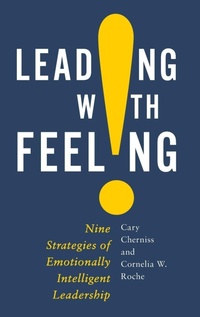
Leading with Feeling
Nine Strategies of Emotionally Intelligent Leadership
Published on 24. September 2020
Book
Hardback
224 pages
978-0-19-069894-2 (ISBN)
Description
For many decades, the conventional wisdom was that emotion has no place in the work world, and the ideal leader is one who approaches problems rationally and unemotionally. However, the reality is that emotion is inevitable when a group of people come together for an extended period of time to work on challenging tasks, and if used effectively, a leader's moods and emotions can be a plus rather than a minus.
This book describes how 25 outstanding leaders used emotional intelligence to deal with critical challenges and opportunities. Featuring commentary from the leaders themselves describing how they handled each situation, it helps managers better understand not just what emotional intelligence is, or how to measure it, or how it is linked to bottom-line results: it also shows how real leaders used their emotional intelligence to deal with real situations. The book distills the leaders' experiences into nine strategies that can help any leader or potential leader to be more effective. Each chapter concludes with activities that help readers to apply immediately each of those strategies.
This book describes how 25 outstanding leaders used emotional intelligence to deal with critical challenges and opportunities. Featuring commentary from the leaders themselves describing how they handled each situation, it helps managers better understand not just what emotional intelligence is, or how to measure it, or how it is linked to bottom-line results: it also shows how real leaders used their emotional intelligence to deal with real situations. The book distills the leaders' experiences into nine strategies that can help any leader or potential leader to be more effective. Each chapter concludes with activities that help readers to apply immediately each of those strategies.
Reviews / Votes
Explores how effective leaders use emotional intelligence (EI) to achieve their goals, presenting nine strategies for helping leaders develop their EI and use it more strategically and effectively at work and in their personal lives. * Journal of Economic Literature (Volume 59, no. 1) * The 'Nine Strategies of Emotionally Intelligent Leaders' are particularly useful in teaching managers how to be 'leaders with feeling.' The interviews with leaders and the real-world examples do a fantastic job in teaching readers how to handle difficult and challenging situations in an emotionally intelligent way. This book could be a career-changer for many readers! * Ronald H. Humphrey, Distinguished Professor of Leadership, University of Lancaster * In today's fast-moving and uncertain world, Cherniss and Roche's book represents an exciting breath of fresh air. Using real-world examples and stimulating self-development exercises, they demonstrate that it's no longer true to say, 'It's all about the economy, stupid!' Instead, today's leaders and managers need to grasp the idea that, 'It's now all about the emotions, stupid!' This book is a must-read for any aspiring leader or manager seeking long-lasting success. * Neal Ashkanasy, Professor of Management, University of Queensland * A common sense guide to help managers at all levels develop simple emotional-based strategies for solving complex leadership problems. * David M. Mendez, CEO, WB Law Coffee Co. * The idea of emotional intelligence has been around for 30 years but Cherniss' and Roche's breakthrough is that they've identified nine EI strategies for corporate executives and other leaders to boost their organization's success and also improve their personal lives. Written in a simple and very readable style-Leading with Feeling is not a scientific treatise. And it's packed with real-world examples that will engage any manager, especially ones looking to move up the ranks. * John Koppisch, Former Editor, the Wall Street Journal and forbes * We've needed this book! Leading with Feeling reviews the research on emotional intelligence that shows how vital these capacities are for leaders and shares practical strategies leaders can use to be more highly effective. Cary Cherniss and Cornelia W. Roche offer any and all leaders a manual for higher performance. * Daniel Goleman, author of Emotional Intelligence * I always try to be mindful of how my demeanor can affect the mood and motivation of the people I lead. A positive work culture always starts at the top, and it's crucial to keeping everyone engaged and reaching their highest potential. Cary Cherniss and Cornelia Roche show how emotionally intelligent leadership can be a guiding light in challenging situations using examples from more than 20 business experts. The book provides a road map for leaders who want to harness their emotions to become more effective managers. * Rhett Power, Forbes *More details
Language
English
Place of publication
New York
United States
Dimensions
Height: 240 mm
Width: 161 mm
Thickness: 16 mm
Weight
490 gr
ISBN-13
978-0-19-069894-2 (9780190698942)
Copyright in bibliographic data and cover images is held by Nielsen Book Services Limited or by the publishers or by their respective licensors: all rights reserved.
Schweitzer Classification
Other editions
Additional editions
Cary Cherniss | Cornelia Roche
Leading with Feeling
Nine Strategies of Emotionally Intelligent Leadership
E-Book
05/2020
OUP eBook
€9.99
Available for download
Cary Cherniss | Cornelia Roche
Leading with Feeling
Nine Strategies of Emotionally Intelligent Leadership
E-Book
05/2020
OUP eBook
€9.99
Available for download
Persons
Cary Cherniss is Director and Co-Chair of the Consortium for Research on Emotional Intelligence in Organizations and Professor of Applied Psychology Emeritus at Rutgers University. He has published over 70 scholarly articles and book chapters as well as seven books, including The Emotionally Intelligent Workplace (Jossey-Bass, with Daniel Goleman) and Promoting Emotional Intelligence in the Workplace: Guidelines for Practitioners (American Society for Training and Development, with Mitchel Adler). In addition to his research and writing, Dr. Cherniss has consulted with many organizations in both the public and private sectors. He received his Ph.D. in Psychology from Yale University.
Cornelia W. Roche has performed management coaching in a variety of corporate settings and has consulted to schools, non-profit entities, and small business. Drawing upon research and her previous management experience in a Fortune 500 company, her work involves helping professionals better
understand and navigate the individual and organizational forces that impact on their work. In addition to consulting, Roche has served as a staff member of the Wharton School's Executive Development Program. Affiliated with the Emotional Intelligence Consortium since its inception, she has a doctorate from Rutgers University in Organizational Psychology. She currently resides in Northern New Jersey with her husband and son.
Cornelia W. Roche has performed management coaching in a variety of corporate settings and has consulted to schools, non-profit entities, and small business. Drawing upon research and her previous management experience in a Fortune 500 company, her work involves helping professionals better
understand and navigate the individual and organizational forces that impact on their work. In addition to consulting, Roche has served as a staff member of the Wharton School's Executive Development Program. Affiliated with the Emotional Intelligence Consortium since its inception, she has a doctorate from Rutgers University in Organizational Psychology. She currently resides in Northern New Jersey with her husband and son.
Content
Nine Strategies of Emotionally Intelligent Leaders
Foreword
Introduction
1. Focus on Feeling
2. Let People Know How You Feel
3. What Is Your Impact on Others?
4. What Is It Like for Others?
5. What Are those Feelings Telling Us?
6. Change Perspective
7. Respect those Boundaries
8. Enlist the Help of Others
9. Become an Emotional Coach
10. Emotional Virtuosity: Using Several Strategies Together
11. Creating a Social Context that Supports Use of the EI Strategies
12. Taking Charge
Appendix A. Leaders Who Participated in the Research and Their Job Titles
Appendix B. The Research Method
Appendix C. Links between the Basic Emotional Intelligence Abilities and the Nine Strategies
References
Foreword
Introduction
1. Focus on Feeling
2. Let People Know How You Feel
3. What Is Your Impact on Others?
4. What Is It Like for Others?
5. What Are those Feelings Telling Us?
6. Change Perspective
7. Respect those Boundaries
8. Enlist the Help of Others
9. Become an Emotional Coach
10. Emotional Virtuosity: Using Several Strategies Together
11. Creating a Social Context that Supports Use of the EI Strategies
12. Taking Charge
Appendix A. Leaders Who Participated in the Research and Their Job Titles
Appendix B. The Research Method
Appendix C. Links between the Basic Emotional Intelligence Abilities and the Nine Strategies
References