

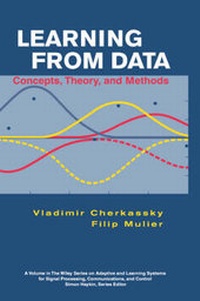
Learning from Data
Concepts, Theory, and Methods
1st Edition
Published on 25. March 1998
Book
Hardback
464 pages
978-0-471-15493-8 (ISBN)
Description
This is an interdisciplinary book on neural networks, statistics and fuzzy systems. This book establishes a general framework for adaptive data modeling within which various methods from statistics, neural networks and fuzzy logic are presented. The main purpose of the book is to show the similarity/difference of the aforementioned approaches to data modeling, and to discuss relative advantages and limitations of various methods.
Reviews / Votes
"...contains considerable information on the concept of statistical learning theory... However, some may find its presentation difficult to follow..." (Technometrics, February, 2001) "...well readable..." (Zentralblatt Math, Vol.960, No.10 2001)More details
Series
Edition
1., Aufl.
Language
English
Place of publication
New York
United States
Publishing group
John Wiley and Sons Ltd
Target group
College/higher education
Professional and scholarly
Illustrations
Illustrations
Dimensions
Height: 24.2 cm
Width: 16.3 cm
Weight
765 gr
ISBN-13
978-0-471-15493-8 (9780471154938)
Schweitzer Classification
Other editions
New editions
Book
09/2007
2nd Edition
Wiley-IEEE Press
€167.50
Shipment within 10-20 days
Persons
VLADIMIR CHERKASSKY is on the faculty of electrical and computer engineering at the University of Minnesota. His current research is on neural network and statistical methods for estimating dependencies from data. Professor Cherkassky is on the governing board of the International Neural Network Society (INNS). He was an organizer of the NATO Advanced Study Institute symposium, From Statistics to Neural Networks, held in France in 1993. FILIP MULIER received a PhD in electrical engineering from the University of Minnesota in 1994. He currently works with a large multinational corporation on industrial applications of learning methods. His current research is on practical applications of learning theory, including industrial process control and financial market prediction.
Content
Problem Statement, Classical Approaches, and Adaptive Learning. Regularization Framework. Statistical Learning Theory. Nonlinear Optimization Strategies. Methods for Data Reduction and Dimensionality Reduction. Methods for Regression. Classification. Support Vector Machines. Fuzzy Systems. Appendices. Index.