

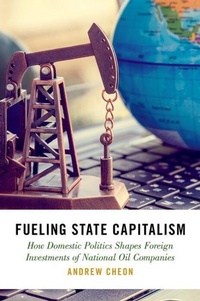
Fueling State Capitalism
How Domestic Politics Shapes Foreign Investments of National Oil Companies
Published on 24. May 2023
Book
Hardback
200 pages
978-0-19-767288-4 (ISBN)
Description
In the late 1990s, governments began investing hundreds of billions of dollars in foreign oil and gas assets through their national oil companies (NOCs), raising concerns about a "resource war" and asymmetric interdependence. Most critics perceive the foreign investments of NOCs as politically driven and inefficient. In Fueling State Capitalism, however, Andrew Cheon sees these investments as commercial ventures by ambitious state-owned enterprises seeking to become global players amid rising oil prices. Some have invested aggressively abroad, often in politically risky destinations, whereas others have been more moderate in their ambitions. The NOCs' capacity to pursue foreign investments varies, as Cheon argues, according to regime types and bureaucratic structures of their governments.
Using principal agent theory, Cheon shows that competition among NOCs' principals at two different levels of government--national and bureaucratic--conditions the foreign investments of NOCs. While competition between the chief executive and opposition parties can limit democratic governments' capacity to tolerate failed investments abroad, non-democratic governments are less constrained. An overlap of authority among bureaucratic institutions can also encourage counterproductive behavior among NOCs, whereas a clear line of authority among them can prevent it.
Looking at investments from 79 countries from 2000 to 2013, as well as case studies of China, India, Brazil, Norway, and Russia, Fueling State Capitalism unpacks the role of institutions, both national and bureaucratic, in shaping the global expansion of national energy firms. Moreover, Cheon probes the energy security motivations of NOC investments and the origins of bureaucratic structures. Based on the experience of NOC global expansion, Cheon concludes that bureaucratic institutions will be critical in achieving decarbonization that not only allows governments to meet their political objectives, but also helps NOCs ensure their long-term commercial viability through a managed transition to renewable energy.
Using principal agent theory, Cheon shows that competition among NOCs' principals at two different levels of government--national and bureaucratic--conditions the foreign investments of NOCs. While competition between the chief executive and opposition parties can limit democratic governments' capacity to tolerate failed investments abroad, non-democratic governments are less constrained. An overlap of authority among bureaucratic institutions can also encourage counterproductive behavior among NOCs, whereas a clear line of authority among them can prevent it.
Looking at investments from 79 countries from 2000 to 2013, as well as case studies of China, India, Brazil, Norway, and Russia, Fueling State Capitalism unpacks the role of institutions, both national and bureaucratic, in shaping the global expansion of national energy firms. Moreover, Cheon probes the energy security motivations of NOC investments and the origins of bureaucratic structures. Based on the experience of NOC global expansion, Cheon concludes that bureaucratic institutions will be critical in achieving decarbonization that not only allows governments to meet their political objectives, but also helps NOCs ensure their long-term commercial viability through a managed transition to renewable energy.
Reviews / Votes
In Fueling State Capitalism, Andrew Cheon rightly focuses our attention on a crucial part of the global economy: national oil companies. Over the past two decades, these state-owned enterprises strode forth from China, Russia, and elsewhere, with political and economic effects all over the world. Cheon gives us a guide for understanding these developments. * Jeff Colgan, Richard Holbrooke Associate Professor of Political Science, Brown University * In a world in which fossil fuels continue to be understood as the economic commanding heights, Fueling State Capitalism shows how political institutions shape the investment choices made by national oil companies. Cheon also provides us with a lens for understanding how these crucial economic actors are grappling with climate change. Highly recommended. * Llewelyn Hughes, Professor of Public Policy, Australian National University * Fueling State Capitalism is a brilliant and meticulously researched work, offering insights from the foreign activities of national oil companies (NOCs) in contexts as diverse as Brazil, China, India, Norway, and Russia. It is sure to change the way we think about the international behavior of state-owned enterprises and, more generally, how we think about bureaucratic competition and authority in state capitalist societies. * Paasha Mahdavi, Associate Professor of Political Science, University of California, Santa Barbara * What role do state-owned enterprises (SOEs) play in a global capitalist economy? Can SOEs aid governments in securing their energy needs in a world undergoing a major energy transition? With a novel argument and data, Cheon casts doubt on whether such national oil companies (NOCs) can help governments pursue 'resource diplomacy' because of the domestic political constraints they face. Achieving energy security may require rethinking how NOCs operate. * Helen V. Milner, B.C. Forbes Professor of Politics and International Affairs, Princeton University * National oil companies have long been significant players in domestic fossil fuel production. Developing a tightly woven argument about bureaucratic structures, Cheon explains the conditions under which national oil companies choose to invest abroad, with particular attention to China, India, Brazil, Norway, and Russia. Fueling State Capitalism is set to be a valuable contribution to the field of international energy politics, especially as countries begin to ponder decarbonization strategies. * Erika Weinthal, Professor of Environmental Policy and Public Policy, Duke University *More details
Series
Language
English
Place of publication
New York
United States
Target group
Professional and scholarly
Product notice
sewn/stitched
Cloth over boards
Dimensions
Height: 239 mm
Width: 162 mm
Thickness: 17 mm
Weight
435 gr
ISBN-13
978-0-19-767288-4 (9780197672884)
Copyright in bibliographic data and cover images is held by Nielsen Book Services Limited or by the publishers or by their respective licensors: all rights reserved.
Schweitzer Classification
Other editions
Additional editions
Andrew Cheon
Fueling State Capitalism
How Domestic Politics Shapes Foreign Investments of National Oil Companies
E-Book
03/2023
OUP eBook
€53.99
Available for download
Andrew Cheon
Fueling State Capitalism
How Domestic Politics Shapes Foreign Investments of National Oil Companies
E-Book
03/2023
OUP eBook
€53.99
Available for download
Person
Andrew Cheon is Assistant Professor of International Political Economy at Johns Hopkins SAIS. His research covers state capitalism, rising powers, coercive diplomacy, energy security, and environmental conflict. He was previously the founding President of Duke East Asia Nexus, an academic journal. His work appears in outlets such as Economics and Politics, Comparative Political Studies, Journal of Conflict Resolution, Political Studies, Global Environmental Change, and Energy Policy. He is also co-author of Activism and the Fossil Fuel Industry.
Content
1. Introduction
2. The Baseline: Political and Economic Drivers
3. Domestic Structure and NOC Global Expansion
4. Do Institutions Matter? A Quantitative Analysis
5. Bureaucratic Competition in China and India
6. Designated Principals in Brazil and Norway
7. The Complicated Case of Russia
8. Professionalization as an Alternative Explanation
9. Conclusion and Implications
2. The Baseline: Political and Economic Drivers
3. Domestic Structure and NOC Global Expansion
4. Do Institutions Matter? A Quantitative Analysis
5. Bureaucratic Competition in China and India
6. Designated Principals in Brazil and Norway
7. The Complicated Case of Russia
8. Professionalization as an Alternative Explanation
9. Conclusion and Implications