

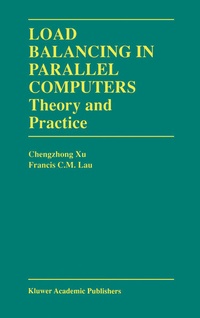
Load Balancing in Parallel Computers
Theory and Practice
Published on 6. May 2013
Book
Paperback/Softback
XV, 210 pages
978-1-4757-7066-7 (ISBN)
Description
Load Balancing in Parallel Computers: Theory and Practice
is about the essential software technique of
load balancing
in distributed memory message-passing parallel computers, also called multicomputers. Each processor has its own address space and has to communicate with other processors by message passing. In general, a direct, point-to-point interconnection network is used for the communications. Many commercial parallel computers are of this class, including the Intel Paragon, the Thinking Machine CM-5, and the IBM SP2.
Load Balancing in Parallel Computers: Theory and Practice presents a comprehensive treatment of the subject using rigorous mathematical analyses and practical implementations. The focus is on nearest-neighbor load balancing methods in which every processor at every step is restricted to balancing its workload with its direct neighbours only. Nearest-neighbor methods are iterative in nature because a global balanced state can be reached through processors' successive local operations. Since nearest-neighbor methods have a relatively relaxed requirement for the spread of local load information across the system, they are flexible in terms of allowing one to control the balancing quality, effective for preserving communication locality, and can be easily scaled in parallel computers with a direct communication network.
Load Balancing in Parallel Computers: Theory and Practice serves as an excellent reference source and may be used as a text for advanced courses on the subject.
Load Balancing in Parallel Computers: Theory and Practice presents a comprehensive treatment of the subject using rigorous mathematical analyses and practical implementations. The focus is on nearest-neighbor load balancing methods in which every processor at every step is restricted to balancing its workload with its direct neighbours only. Nearest-neighbor methods are iterative in nature because a global balanced state can be reached through processors' successive local operations. Since nearest-neighbor methods have a relatively relaxed requirement for the spread of local load information across the system, they are flexible in terms of allowing one to control the balancing quality, effective for preserving communication locality, and can be easily scaled in parallel computers with a direct communication network.
Load Balancing in Parallel Computers: Theory and Practice serves as an excellent reference source and may be used as a text for advanced courses on the subject.
More details
Series
Edition
Softcover reprint of the original 1st ed. 1997
Language
English
Place of publication
New York
United States
Target group
Professional and scholarly
Research
Illustrations
XV, 210 p.
Dimensions
Height: 235 mm
Width: 155 mm
Thickness: 13 mm
Weight
359 gr
ISBN-13
978-1-4757-7066-7 (9781475770667)
DOI
10.1007/b102252
Schweitzer Classification
Other editions
Additional editions
E-Book
08/2007
Kluwer Academic Publishers
€203.29
Available for download
Book
11/1996
Kluwer Academic Publishers
€213.99
Shipment within 15-20 days
Content
A Survey of Nearest-Neighbor Load Balancing Algorithms.- The GDE Method.- GDE on Tori and Meshes.- The Diffusion Method.- GDE Versus Diffusion.- Termination Detection of Load Balancing.- Remapping With the GDE Method.- Load Distribution in Combinatorial Optimizations.- Conclusions.