

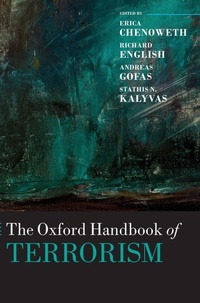
The Oxford Handbook of Terrorism
Published on 19. March 2019
Book
Hardback
824 pages
978-0-19-873291-4 (ISBN)
Description
The Oxford Handbook of Terrorism systematically integrates the substantial body of scholarship on terrorism and counterterrorism before and after 9/11. In doing so, it introduces scholars and practitioners to state of the art approaches, methods, and issues in studying and teaching these vital phenomena. This Handbook goes further than most existing collections by giving structure and direction to the fast-growing but somewhat disjointed field of terrorism studies.
The volume locates terrorism within the wider spectrum of political violence instead of engaging in the widespread tendency towards treating terrorism as an exceptional act. Moreover, the volume makes a case for studying terrorism within its socio-historical context. Finally, the volume addresses the critique that the study of terrorism suffers from lack of theory by reviewing and extending the theoretical insights contributed by several fields - including political science, political economy, history, sociology, anthropology, criminology, law, geography, and psychology. In doing so, the volume showcases the analytical advancements and reflects on the challenges that remain since the emergence of the field in the early 1970s.
The volume locates terrorism within the wider spectrum of political violence instead of engaging in the widespread tendency towards treating terrorism as an exceptional act. Moreover, the volume makes a case for studying terrorism within its socio-historical context. Finally, the volume addresses the critique that the study of terrorism suffers from lack of theory by reviewing and extending the theoretical insights contributed by several fields - including political science, political economy, history, sociology, anthropology, criminology, law, geography, and psychology. In doing so, the volume showcases the analytical advancements and reflects on the challenges that remain since the emergence of the field in the early 1970s.
Reviews / Votes
This vast scope of discussion, with deeply penetrating views by scholars who have immersed themselves in terrorism studies or intelligence for their entire careers, make this handbook a great reference for new or seasoned researchers. * J. Agee, independent scholar, CHOICE * The Oxford Handbook of Terrorism fills an immense gap in the study of this subject in presenting the research, analysis and reflections of the field's most eminent scholars. Its nearly fifty chapters comprehensively address the key debates, critical contours, and diverse methodological approaches that comprise terrorism studies. The editors have commendably assembled a truly authoritative and indisputably provocative work that will be of interest to students and scholars as well as to policymakers and government officials. * Bruce Hoffman, Professor at the Security Studies Program, Georgetown University and author of Inside Terrorism * This is a very useful, comprehensive and well-organized study of a very difficult, important subject. Many leading scholars in the field provide significant contributions. * David C. Rapoport, UCLA, Founding and Chief Editor of Terrorism and Political Violence * This enormously important Handbook is a wonderful contribution to the literature on terrorism. It brings together from across the globe the insights of many of the most accomplished academics who have been working in this field for decades, along with keen analysis from a broad range of young academics. It is a testament to the maturation of the field. * Louise Richardson, Professor at the University of Oxford and author of What Terrorists Want * With an impressive muster of contributors, including many of the most distinguished scholars in the field, addressing a comprehensive range of issues, this Handbook provides a state-of-the-art survey of current research on terrorism. * Charles Townshend, Professor of International History Emeritus, Keele University * This is a comprehensive, thoughtful, and critical assessment of the state of terrorism studies, from its origins to today, with a wonderful range of contributors. Itas an invaluable handbook for those teaching, researching, and writing about terrorism on the cutting edge of scholarship--and for those who aspire to do so. Strongly recommended. * Audrey Kurth Cronin, Professor at American University and author of How Terrorism Ends *More details
Series
Language
English
Place of publication
Oxford
United Kingdom
Target group
College/higher education
Dimensions
Height: 250 mm
Width: 175 mm
Thickness: 48 mm
Weight
1573 gr
ISBN-13
978-0-19-873291-4 (9780198732914)
Copyright in bibliographic data and cover images is held by Nielsen Book Services Limited or by the publishers or by their respective licensors: all rights reserved.
Schweitzer Classification
Other editions
Additional editions
Erica Chenoweth | Richard English | Andreas Gofas
The Oxford Handbook of Terrorism
E-Book
03/2019
1st Edition
OUP eBook
€84.99
Available for download
Erica Chenoweth | Richard English | Andreas Gofas
The Oxford Handbook of Terrorism
E-Book
03/2019
1st Edition
OUP eBook
€84.99
Available for download
Persons
Erica Chenoweth is a Professor of Public Policy at the Harvard Kennedy School and, beginning in 2019, the Susan S. and Kenneth L. Wallach Professor at the Radcliffe Institute for Advanced Study, Harvard University. Foreign Policy magazine ranked her among the Top 100 Global Thinkers of 2013 for her work to advance the empirical study of civil resistance. Her book, Why Civil Resistance Works (Columbia University Press, 2011) with Maria J. Stephan, also won the 2013 Grawemeyer Award for Ideas Improving World Order. Chenoweth has authored or edited five books and dozens of articles on political violence and its alternatives. She earned a PhD and an MA from the University of Colorado and a BA from the University of Dayton.
Richard English is Professor of Politics at Queen's University Belfast, where he is also Distinguished Professorial Fellow in the Senator George J. Mitchell Institute for Global Peace, Security, and Justice. He is the author of eight books, including the award-winning studies Armed Struggle: The History of the IRA (2003) and Irish Freedom: The History of Nationalism in Ireland (2006). He is a Fellow of the British Academy, a Member of the Royal Irish Academy, a Fellow of the Royal Society of Edinburgh, a Fellow of the Royal Historical Society, an Honorary Fellow of Keble College Oxford, and an Honorary Professor at the University of St Andrews.
Andreas Gofas is Associate Professor of International Relations at Panteion University of Athens and director of the Center for the Analysis of Terrorism and European Security (CATES) at the European Law and Governance School. His publication include The Sage Handbook of the History, Philosophy, and Sociology of International Relations (co-edited with Inanna Hamati-Ataya and Nicholas Onuf, Sage, 2018), and The Role of Ideas in Political Analysis (co-edited wtih Colin Hay, Routledge, 2012).
Stathis N. Kalyvas is the Gladstone Professor of Government at the Department of Politics and International Relations at the University of Oxford and a fellow of All Souls College. Prior to his appointment at Oxford, he was the Arnold Wolfers Professor of Political Science at Yale University, where he also founded and headed the Program on Order, Conflict and Violence. His publications include Modern Greece: What Everyone Needs to Know (OUP, 2015), and The Logic of Violence in Civil War (CUP, 2006).
Richard English is Professor of Politics at Queen's University Belfast, where he is also Distinguished Professorial Fellow in the Senator George J. Mitchell Institute for Global Peace, Security, and Justice. He is the author of eight books, including the award-winning studies Armed Struggle: The History of the IRA (2003) and Irish Freedom: The History of Nationalism in Ireland (2006). He is a Fellow of the British Academy, a Member of the Royal Irish Academy, a Fellow of the Royal Society of Edinburgh, a Fellow of the Royal Historical Society, an Honorary Fellow of Keble College Oxford, and an Honorary Professor at the University of St Andrews.
Andreas Gofas is Associate Professor of International Relations at Panteion University of Athens and director of the Center for the Analysis of Terrorism and European Security (CATES) at the European Law and Governance School. His publication include The Sage Handbook of the History, Philosophy, and Sociology of International Relations (co-edited with Inanna Hamati-Ataya and Nicholas Onuf, Sage, 2018), and The Role of Ideas in Political Analysis (co-edited wtih Colin Hay, Routledge, 2012).
Stathis N. Kalyvas is the Gladstone Professor of Government at the Department of Politics and International Relations at the University of Oxford and a fellow of All Souls College. Prior to his appointment at Oxford, he was the Arnold Wolfers Professor of Political Science at Yale University, where he also founded and headed the Program on Order, Conflict and Violence. His publications include Modern Greece: What Everyone Needs to Know (OUP, 2015), and The Logic of Violence in Civil War (CUP, 2006).
Editor
Professor, Harvard Kennedy School
Professor of PoliticsProfessor of Politics, Queen's University Belfast
Associate Professor of International RelationsAssociate Professor of International Relations, Panteion University of Athens
Gladstone Professor of GovernmentGladstone Professor of Government, University of Oxford
Content
Introduction
1: Erica Chenoweth and Andreas Gofas: The Study of Terrorism: Achievements and Challenges Ahead
Part One: Concepts and Typologies
2: Stathis Kalyvas: The Landscape of Political Violence
3: Ben Saul: Defining Terrorism: A Conceptual Minefield
4: Gary LaFree: The Evolution of Terrorism Event Databases
5: Virginia Held: The Moral Dimensions of Terrorism
Part Two: The History of Terrorist Violence
6: Warren C. Brown: The Pre-History of Terrorism
7: Martin A. Miller: European Political Violence During the Long 19th Century
8: John Bew, Alexander Meleagrou-Hitchens, and Martyn Frampton: The Long 20th Century
Part Three: Approaches and Methods
9: Lorenzo Bosi, Donatella della Porta, and Stefan Malthaner: Organizational and Institutional Approaches: Social Movement Studies Perspectives on Political Violence
10: Jacob N. Shapiro: Formal Approaches to the Study of Terrorism
11: Daren G. Fisher and Laura Dugan: Sociological and Criminological Explanations of Terrorism
12: Sini%sa Male%sevi'c: Anthropological and Cultural Approaches to the Study of Terrorism
13: Brenda J. Lutz: Historical Approaches to Terrorism
14: John G. Horgan: Psychological Approaches to the Study of Terrorism
15: Charlotte Heath-Kelly: Critical Approaches to the Study of Terrorism
16: Megan Farrell, Michael Findley, and Joseph Young: Geographical Approaches to the Study of Terrorism
Part Four: Causes and Motivations
17: Jeff Goodwin: The Causes of Terrorism
18: Richard English: Nationalism and Terrorism
19: Jeffry Haynes: Religion and Terrorism
20: Alia Brahimi: Ideology and Terrorism
21: Gary Ackerman and Anastasia Kouloganes: Single-Issue Terrorism
Part Five: Terrorism, Political Violence, and Collective Action
22: Tim Wilson: State Terrorism
23: Jessica A. Stanton: Terrorism, Civil War, and Insurgency
24: Vanda Felbab-Brown: The Crime-Terror Nexus and its Fallacies
Part Six: Actors, Strategies, and Modus Operandi
25: Brian Phillips: Terrorist Organizational Dynamics
26: Evan Perkoski: Terrorist Technological Innovation
27: Caron E. Gentry: Women and Terrorism
28: Rashmi Singh: Suicide Terrorism
29: Max Abrahms: The Strategic Model of Terrorism Revisited
Part Seven: Issues and Pedagogical Challenges
30: Erin Miller and Susan Fahey: The Rise and Fall of Terrorism
31: Harold Trinkunas: Financing Terrorism
32: David B. Carter and Saurabh Pant: Terrorism and State Sponsorship in World Politics
33: Gregory D. Miller: Teaching about Terrorism: Methodology and Ethics
34: David A. Siegel: New Techniques in Teaching Terrorism
Part Eight: The Geographical Context of Terrorism
35: Luis de la Calle and Ignacio Sanchez-Cuena: Terrorism in Western Europe: A Homegrown Trademark
36: Jennifer S. Holmes: Terrorism in Latin America
37: Boaz Ganor and Eitan Azani: Terrorism in the Middle East
38: Brahma Chellaney: Terrorism in Asia
39: Juliet U. Elu and Gregory N. Price: Terrorism in Sub-Saharan Africa: A Recapitulation of Causes and Consequences
Part Nine: Academic and Policy Perspectives on Countering Terrorism
40: Daniel Byman: Counterterrorism Strategies
41: Juliette Bird: Terrorism and Counterterrorism: A Policy Perspective
42: Andrea Bianchi: Counterterrorism and International Law
43: Courtenay R. Conrad: Torture and the War on Terrorism
44: Jonathan Evans: Academic Research and the Intelligence Community: Some Reflections
Part Ten: Autobiographic Reflections on the Evolution of a Field
45: Martha Crenshaw: Constructing the Field of Terrorism
46: Alex P. Schmid: Institutionalizing the Field of Terrorism
47: Richard Jackson: Revising the Field of Terrorism
1: Erica Chenoweth and Andreas Gofas: The Study of Terrorism: Achievements and Challenges Ahead
Part One: Concepts and Typologies
2: Stathis Kalyvas: The Landscape of Political Violence
3: Ben Saul: Defining Terrorism: A Conceptual Minefield
4: Gary LaFree: The Evolution of Terrorism Event Databases
5: Virginia Held: The Moral Dimensions of Terrorism
Part Two: The History of Terrorist Violence
6: Warren C. Brown: The Pre-History of Terrorism
7: Martin A. Miller: European Political Violence During the Long 19th Century
8: John Bew, Alexander Meleagrou-Hitchens, and Martyn Frampton: The Long 20th Century
Part Three: Approaches and Methods
9: Lorenzo Bosi, Donatella della Porta, and Stefan Malthaner: Organizational and Institutional Approaches: Social Movement Studies Perspectives on Political Violence
10: Jacob N. Shapiro: Formal Approaches to the Study of Terrorism
11: Daren G. Fisher and Laura Dugan: Sociological and Criminological Explanations of Terrorism
12: Sini%sa Male%sevi'c: Anthropological and Cultural Approaches to the Study of Terrorism
13: Brenda J. Lutz: Historical Approaches to Terrorism
14: John G. Horgan: Psychological Approaches to the Study of Terrorism
15: Charlotte Heath-Kelly: Critical Approaches to the Study of Terrorism
16: Megan Farrell, Michael Findley, and Joseph Young: Geographical Approaches to the Study of Terrorism
Part Four: Causes and Motivations
17: Jeff Goodwin: The Causes of Terrorism
18: Richard English: Nationalism and Terrorism
19: Jeffry Haynes: Religion and Terrorism
20: Alia Brahimi: Ideology and Terrorism
21: Gary Ackerman and Anastasia Kouloganes: Single-Issue Terrorism
Part Five: Terrorism, Political Violence, and Collective Action
22: Tim Wilson: State Terrorism
23: Jessica A. Stanton: Terrorism, Civil War, and Insurgency
24: Vanda Felbab-Brown: The Crime-Terror Nexus and its Fallacies
Part Six: Actors, Strategies, and Modus Operandi
25: Brian Phillips: Terrorist Organizational Dynamics
26: Evan Perkoski: Terrorist Technological Innovation
27: Caron E. Gentry: Women and Terrorism
28: Rashmi Singh: Suicide Terrorism
29: Max Abrahms: The Strategic Model of Terrorism Revisited
Part Seven: Issues and Pedagogical Challenges
30: Erin Miller and Susan Fahey: The Rise and Fall of Terrorism
31: Harold Trinkunas: Financing Terrorism
32: David B. Carter and Saurabh Pant: Terrorism and State Sponsorship in World Politics
33: Gregory D. Miller: Teaching about Terrorism: Methodology and Ethics
34: David A. Siegel: New Techniques in Teaching Terrorism
Part Eight: The Geographical Context of Terrorism
35: Luis de la Calle and Ignacio Sanchez-Cuena: Terrorism in Western Europe: A Homegrown Trademark
36: Jennifer S. Holmes: Terrorism in Latin America
37: Boaz Ganor and Eitan Azani: Terrorism in the Middle East
38: Brahma Chellaney: Terrorism in Asia
39: Juliet U. Elu and Gregory N. Price: Terrorism in Sub-Saharan Africa: A Recapitulation of Causes and Consequences
Part Nine: Academic and Policy Perspectives on Countering Terrorism
40: Daniel Byman: Counterterrorism Strategies
41: Juliette Bird: Terrorism and Counterterrorism: A Policy Perspective
42: Andrea Bianchi: Counterterrorism and International Law
43: Courtenay R. Conrad: Torture and the War on Terrorism
44: Jonathan Evans: Academic Research and the Intelligence Community: Some Reflections
Part Ten: Autobiographic Reflections on the Evolution of a Field
45: Martha Crenshaw: Constructing the Field of Terrorism
46: Alex P. Schmid: Institutionalizing the Field of Terrorism
47: Richard Jackson: Revising the Field of Terrorism