

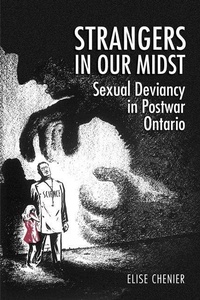
Strangers in Our Midst
Sexual Deviancy in Postwar Ontario
Published on 28. June 2008
Book
Paperback/Softback
320 pages
978-0-8020-9453-7 (ISBN)
Description
Contemporary efforts to treat sex offenders are rooted in the post-Second World War era, in which an unshakable faith in science convinced many Canadian parents that pedophilia could be cured. Strangers in Our Midst explores the popularization of the notion of sexual deviancy as a way of understanding sexual behaviour, the emergence in Canada of legislation directed at sex offenders, and the evolution of treatment programs in Ontario.
Popular discourses regarding sexual deviancy, legislative action against sex criminals, and the implementation of treatment programs for sex offenders have been widely attributed to a reactionary, conservative moral panic over changing sex and gender roles after the Second World War. Elise Chenier challenges this assumption, arguing that, in Canada, advocates of sex-offender treatment were actually liberal progressives. Drawing on previously unexamined sources, including medical reports, government commissions, prison files, and interviews with key figures, Strangers in Our Midst offers an original critical analysis of the rise of sexological thinking in Canada, and shows how what was conceived as a humane alternative to traditional punishment could be put into practice in inhumane ways.
Popular discourses regarding sexual deviancy, legislative action against sex criminals, and the implementation of treatment programs for sex offenders have been widely attributed to a reactionary, conservative moral panic over changing sex and gender roles after the Second World War. Elise Chenier challenges this assumption, arguing that, in Canada, advocates of sex-offender treatment were actually liberal progressives. Drawing on previously unexamined sources, including medical reports, government commissions, prison files, and interviews with key figures, Strangers in Our Midst offers an original critical analysis of the rise of sexological thinking in Canada, and shows how what was conceived as a humane alternative to traditional punishment could be put into practice in inhumane ways.
More details
Series
Language
English
Place of publication
Toronto
Canada
Target group
College/higher education
Professional and scholarly
Product notice
Paperback (trade)
Dimensions
Height: 227 mm
Width: 155 mm
Thickness: 20 mm
Weight
490 gr
ISBN-13
978-0-8020-9453-7 (9780802094537)
Copyright in bibliographic data and cover images is held by Nielsen Book Services Limited or by the publishers or by their respective licensors: all rights reserved.
Schweitzer Classification
Person
Elise Chenier is an assistant professor in the Department of History at Simon Fraser University.
Content
Acknowledgments IntroductionPART ONE: THEORIES1 Criminal Sexual Psychopathy: The Birth of a Legal Concept2 Social Citizenship and Sexual Danger3 Surveying Sex: The Royal Commission on the Criminal Law Relating to Criminal Sexual PsychopathsPART TWO: PRACTICES4 The Mad and the Bad: Treating Sexual Deviation5 Sex Deviant Treatment in Ontario Prisons6 Compulsory Heterosexuality and the Limits of Forensic SexologyConclusionNotes Bibliography Index