

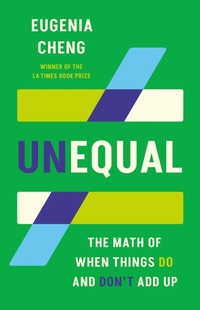
Unequal
The Math of When Things Do and Don't Add Up
Published on 2. September 2025
Book
Hardback
400 pages
978-1-5416-0655-5 (ISBN)
Description
Why the familiar equal sign is a gateway into math’s—and humanity’s—most profound questions
"Eugenia Cheng has opened up my mind to the wondrous world of pure mathematics in a way that I never thought was possible." ―Willow Smith, singer and actress
A New Scientist Best Book of the Year
Math is famous for its equations: 1 + 1 = 2, a^2 + b^2 = c^2, or y = mx + b. It can seem like that’s all mathematics is: following steps to show that what’s on one side of an equation is the same as what’s on the other.
In Unequal, Eugenia Cheng shows that’s just part of the story, and the boring part to boot. Mathematics is a world of shapes, symmetries, and logical ideas. And in that world, the boundary between things being equal and unequal is a gray area, or perhaps a rainbow of beautiful, vibrant, subtly nuanced color.
As Unequal shows, once you go over that rainbow, almost everything can be considered equal and unequal at the same time, whether it’s shapes (seen from the right perspective, a circle is the same as an ellipse), words (synonyms), or people—even numbers! That’s because mathematics isn’t a series of rules, facts, or answers. It’s an invitation to a more powerful way of thinking.
"Eugenia Cheng has opened up my mind to the wondrous world of pure mathematics in a way that I never thought was possible." ―Willow Smith, singer and actress
A New Scientist Best Book of the Year
Math is famous for its equations: 1 + 1 = 2, a^2 + b^2 = c^2, or y = mx + b. It can seem like that’s all mathematics is: following steps to show that what’s on one side of an equation is the same as what’s on the other.
In Unequal, Eugenia Cheng shows that’s just part of the story, and the boring part to boot. Mathematics is a world of shapes, symmetries, and logical ideas. And in that world, the boundary between things being equal and unequal is a gray area, or perhaps a rainbow of beautiful, vibrant, subtly nuanced color.
As Unequal shows, once you go over that rainbow, almost everything can be considered equal and unequal at the same time, whether it’s shapes (seen from the right perspective, a circle is the same as an ellipse), words (synonyms), or people—even numbers! That’s because mathematics isn’t a series of rules, facts, or answers. It’s an invitation to a more powerful way of thinking.
More details
Language
English
Product notice
sewn/stitched
Cloth over boards
Dimensions
Height: 239 mm
Width: 156 mm
Thickness: 38 mm
Weight
618 gr
ISBN-13
978-1-5416-0655-5 (9781541606555)
Copyright in bibliographic data and cover images is held by Nielsen Book Services Limited or by the publishers or by their respective licensors: all rights reserved.
Schweitzer Classification
Person
Eugenia Cheng is Scientist in Residence at the School of the Art Institute of Chicago. She has authored numerous books, including the LA Times Book Prize winner Is Math Real?, Beyond Infinity, How to Bake Pi, The Art of Logic, and x + y. Cheng lives in Chicago, Illinois.