

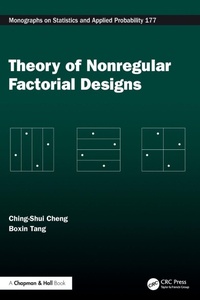
Theory of Nonregular Factorial Designs
1st Edition
Published on 30. April 2025
Book
Hardback
266 pages
978-1-032-44379-9 (ISBN)
Description
Nonregular factorial designs are a class of factorial designs that enable researchers to study simultaneously the effects of many explanatory variables on a response variable of interest. Factorial designs have been in the mainstream of design research for decades, but interest in nonregular factorial designs has been increasing significantly in the last twenty years or so. These designs are practically useful as they offer much richer and more flexible choices for experimenters to contemplate than regular designs. Theoretically, they present new challenges and raise new issues that require new ideas and methods to properly address. This book is the first to synthesize research on this topic into a consistent statistical design framework. It is focused on the theoretical underpinnings of nonregular factorial designs but emphasizes the ideas and methods of statistical designs, rather than mathematical rigor. Some background is provided in an appendix, and the book also includes lots of worked examples to illustrate the ideas and methods.
Features:
A unified and comprehensive overview of the theory and application of nonregular factorial designs
Self-contained, with an appendix of necessary background knowledge in factorial designs
Mathematics is kept to a minimum, with proofs only included if simple or insightful, or is otherwise in chapter appendices
Great attention has been paid to the narrative flow
Lots of worked examples to illustrate the ideas and methods
This book is primarily aimed at researchers and practitioners working on the design of experiments. It will be a perfect entry into the field for a junior researcher and a useful reference for all researchers already in the field. It could be used as a textbook for graduate students who have taken a first design course and have a passion for design ideas and research. Scientists from other disciplines will find the book useful as well, if their research involves multi-factor experiments.
Features:
A unified and comprehensive overview of the theory and application of nonregular factorial designs
Self-contained, with an appendix of necessary background knowledge in factorial designs
Mathematics is kept to a minimum, with proofs only included if simple or insightful, or is otherwise in chapter appendices
Great attention has been paid to the narrative flow
Lots of worked examples to illustrate the ideas and methods
This book is primarily aimed at researchers and practitioners working on the design of experiments. It will be a perfect entry into the field for a junior researcher and a useful reference for all researchers already in the field. It could be used as a textbook for graduate students who have taken a first design course and have a passion for design ideas and research. Scientists from other disciplines will find the book useful as well, if their research involves multi-factor experiments.
More details
Series
Language
English
Place of publication
United Kingdom
Publishing group
Taylor & Francis Ltd
Target group
Professional and scholarly
College/higher education
Professional Reference
Illustrations
2 s/w Abbildungen, 2 s/w Zeichnungen, 22 s/w Tabellen
22 Tables, black and white; 2 Line drawings, black and white; 2 Illustrations, black and white
Dimensions
Height: 260 mm
Width: 183 mm
Thickness: 20 mm
Weight
730 gr
ISBN-13
978-1-032-44379-9 (9781032443799)
Copyright in bibliographic data and cover images is held by Nielsen Book Services Limited or by the publishers or by their respective licensors: all rights reserved.
Schweitzer Classification
Other editions
Additional editions
Ching-Shui Cheng | Boxin Tang
Theory of Nonregular Factorial Designs
E-Book
05/2025
Chapman and Hall
€73.99
Available for download
Ching-Shui Cheng | Boxin Tang
Theory of Nonregular Factorial Designs
E-Book
05/2025
Chapman and Hall
€73.99
Available for download
Persons
Ching-Shui Cheng is a Professor Emeritus at University of California, Berkeley. Boxin Tang is a Professor of Statistics at Simon Fraser University. Both have their main research interests in the area of experimental design.
Professor Cheng is a Fellow of the Institute of Mathematical Statistics and a Fellow of the American Statistical Association. He is a former Chair-Editor for Statistica Sinica, and also served as an Associate Editor for the Annals of Statistics, Biometrika, Journal of Statistical Planning and Inference, Statistica Sinica, and Technometrics.
Professor Tang is a Fellow of the Institute of Mathematical Statistics and a Fellow of the American Statistical Association. He has served on the editorial boards of the Annals of Statistics, Bernoulli Journal, Electronic Journal of Statistics, Journal of the Royal Statistical Society: Series B, Journal of Statistical Theory and Practice, and Statistica Sinica.
Professor Cheng is a Fellow of the Institute of Mathematical Statistics and a Fellow of the American Statistical Association. He is a former Chair-Editor for Statistica Sinica, and also served as an Associate Editor for the Annals of Statistics, Biometrika, Journal of Statistical Planning and Inference, Statistica Sinica, and Technometrics.
Professor Tang is a Fellow of the Institute of Mathematical Statistics and a Fellow of the American Statistical Association. He has served on the editorial boards of the Annals of Statistics, Bernoulli Journal, Electronic Journal of Statistics, Journal of the Royal Statistical Society: Series B, Journal of Statistical Theory and Practice, and Statistica Sinica.
Content
1. Introduction. 2. Basics of Factorial Designs. 3. J-Characteristics and Projection Properties. 4. Generalized Resolution and Minimum G-Aberration. 5. Minimum G2-Aberration. 6. Clear Effects, Requirement Sets, and SOS Designs. 7. Minimum G2-Aberration in Complex Settings. 8. Supersaturated Designs. 9. Other Nonregular Designs. 10. Multi-Level Nonregular Designs. 11. Mixed-Level Designs and Complicated Unit Structures. 12. Space-Filling Designs.