

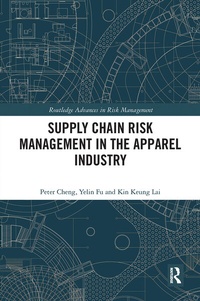
Supply Chain Risk Management in the Apparel Industry
1st Edition
Published on 18. December 2020
Book
Paperback/Softback
136 pages
978-0-367-50411-3 (ISBN)
Description
Apparel is one of the oldest and largest export industries in the world. It is also one of the most global industries because most nations produce for the international textile and apparel market. The changing global landscape drives cost volatility, regulatory risk and change in consumer preference. In today's retail landscape, media and advocacy groups have focussed attention on social and environmental issues, as well as new regulatory requirements and stricter legislations. Understanding and managing any risk within the supply chain, particularly ethical and responsible sourcing, has become increasingly critical.
This book first gives a systematic introduction to the evolution of SCRM through literature review and discusses the importance of SCRM in the apparel industry. Second, it describes the life cycle of the apparel supply chain and defines the different roles of the value chain in the apparel industry. Thirdly, it identifies the risk factors in the Apparel Life Cycle and analyses the risk sources and consequences and finally, extends the importance of selection of the suppliers and develops a supplier selection model and SCRM strategies solution by data analysis and case studies.
This book first gives a systematic introduction to the evolution of SCRM through literature review and discusses the importance of SCRM in the apparel industry. Second, it describes the life cycle of the apparel supply chain and defines the different roles of the value chain in the apparel industry. Thirdly, it identifies the risk factors in the Apparel Life Cycle and analyses the risk sources and consequences and finally, extends the importance of selection of the suppliers and develops a supplier selection model and SCRM strategies solution by data analysis and case studies.
More details
Series
Language
English
Place of publication
London
United Kingdom
Publishing group
Taylor & Francis Ltd
Target group
College/higher education
Postgraduate and Undergraduate
Illustrations
13 s/w Abbildungen, 13 s/w Zeichnungen, 21 s/w Tabellen
21 Tables, black and white; 13 Line drawings, black and white; 13 Illustrations, black and white
Dimensions
Height: 234 mm
Width: 156 mm
Weight
270 gr
ISBN-13
978-0-367-50411-3 (9780367504113)
Copyright in bibliographic data and cover images is held by Nielsen Book Services Limited or by the publishers or by their respective licensors: all rights reserved.
Schweitzer Classification
Other editions
Additional editions
Peter Cheng | Yelin Fu | Kin Keung Lai
Supply Chain Risk Management in the Apparel Industry
E-Book
05/2018
Routledge
€61.99
Available for download
Peter Cheng | Yelin Fu | Kin Keung Lai
Supply Chain Risk Management in the Apparel Industry
E-Book
05/2018
1st Edition
Routledge
€61.99
Available for download
Peter Cheng | Yelin Fu | Kin Keung Lai
Supply Chain Risk Management in the Apparel Industry
Book
05/2018
1st Edition
Routledge
€215.41
Shipment within 10-20 days
Persons
Peter Cheng is the cofounder and Chairman of Hanbo group. He obtained his Executive Master of Business Administration (EMBA) degree in 2014 and Doctorate of Business Administration (DBA) degree in 2018 at City University of Hong Kong. His research interests are supply chain risk management and management science. He has been an important figure in the co-founding of both the Hong Kong Apparel Society Limited (HKAS) and Hanbo Enterprises Limited, and his experience in offshore production bases includes Sri Lanka, Cambodia, Kenya, Honduras, Jordan, Bangladesh, Vietnam, Myanmar and Indonesia. He also conceptualised the SMART supply chain management model.
Yelin Fu is Post-Doctoral Fellow at College of Economics, Shenzhen University. He has two PhDs from the College of Business, City University of Hong Kong, and the School of Management, University of Science and Technology of China. He has published papers in Annals of Operations Research, International Journal of Logistics Management, International Transactions in Operational Research, Journal of Engineer Manufacture, and International Journal of Systems Science.
Kin Keung Lai is the Changjiang Chair Professor of the International Business School of the Shaanxi Normal University, China. He was previously Chair Professor of Management Science at the City University of Hong Kong. His main areas of research interests are operations and supply chain management, financial and business risk analysis and modelling using computational intelligence. He is the Founding Chairman of the Hong Kong Operational Research Society of Hong Kong and is also currently the President of the Asia Association on Risk and Crises Management.
Yelin Fu is Post-Doctoral Fellow at College of Economics, Shenzhen University. He has two PhDs from the College of Business, City University of Hong Kong, and the School of Management, University of Science and Technology of China. He has published papers in Annals of Operations Research, International Journal of Logistics Management, International Transactions in Operational Research, Journal of Engineer Manufacture, and International Journal of Systems Science.
Kin Keung Lai is the Changjiang Chair Professor of the International Business School of the Shaanxi Normal University, China. He was previously Chair Professor of Management Science at the City University of Hong Kong. His main areas of research interests are operations and supply chain management, financial and business risk analysis and modelling using computational intelligence. He is the Founding Chairman of the Hong Kong Operational Research Society of Hong Kong and is also currently the President of the Asia Association on Risk and Crises Management.
Content
1. Introduction 2. Concept, Application and Theory of Apparel Supply Chain Risk Management 3. A Subjective Method for Vendor Selection 4. Alternative Objective Methods for Vendor Selection 5. Vendor Selection Under Uncertain Preference Among Evaluation Criteria 6. Robust Supplier Selection in the Presence of Uncertain Demand 7. Production Capacity Planning via Robust Optimization 8. A Case Study in Hong Kong Apparel Industry: Hanbo Enterprise Holdings Limited