

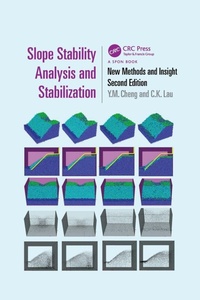
Slope Stability Analysis and Stabilization
New Methods and Insight, Second Edition
2nd Edition
Published on 28. April 2017
Book
Paperback/Softback
438 pages
978-1-138-07550-4 (ISBN)
Description
Includes Recommendations for Analysis, Design Practice, Design Charts, Tables, and More
Using a unified approach to address a medley of engineering and construction problems, Slope Stability Analysis and Stabilization: New Methods and Insight, Second Edition provides helpful practical advice and design resources for the practicing engineer. This text examines a range of current methods for the analysis and design of slopes, and details the limitations of both limit equilibrium and the finite element method in the assessment of the stability of a slope. It also introduces a variety of alternative approaches for overcoming numerical non-convergence and the location of critical failure surfaces in two-dimensional and three-dimensional cases.
What's New in the Second Edition:
This latest edition builds on the concepts of the first edition and covers the case studies involved in slope stability analysis in greater detail. The book adds a chapter on the procedures involved in performing limit equilibrium analysis, as well as a chapter on the design and construction practice in Hong Kong. It includes more examples and illustrations on the distinct element of slope, the relation between limit equilibrium and plasticity theory, the fundamental connections between slope stability analysis and the bearing capacity problem, as well as the stability of the three-dimensional slope under patch load conditions.
Addresses new concepts in three-dimensional stability analysis, finite element analysis, and the extension of slope stability problems to lateral earth pressure problems
Offers a unified approach to engineering and construction problems, including slope stability, bearing capacity, and earth pressure behind retaining structures
Emphasizes how to translate the conceptual design conceived in the design office into physical implementation on site in a holistic way
Discusses problems that were discovered during the development of associated computer programs
This text assesses the fundamental assumptions and limitations of stability analysis methods and computer modelling, and benefits students taking an elective course on slope stability, as well as geotechnical engineering professionals specializing in slope stability
Using a unified approach to address a medley of engineering and construction problems, Slope Stability Analysis and Stabilization: New Methods and Insight, Second Edition provides helpful practical advice and design resources for the practicing engineer. This text examines a range of current methods for the analysis and design of slopes, and details the limitations of both limit equilibrium and the finite element method in the assessment of the stability of a slope. It also introduces a variety of alternative approaches for overcoming numerical non-convergence and the location of critical failure surfaces in two-dimensional and three-dimensional cases.
What's New in the Second Edition:
This latest edition builds on the concepts of the first edition and covers the case studies involved in slope stability analysis in greater detail. The book adds a chapter on the procedures involved in performing limit equilibrium analysis, as well as a chapter on the design and construction practice in Hong Kong. It includes more examples and illustrations on the distinct element of slope, the relation between limit equilibrium and plasticity theory, the fundamental connections between slope stability analysis and the bearing capacity problem, as well as the stability of the three-dimensional slope under patch load conditions.
Addresses new concepts in three-dimensional stability analysis, finite element analysis, and the extension of slope stability problems to lateral earth pressure problems
Offers a unified approach to engineering and construction problems, including slope stability, bearing capacity, and earth pressure behind retaining structures
Emphasizes how to translate the conceptual design conceived in the design office into physical implementation on site in a holistic way
Discusses problems that were discovered during the development of associated computer programs
This text assesses the fundamental assumptions and limitations of stability analysis methods and computer modelling, and benefits students taking an elective course on slope stability, as well as geotechnical engineering professionals specializing in slope stability
More details
Edition
2nd edition
Language
English
Place of publication
London
United Kingdom
Publishing group
Taylor & Francis Ltd
Target group
College/higher education
Geotechnical engineering researchers specializing in slope stability, geotechnical engineering firms specializing in slope stabilization, and final year undergraduates and masters students taking an elective course on slope stability.
Illustrations
243 s/w Abbildungen, 80 s/w Tabellen
80 Tables, black and white; 243 Illustrations, black and white
Dimensions
Height: 234 mm
Width: 156 mm
Thickness: 24 mm
Weight
664 gr
ISBN-13
978-1-138-07550-4 (9781138075504)
Copyright in bibliographic data and cover images is held by Nielsen Book Services Limited or by the publishers or by their respective licensors: all rights reserved.
Schweitzer Classification
Other editions
Additional editions
Y. M. Cheng | C. K. Lau
Slope Stability Analysis and Stabilization
New Methods and Insight, Second Edition
E-Book
05/2014
2nd Edition
CRC Press
€138.99
Available for download
Y. M. Cheng | C. K. Lau
Slope Stability Analysis and Stabilization
New Methods and Insight, Second Edition
E-Book
05/2014
2nd Edition
CRC Press
€138.99
Available for download
Y. M. Cheng | C. K. Lau
Slope Stability Analysis and Stabilization
New Methods and Insight, Second Edition
Book
05/2014
2nd Edition
CRC Press
€385.00
Shipment within 15-20 days
Persons
Dr. YM Cheng has an interest in research work in slope stability: unification of 2D methods, location of critical 2D failure surfaces, 3D slope stability analysis, location of critical 3D failure surfaces, development of slope stability software SLOPE2000 and SLOPE3D, unification of lateral earth pressure and slope stability problems, convergence problems in slope stability analysis, field tests of steel, GFRP, CFRP bars and tubes soil nails in Hong Kong, numerical modelling of soil nail pull out tests, finite element analysis of slope stability, and distinct element analysis of slope stability analysis.
Dr. C.K. Lau
obtained his PhD from Cambridge University, studying geotechnical engineering under Prof. M. Bolton. He is a past chairman of Geotechnical Division, Hong Kong Institution of Engineers, specializing in the design and construction of slope stabilization works in Hong Kong. His research interests include slope stability, slip line analysis, and bearing capacity.
Dr. C.K. Lau
obtained his PhD from Cambridge University, studying geotechnical engineering under Prof. M. Bolton. He is a past chairman of Geotechnical Division, Hong Kong Institution of Engineers, specializing in the design and construction of slope stabilization works in Hong Kong. His research interests include slope stability, slip line analysis, and bearing capacity.
Content
Introduction. Basic slope stability analysis methods. Location of critical failure surface, convergence and advanced formulations. Finite-element methods for slope stability analysis and comparisons with limit equilibrium analysis. Three-dimensional slope stability analysis. Implementation. Routine assessment of feature and design of landslip preventive measures. Numerical implementation of slope stability analysis methods. Appendix. References. Index.