

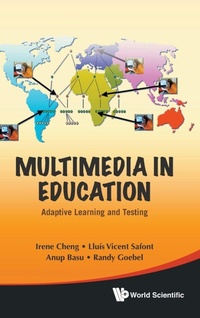
Multimedia In Education: Adaptive Learning And Testing
Adaptive Learning and Testing
Published on 20. August 2010
Book
Hardback
188 pages
978-981-283-705-9 (ISBN)
Description
In this book, we review many examples of multimedia item types for testing. We also outline how games can be used to test physics concepts - discuss designing chemistry item types with interactive graphics; study how culture-specific linguistics can help inner-city kids and new immigrants learn better; suggest approaches for automatically adjusting difficulty level in interactive graphics-based questions; and propose strategies for giving partial marks for incorrect answers. We also study how to test different cognitive skills, such as music, using multimedia interfaces and also evaluate the effectiveness of our model. Methods for estimating difficulty levels of mathematical item types using Item Response Theory (IRT) will be discussed. Examples of item shells for human computer interaction and cell phones will be shown.
More details
Language
English
Place of publication
Singapore
Singapore
Target group
College/higher education
Professional and scholarly
Academics and graduate students in multimedia and education, educational content developers, employees testing and training organizations, game developers.
Dimensions
Height: 235 mm
Width: 157 mm
Thickness: 15 mm
Weight
434 gr
ISBN-13
978-981-283-705-9 (9789812837059)
Copyright in bibliographic data and cover images is held by Nielsen Book Services Limited or by the publishers or by their respective licensors: all rights reserved.
Schweitzer Classification
Persons
Content
The Trend Towards Online Multimedia Education and Its Advantages Over Traditional Methods; Framework of an Online Multimedia Education System; Innovative Item Types for Learning and Testing; Educational Games; Item Shells for Automatic Generation of Multiple Items; Testing Intelligence and Problem Solving Skills; Student Modeling; Adaptive Testing and Item Response Theory; Educational Item Authoring; Multimedia Education on Mobile Devices; Human Computer Interaction, Affective Education and User Evaluation.