

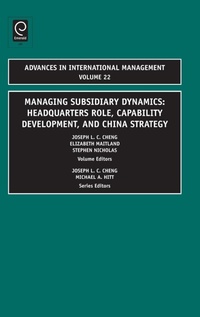
Managing Subsidiary Dynamics
Headquarters Role, Capability Development, and China Strategy
Published on 3. July 2009
Book
Hardback
264 pages
978-1-84855-666-9 (ISBN)
Description
A major development in recent research on the multinational enterprise (MNE) is the increased attention given to the interdependent, differentiated roles of the subsidiaries and their implications for MNE and subsidiary management. Paralleling this development is the shift away from studying subsidiaries as subunits to be controlled by the headquarters to investigating what subsidiaries do and how their activities can help develop firm-specific advantages. This volume includes contributions from leading scholars in the field from North America, Europe, and Asia-Pacific. Different from the traditional, single-discipline based investigation, it presents a multi-disciplinary approach to researching subsidiary dynamics and its effective management, with a focus on three important issues: the role of the headquarters within the context of subsidiaries as members of a differentiated, interdependent network; the development of subsidiary capabilities and their impact on firm performance; and, subsidiaries as learning agents for the MNE, particularly in emerging markets such as China.
More details
Series
Language
English
Place of publication
Bingley
United Kingdom
Publishing group
Emerald Publishing Limited
Target group
Professional and scholarly
Dimensions
Height: 240 mm
Width: 161 mm
Thickness: 19 mm
Weight
564 gr
ISBN-13
978-1-84855-666-9 (9781848556669)
Copyright in bibliographic data and cover images is held by Nielsen Book Services Limited or by the publishers or by their respective licensors: all rights reserved.
Schweitzer Classification
Other editions
Additional editions
Joseph L.C. Cheng | Elizabeth Maitland | Stephen Nicholas
Managing Subsidiary Dynamics
Headquarters Role, Capability Development, and China Strategy
E-Book
07/2009
1st Edition
Emerald Publishing Limited
€113.99
Available for download
Content
Editors' biography.
List of Contributors.
Preface.
In search of the matrix advantage: A reexamination of the fit of matrix structures to transnational strategy.
The dynamics of attention markets in multinational enterprises.
Subsidiaries in motion: Assessing the impact of sunk versus flexible assets.
Commentary The changing dynamics of headquarters-subsidiary relations: Toward greater system flexibility.
Subsidiary capability development in multinational enterprises: An empirical investigation.
Does knowledge sharing pay? A multinational subsidiary perspective on knowledge outflows.
Commentary The liability of foreignness, capabilities, knowledge, and the performance of the subsidiary.
New perspectives on subsidiaries in the transition economy of China.
The effects of strategies on the management control-performance relationship in Sino joint ventures.
Competition, learning, and foreign entry strategy: A macro organization perspective.
Commentary Subsidiary operations in China: Learning in an evolving institutional environment.
Advances in international Management.
Managing subsidiary dynamics: Headquarters role, capability development, and China strategy.
Copyright page.
List of Contributors.
Preface.
In search of the matrix advantage: A reexamination of the fit of matrix structures to transnational strategy.
The dynamics of attention markets in multinational enterprises.
Subsidiaries in motion: Assessing the impact of sunk versus flexible assets.
Commentary The changing dynamics of headquarters-subsidiary relations: Toward greater system flexibility.
Subsidiary capability development in multinational enterprises: An empirical investigation.
Does knowledge sharing pay? A multinational subsidiary perspective on knowledge outflows.
Commentary The liability of foreignness, capabilities, knowledge, and the performance of the subsidiary.
New perspectives on subsidiaries in the transition economy of China.
The effects of strategies on the management control-performance relationship in Sino joint ventures.
Competition, learning, and foreign entry strategy: A macro organization perspective.
Commentary Subsidiary operations in China: Learning in an evolving institutional environment.
Advances in international Management.
Managing subsidiary dynamics: Headquarters role, capability development, and China strategy.
Copyright page.