

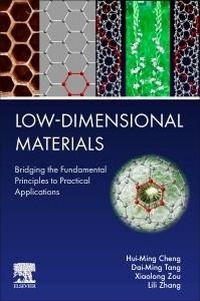
Low-Dimensional Materials
Bridging the Fundamental Principles to Practical Applications
Published on 4. October 2024
Book
Paperback/Softback
384 pages
978-0-443-29046-6 (ISBN)
Description
Low Dimensional Materials: Bridging the Fundamental Principles to Practice Applications provides an overview of research on low-dimensional materials, devices, and their applications. There are seven chapters in the book, starting from the basic quantum theory in chapter one, to the control and characterization of the unique structures (chapters two and four), to the relation of the physical and chemical properties with structures (chapter five), and to the practical and promising applications in energy, information, and health (chapter six), before conclusions and future outlook in chapter seven.
More details
Language
English
Place of publication
Philadelphia
United States
Target group
Professional and scholarly
Product notice
Paperback (trade)
Unsewn / adhesive bound
Dimensions
Height: 229 mm
Width: 152 mm
Weight
450 gr
ISBN-13
978-0-443-29046-6 (9780443290466)
Copyright in bibliographic data and cover images is held by Nielsen Book Services Limited or by the publishers or by their respective licensors: all rights reserved.
Schweitzer Classification
Other editions
Additional editions
Hui-Ming Cheng | Dai-Ming Tang | Xiaolong Zou
Low-Dimensional Materials
Bridging the Fundamental Principles to Practical Applications
E-Book
10/2024
Elsevier
€208.99
Available for download
Persons
Professor Cheng is a Member of Chinese Academy of Sciences; Director of the Advanced Carbon Research Division of Shenyang National Laboratory for Materials Science, IMR CAS; Director of the Institute of Technology for Carbon Neutrality, Shenzhen Institute of Advanced Technology, CAS. His research focus is on: carbon nanotubes, graphene, other 2D materials, energy storage materials and photocatalytic materials.
Dr Tang is a Principal Researcher at the National Institute for Materials Science (NIMS), Japan. Research fields include: nanomechanics, nanoelectronics, carbon nanotubes, in situ electron microscopy.
Dr Zou is Associate Professor, Shenzhen Geim Graphene Center, Tsinghua-Berkeley Shenzhen Institute and Tsinghua Shenzhen International Graduate School, Tsinghua University; research field: 2D materials, theoretical computation and simulations, magnetism, optical properties, catalytic properties.
Dr Zhang is Associate Professor, Shenyang National Laboratory for Materials Science, Institute of Metal Research (IMR), CAS, China; research field: controlled synthesis of carbon nanotubes, catalytic growth mechanism of carbon nanomaterials, environmental TEM.
Dr Tang is a Principal Researcher at the National Institute for Materials Science (NIMS), Japan. Research fields include: nanomechanics, nanoelectronics, carbon nanotubes, in situ electron microscopy.
Dr Zou is Associate Professor, Shenzhen Geim Graphene Center, Tsinghua-Berkeley Shenzhen Institute and Tsinghua Shenzhen International Graduate School, Tsinghua University; research field: 2D materials, theoretical computation and simulations, magnetism, optical properties, catalytic properties.
Dr Zhang is Associate Professor, Shenyang National Laboratory for Materials Science, Institute of Metal Research (IMR), CAS, China; research field: controlled synthesis of carbon nanotubes, catalytic growth mechanism of carbon nanomaterials, environmental TEM.
Content
1. Theoretical basis of low-dimensional materials
2. Unique structures of low-dimensional materials
3. Controlled fabrication of low-dimensional materials
4. Structural characterization of low-dimensional materials
5. Novel properties of low-dimensional materials
6. Applications of low dimensional materials
7. The past, present and future of low-dimensional materials
2. Unique structures of low-dimensional materials
3. Controlled fabrication of low-dimensional materials
4. Structural characterization of low-dimensional materials
5. Novel properties of low-dimensional materials
6. Applications of low dimensional materials
7. The past, present and future of low-dimensional materials