

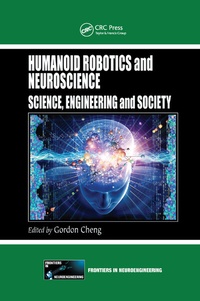
Humanoid Robotics and Neuroscience
Science, Engineering and Society
1st Edition
Published on 10. October 2019
Book
Paperback/Softback
300 pages
978-0-367-37789-2 (ISBN)
Description
Humanoid robots are highly sophisticated machines equipped with human-like sensory and motor capabilities. Today we are on the verge of a new era of rapid transformations in both science and engineering-one that brings together technological advancements in a way that will accelerate both neuroscience and robotics. Humanoid Robotics and Neuroscience: Science, Engineering and Society presents the contributions of prominent scientists who explore key aspects of the further potential of these systems.
Topics include:
Neuroscientific research findings on dexterous robotic hand control
Humanoid vision and how understanding the structure of the human eye can lead to improvements in artificial vision
Humanoid locomotion, motor control, and the learning of motor skills
Cognitive elements of humanoid robots, including the neuroscientific aspects of imitation and development
The impact of robots on society and the potential for developing new systems and devices to benefit humans
The use of humanoid robotics can help us develop a greater scientific understanding of humans, leading to the design of better engineered systems and machines for society. This book assembles the work of scientists on the cutting edge of robotic research who demonstrate the vast possibilities in this field of research.
Topics include:
Neuroscientific research findings on dexterous robotic hand control
Humanoid vision and how understanding the structure of the human eye can lead to improvements in artificial vision
Humanoid locomotion, motor control, and the learning of motor skills
Cognitive elements of humanoid robots, including the neuroscientific aspects of imitation and development
The impact of robots on society and the potential for developing new systems and devices to benefit humans
The use of humanoid robotics can help us develop a greater scientific understanding of humans, leading to the design of better engineered systems and machines for society. This book assembles the work of scientists on the cutting edge of robotic research who demonstrate the vast possibilities in this field of research.
More details
Language
English
Place of publication
London
United Kingdom
Publishing group
Taylor & Francis Ltd
Target group
College/higher education
Professional and scholarly
Professional Reference
Dimensions
Height: 234 mm
Width: 156 mm
Weight
453 gr
ISBN-13
978-0-367-37789-2 (9780367377892)
Copyright in bibliographic data and cover images is held by Nielsen Book Services Limited or by the publishers or by their respective licensors: all rights reserved.
Schweitzer Classification
Other editions
Additional editions
Book
12/2014
1st Edition
CRC Press
€257.50
Shipment within 15-20 days
E-Book
12/2014
CRC Press
€89.99
Available for download

E-Book
12/2014
1st Edition
CRC Press
€89.99
Available for download
Person
Gordon Cheng is the chair, founder, and director of the Institute for Cognitive Systems at the Technical University of Munich. From 2002-2008, he was the head of the Department of Humanoid Robotics and Computational Neuroscience, ATR Computational Neuroscience Laboratories, Kyoto, Japan. His research interests include humanoid robotics, cognitive systems, neuroengineering, real-time network robot control, brain-machine interfaces, biomimetics of human vision, computational neuroscience of vision, action understanding, human-robot interaction, active vision, mobile robot navigation, and object-oriented software construction.
Content
Section I: Humanoid Robotics Perspectives to Neuroscience. Humanoid Robotics and Neuroscience: Science, Engineering and Society. Humanoid Brain Science.Section II: Emulating the Neuro-mechanisms with Humanoid Robots. Hands, Dexterity and the Brain. Humanoid Action, Recognition and the Brain: Stochastic Information Processing that Unifies Recognition and Generation of Motion Patterns - Toward Symbolical Understanding of the Continuous World. Humanoid Vision and the Brain: Foveal Vision for Humanoid Robots. Humanoid Robotics Motor Learning and Neuroscience: Representation and Control of the Task Space in Humans and Humanoid Robots. Humanoid Locomotion and the Brain. Humanoid Motor Control: Dynamics and the Brain. Section III: Leaping forward: Toward Cognitive Humanoid Robots. Learning from Examples: Imitation Learning Emerging Cognition. Cognitive Developmental Robotics towards Humanoid Science: Towards Language: Vocalization by Cognitive Developmental Robotics.