

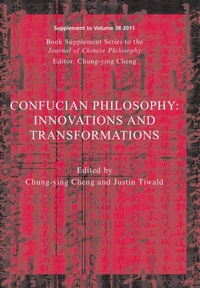
Confucian Philosophy
Innovations and Transformations
Will be published approx. on 30. April 2012
Book
Paperback/Softback
250 pages
978-1-118-36433-8 (ISBN)
Description
In Chinese tradition Confucianism has been always both
a philosophy of moral self-cultivation for the human individual and an
ideological guide for political institutional policy and governmental action.
After the May 4th Movement of 1919 (WusiYundong ),
Confucianism lost much of its moral appeal and political authority and entered a
kind of limbo, bearing blame for the backwardness and weakening of China. Now that China has asserted its political rights among world nations, it seems natural to ask whether Confucianism as a
philosophy has a modern or even postmodern role to play for building modern China and for enlightening the world. This question is even more meaningful in light of the fact that there is a genuine need felt in China
for a return to its Confucian heritage and vision for purposes of sustaining societal harmonization and reconstructing
cultural identity in the modern world.
a philosophy of moral self-cultivation for the human individual and an
ideological guide for political institutional policy and governmental action.
After the May 4th Movement of 1919 (WusiYundong ),
Confucianism lost much of its moral appeal and political authority and entered a
kind of limbo, bearing blame for the backwardness and weakening of China. Now that China has asserted its political rights among world nations, it seems natural to ask whether Confucianism as a
philosophy has a modern or even postmodern role to play for building modern China and for enlightening the world. This question is even more meaningful in light of the fact that there is a genuine need felt in China
for a return to its Confucian heritage and vision for purposes of sustaining societal harmonization and reconstructing
cultural identity in the modern world.
More details
Series
Edition
Tion edition
Language
English
Place of publication
Hoboken
United Kingdom
Publishing group
John Wiley and Sons Ltd
Target group
Professional and scholarly
Product notice
Paperback (trade)
Unsewn / adhesive bound
Dimensions
Height: 249 mm
Width: 175 mm
Thickness: 10 mm
Weight
318 gr
ISBN-13
978-1-118-36433-8 (9781118364338)
Copyright in bibliographic data and cover images is held by Nielsen Book Services Limited or by the publishers or by their respective licensors: all rights reserved.
Schweitzer Classification
Person
Chung-ying Cheng, internationally known philosopher of East-West integration and a leading representative of Neo-Confucian philosophy in contemporary world, was born in 1935 in China, received his college education at National Taiwan University in Taipei with major in philosophy and literature. He received his M.A. in Philosophy from University of Washington, received Ph.D. in Philosophy from Harvard University and started teaching in 1964. He became a tenured full Professor of Philosophy by 1972 at University of Hawaii at Manoa.
Content
Chung-Ying Cheng, Preface: New Confucianism as Philosophy of Humanity and Governance
Justin Tiwald, Introduction: A Confucian Philosophical Agenda
Chung-ying Cheng, A Transformative Conception of Confucian Ethics: The Yijing, Utility, and Rights
Justin Tiwald, Dai Zhen's Defense of Self-Interest
Chenyang Li, Xunzi on the Origin of Goodness: A New Interpretation
Shirley Chan, Tian (Heaven) in the Guodian Texts (Part I): Natural Order and Moral Norms
Daniel A. Bell and Thaddeus Metz, Confucianism and Ubuntu: Reflections on a Dialogue Between Chinese and African Traditions
Shun Kwong-Loi, Wang Yang-Ming on Self-Cultivation in the Daxue
Pauline C. Lee, "Spewing Jade and Spitting Pearls" Li Zhi's Ethics of Genuineness
Wing-Cheuk Chan, Mou Zongsan on Confucian and Kant's Ethics: A Critical Reflection
Anne Cheng, Virtue and Politics: Some Conceptions of Sovereignty in Ancient China
Lauren F. Pfister, Family Ethics and New Visions of Selfhood in Post-Secular Chinese Teachings
Stephen C. Angle, A Productive Dialogue: Contemporary Moral Education and Zhu Xi's Neo-Confucian Ethics
Justin Tiwald, Introduction: A Confucian Philosophical Agenda
Chung-ying Cheng, A Transformative Conception of Confucian Ethics: The Yijing, Utility, and Rights
Justin Tiwald, Dai Zhen's Defense of Self-Interest
Chenyang Li, Xunzi on the Origin of Goodness: A New Interpretation
Shirley Chan, Tian (Heaven) in the Guodian Texts (Part I): Natural Order and Moral Norms
Daniel A. Bell and Thaddeus Metz, Confucianism and Ubuntu: Reflections on a Dialogue Between Chinese and African Traditions
Shun Kwong-Loi, Wang Yang-Ming on Self-Cultivation in the Daxue
Pauline C. Lee, "Spewing Jade and Spitting Pearls" Li Zhi's Ethics of Genuineness
Wing-Cheuk Chan, Mou Zongsan on Confucian and Kant's Ethics: A Critical Reflection
Anne Cheng, Virtue and Politics: Some Conceptions of Sovereignty in Ancient China
Lauren F. Pfister, Family Ethics and New Visions of Selfhood in Post-Secular Chinese Teachings
Stephen C. Angle, A Productive Dialogue: Contemporary Moral Education and Zhu Xi's Neo-Confucian Ethics