

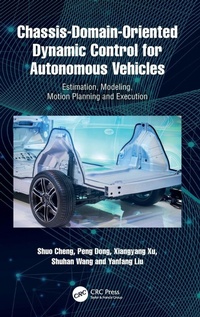
Chassis-Domain-Oriented Dynamic Control for Autonomous Vehicles
Estimation, Modeling, Motion Planning and Execution
1st Edition
Published on 2. September 2025
Book
Hardback
176 pages
978-1-032-95253-6 (ISBN)
Description
Over seven detail-rich chapters, this book comprehensively describes autonomous vehicle chassis modeling and control, chassis domain dynamic control, the estimation of essential dynamic states, research on motion planning, the development of chassis coordinated control, and related topics.
This book first summarizes vehicle dynamic modeling and control and provides the background and related topics for chassis domain dynamic control. It then presents the motivations of chassis domain control and introduces its conceptual framework. The book then focuses on the identification of tire-road interactions, which contain lateral, longitudinal, and vertical tire forces, before then discussing the estimation of essential dynamic states, which represent vehicle handling stability status, and the observation of road surface coefficient. The quantitative evaluation of vehicle chassis domain performance is then provided, with the rigorous definition and design of a comprehensive metric for assessing chassis dynamic performance. Next, the book instructs readers on the chassis-domain dynamic-aware motion planning for autonomous vehicles and the multi-objective multi-subsystem coordinated control. Finally, the authors present their conclusions and future recommendations for the advanced control of autonomous vehicles. The content and structure of this book will enable readers to address the high complexity and unpredictability of traffic conditions, along with the strong nonlinearity of vehicle dynamics during maneuvers, to facilitate the safe and coordinated operations of chassis subsystems. This will further the advancement of autonomous vehicles as the automobile industry transitions into the intelligent age.
This is a vital guide for readers from various expertise backgrounds. Advanced undergraduate and postgraduate students who study vehicle engineering will benefit from the descriptions of theoretical foundations and practical methodologies. Engineers and researchers will also benefit from the unique insights into modeling and control technologies for autonomous vehicles.
This book first summarizes vehicle dynamic modeling and control and provides the background and related topics for chassis domain dynamic control. It then presents the motivations of chassis domain control and introduces its conceptual framework. The book then focuses on the identification of tire-road interactions, which contain lateral, longitudinal, and vertical tire forces, before then discussing the estimation of essential dynamic states, which represent vehicle handling stability status, and the observation of road surface coefficient. The quantitative evaluation of vehicle chassis domain performance is then provided, with the rigorous definition and design of a comprehensive metric for assessing chassis dynamic performance. Next, the book instructs readers on the chassis-domain dynamic-aware motion planning for autonomous vehicles and the multi-objective multi-subsystem coordinated control. Finally, the authors present their conclusions and future recommendations for the advanced control of autonomous vehicles. The content and structure of this book will enable readers to address the high complexity and unpredictability of traffic conditions, along with the strong nonlinearity of vehicle dynamics during maneuvers, to facilitate the safe and coordinated operations of chassis subsystems. This will further the advancement of autonomous vehicles as the automobile industry transitions into the intelligent age.
This is a vital guide for readers from various expertise backgrounds. Advanced undergraduate and postgraduate students who study vehicle engineering will benefit from the descriptions of theoretical foundations and practical methodologies. Engineers and researchers will also benefit from the unique insights into modeling and control technologies for autonomous vehicles.
More details
Language
English
Place of publication
London
United Kingdom
Publishing group
Taylor & Francis Ltd
Target group
Professional and scholarly
College/higher education
Postgraduate, Professional Reference, and Undergraduate Advanced
Illustrations
105 s/w Abbildungen, 20 s/w Photographien bzw. Rasterbilder, 85 s/w Zeichnungen, 18 s/w Tabellen
18 Tables, black and white; 85 Line drawings, black and white; 20 Halftones, black and white; 105 Illustrations, black and white
Dimensions
Height: 240 mm
Width: 161 mm
Thickness: 15 mm
Weight
455 gr
ISBN-13
978-1-032-95253-6 (9781032952536)
Copyright in bibliographic data and cover images is held by Nielsen Book Services Limited or by the publishers or by their respective licensors: all rights reserved.
Schweitzer Classification
Other editions
Additional editions
Shuo Cheng | Peng Dong | Xiangyang Xu
Chassis-Domain-Oriented Dynamic Control for Autonomous Vehicles
Estimation, Modeling, Motion Planning and Execution
E-Book
09/2025
1st Edition
CRC Press
€73.99
Available for download
Shuo Cheng | Peng Dong | Xiangyang Xu
Chassis-Domain-Oriented Dynamic Control for Autonomous Vehicles
Estimation, Modeling, Motion Planning and Execution
E-Book
09/2025
1st Edition
CRC Press
€73.99
Available for download
Persons
Shuo Cheng is an associate professor at the School of Transportation Science and Engineering, Beihang University, Beijing, China. He received his Ph.D. degree in mechanical engineering from the School of Vehicle and Mobility, Tsinghua University, Beijing, China, in 2021. His research interests include intelligent motion planning and control, automotive chassis system design, and dynamic control for autonomous vehicles.
Peng Dong is a professor at the School of Transportation Science and Engineering, Beihang University, Beijing, China. He received his Ph.D. degree in mechanical engineering from Ruhr-University Bochum, Germany, in 2015. His research interests include powertrain systems of electric vehicles, design and control of vehicle transmission, vehicle electric propulsion, hybrid energy management, and vehicle distributed drive technology.
Xiangyang Xu has been a professor at the School of Transportation Science and Engineering, Beihang University since 2002. He received his Ph. D. degree in mechatronic engineering, from Harbin Institute of Technology, Harbin, China, in 1999. He serves as a Fellow of SAE-China, an Executive member of SAE-China, etc. His research interests include transmission technology, hybrid, and EV drive.
Shuhan Wang is currently a professor at the School of Transportation Science and Engineering, Beihang University. He received a Ph.D. degree in vehicle engineering from Beihang University, Beijing, China, in 2009. In 2016, he won the First Prize of the National Science and Technology Progress Award (ranked third). His research interests include transmission technology and the design of automotive chassis.
Yanfang Liu is a professor at the School of Transportation Science and Engineering, Beihang University, Beijing, China. She received her Ph.D. degree in mechanical engineering from Beihang University, Beijing, China, in 2005. Her research interests include the collaborative design and optimization of automotive transmission systems, vehicle multi-domain system dynamics and its intelligent control, etc.
Peng Dong is a professor at the School of Transportation Science and Engineering, Beihang University, Beijing, China. He received his Ph.D. degree in mechanical engineering from Ruhr-University Bochum, Germany, in 2015. His research interests include powertrain systems of electric vehicles, design and control of vehicle transmission, vehicle electric propulsion, hybrid energy management, and vehicle distributed drive technology.
Xiangyang Xu has been a professor at the School of Transportation Science and Engineering, Beihang University since 2002. He received his Ph. D. degree in mechatronic engineering, from Harbin Institute of Technology, Harbin, China, in 1999. He serves as a Fellow of SAE-China, an Executive member of SAE-China, etc. His research interests include transmission technology, hybrid, and EV drive.
Shuhan Wang is currently a professor at the School of Transportation Science and Engineering, Beihang University. He received a Ph.D. degree in vehicle engineering from Beihang University, Beijing, China, in 2009. In 2016, he won the First Prize of the National Science and Technology Progress Award (ranked third). His research interests include transmission technology and the design of automotive chassis.
Yanfang Liu is a professor at the School of Transportation Science and Engineering, Beihang University, Beijing, China. She received her Ph.D. degree in mechanical engineering from Beihang University, Beijing, China, in 2005. Her research interests include the collaborative design and optimization of automotive transmission systems, vehicle multi-domain system dynamics and its intelligent control, etc.
Author
Nanyang Technological University
School of Transportation Science and Engineering, Beihang University
School of Transportation Science and Engineering, Beihang University
School of Transportation Science and Engineering, Beihang University
School of Transportation Science and Engineering, Beihang University
Content
Preface. Author. Chapter 1 Introduction. Chapter 2 Concept and Framework of Chassis Domain Dynamics. Chapter 3 Identification of Tire-Road Interactions. Chapter 4 Estimation of Vehicle Crucial Dynamic States. Chapter 5 Chassis-Domain-Aware Motion Planning. Chapter 6 Multi-Actuator Integrated Control for Chassis Domain Dynamics Optimization. Chapter 7 Conclusion and Prospects. References. Index.