

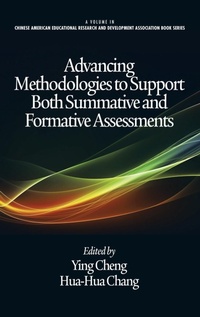
Advancing Methodologies to Support Both Summative and Formative Assessments
Published on 10. March 2014
Book
Hardback
348 pages
978-1-62396-596-9 (ISBN)
Description
Over the past thirty years, student assessment has become an increasingly important component of public education. A variety of methodologies in testing have been developed to obtain and interpret the wealth of assessment outcomes. As assessment goals are getting increasingly multifaceted, new testing methodologies are called for to provide more accessible and reliable information on more complex constructs or processes, such as students' critical thinking and problem-solving skills.
Testing methodologies are needed to extract information from assessments on such complicated skills, in order to advise teachers about certain areas of students that need intervention. It is even a bigger challenge, and a vital mission of today's large-scale assessments, to gain such information from testing data in an efficient manner. For example PARCC and Smarter Balanced Assessments consortia are both striving to offer formative assessments through individualized, tailored testing. The book provides state-of-the-art coverage on new methodologies to support tradit ional summative assessment, and more importantly, for emerging formative assessments.
Testing methodologies are needed to extract information from assessments on such complicated skills, in order to advise teachers about certain areas of students that need intervention. It is even a bigger challenge, and a vital mission of today's large-scale assessments, to gain such information from testing data in an efficient manner. For example PARCC and Smarter Balanced Assessments consortia are both striving to offer formative assessments through individualized, tailored testing. The book provides state-of-the-art coverage on new methodologies to support tradit ional summative assessment, and more importantly, for emerging formative assessments.
More details
Series
Language
English
Place of publication
Charlotte
United States
Publishing group
Emerald Publishing Inc
Target group
Professional and scholarly
Dimensions
Height: 240 mm
Width: 161 mm
Thickness: 23 mm
Weight
687 gr
ISBN-13
978-1-62396-596-9 (9781623965969)
Copyright in bibliographic data and cover images is held by Nielsen Book Services Limited or by the publishers or by their respective licensors: all rights reserved.
Schweitzer Classification
Other editions
Additional editions
Ying Cheng | Hua-Hua Chang
Advancing Methodologies to Support Both Summative and Formative Assessments
E-Book
03/2014
1st Edition
Information Age Publishing
from
€62.33
Available for download
Persons
Ying Cheng, University of Notre Dame, USA
Hua-Hua Chang, University of Illinois at Urbana-Champaign, USA
Hua-Hua Chang, University of Illinois at Urbana-Champaign, USA
Content
Part I. Advances in Making Testing More Efficient.
Chapter 1. Review on Automated Test Assembly, Dmitry Belov & Pei-Hua Chen.
Chapter 2. Automated Test Assembly in Multi-Stage Testing, Yi Zheng.
Chapter 3. Repeated Testing in Clinical Trials and Its Implications to Educational Assessments, Yi Cheng & Ying Cheng.
Part II. Advances in Gaining Information On/From Test Items
Chapter 4. Review of Online Calibration Using IRT Models, Hao Ren & Qi Diao.
Chapter 5. Impact of Calibration Error on Applications of IRT, Jeffrey Patton & Ying Cheng.
Chapter 6. Optimal Item Weighting, Jian Tao.
Part III. Formative Assessment: Gaining Diagnostic Information by Having Subdimensions and Subscores
Chapter 7. Dimensionality Detection, Jinming Zhang.
Chapter 8. Subscore Reporting Through Multidimensional IRT Modeling, Ihua Yao.
Chapter 9. Review on Multidimensional CAT, Chun Wang.
Chapter 10. Multidimensional Rasch Models, Wen-Chung Wang.
Part IV. Formative Assessment: Gaining Diagnostic Information by Cognitive Diagnostic Modeling
Chapter 11. Large Scale Implementation of Cognitive Diagnosis in China, Hongyun Liu.
Chapter 12. Online Calibration Using Cognitive Diagnostic Models, Ping Chen & Tao Xin.
Chapter 13. Person Fit Analysis in Cognitive Diagnostic Assessments, Ying Cui.
Chapter 14. An Application of the Fusion Cognitive Diagnostic Model to a Large-Scale State Assessment, Meghan McGlohen, Edward Miller & Hua-Hua Chang.
Chapter 1. Review on Automated Test Assembly, Dmitry Belov & Pei-Hua Chen.
Chapter 2. Automated Test Assembly in Multi-Stage Testing, Yi Zheng.
Chapter 3. Repeated Testing in Clinical Trials and Its Implications to Educational Assessments, Yi Cheng & Ying Cheng.
Part II. Advances in Gaining Information On/From Test Items
Chapter 4. Review of Online Calibration Using IRT Models, Hao Ren & Qi Diao.
Chapter 5. Impact of Calibration Error on Applications of IRT, Jeffrey Patton & Ying Cheng.
Chapter 6. Optimal Item Weighting, Jian Tao.
Part III. Formative Assessment: Gaining Diagnostic Information by Having Subdimensions and Subscores
Chapter 7. Dimensionality Detection, Jinming Zhang.
Chapter 8. Subscore Reporting Through Multidimensional IRT Modeling, Ihua Yao.
Chapter 9. Review on Multidimensional CAT, Chun Wang.
Chapter 10. Multidimensional Rasch Models, Wen-Chung Wang.
Part IV. Formative Assessment: Gaining Diagnostic Information by Cognitive Diagnostic Modeling
Chapter 11. Large Scale Implementation of Cognitive Diagnosis in China, Hongyun Liu.
Chapter 12. Online Calibration Using Cognitive Diagnostic Models, Ping Chen & Tao Xin.
Chapter 13. Person Fit Analysis in Cognitive Diagnostic Assessments, Ying Cui.
Chapter 14. An Application of the Fusion Cognitive Diagnostic Model to a Large-Scale State Assessment, Meghan McGlohen, Edward Miller & Hua-Hua Chang.