

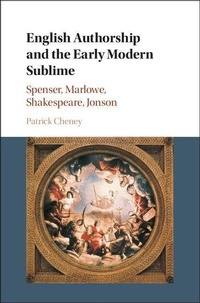
English Authorship and the Early Modern Sublime
Spenser, Marlowe, Shakespeare, Jonson
Published on 29. March 2018
Book
Hardback
328 pages
978-1-107-04962-8 (ISBN)
Description
Patrick Cheney's new book places the sublime at the heart of poems and plays in late sixteenth- and early seventeenth-century England. Specifically, Cheney argues for the importance of an 'early modern sublime' to the advent of modern authorship in Spenser, Marlowe, Shakespeare, and Jonson. Chapters feature a model of creative excellence and social liberty that helps explain the greatness of the English Renaissance. Cheney's argument revises the received wisdom, which locates the sublime in the eighteenth-century philosophical 'subject'. The book demonstrates that canonical works like The Faerie Queene and King Lear reinvent sublimity as a new standard of authorship. This standard emerges not only in rational, patriotic paradigms of classical and Christian goodness but also in the eternizing greatness of the author's work: free, heightened, ecstatic. Playing a centralizing role in the advent of modern authorship, the early modern sublime becomes a catalyst in the formation of an English canon.
Reviews / Votes
'A remarkable and important study that not only provides the missing link in the history of the sublime, but also redirects the reader towards what is truly great about the literature we read, study, and teach, and why. It is an extraordinarily ambitious project: the work maintains an intellectual focus, energy, and generosity throughout that explains and actually exemplifies the sublime.' Catherine Bates, University of Warwick 'In English Authorship and the Early Modern Sublime, Cheney ... asserts that the early modern era functions as a crucial link in understanding the sublime. Recommended.' K. K. Smith, Choice 'Patrick Cheney, observing a resurgence of interest in the idea of the sublime, has contributed an original and persuasive book on this subject ... The book meticulously catalogs and analyzes uses of the word sublime throughout the period.' Richard F. Hardin, Renaissance QuarterlyMore details
Language
English
Place of publication
Cambridge
United Kingdom
Target group
Professional and scholarly
College/higher education
Illustrations
2 Halftones, black and white
Dimensions
Height: 235 mm
Width: 157 mm
Thickness: 22 mm
Weight
630 gr
ISBN-13
978-1-107-04962-8 (9781107049628)
Copyright in bibliographic data and cover images is held by Nielsen Book Services Limited or by the publishers or by their respective licensors: all rights reserved.
Schweitzer Classification
Other editions
Additional editions
Book
06/2022
Cambridge University Press
€37.10
Shipment within 15-20 days
E-Book
03/2018
Cambridge University Press
€73.99
Available for download
E-Book
03/2018
Cambridge University Press
€88.99
Available for download
Person
Patrick Cheney is Edwin Erle Sparks Professor of English and Comparative Literature at Pennsylvania State University. He is the author of seven monographs and the editor of eleven collections, as well as the editor of poems by Spenser, Marlowe, and Shakespeare. A recipient of the Faculty Scholar Medal from Pennsylvania State University and the Distinguished Alumni Award from the University of Montana, Cheney has been a Visiting Research Fellow at Merton College, Oxford, and a Visiting Fellow at All Souls College, Oxford. Currently, he is General Editor of the 14-volume Oxford History of Poetry in English.
Content
Acknowledgements; Note on texts and references; Illustrations; Introduction: authorship and sublimity; 1. Citizenship and Godhood: a historical aesthetics of the sublime image, longinus to lyotard; 2. Spenser's sublime career; 3. Fictions of transport: Spenser's heroic sublime; 4. Tragedy and transport: Phantasia in Marlowe's poems and plays; 5. 'A world of figures': the Shakespearean sublime; 6. The sublime wit of Ben Jonson; Afterword: 'the Aonian mount': sublimity, eloquence, canonicity; Works cited; Index.