


European Democracy as Demoi-cracy
1st Edition
Published on 7. June 2017
Book
Paperback/Softback
170 pages
978-1-138-08284-7 (ISBN)
Description
Whereas 'democracy' assumes a single demos or people, 'demoi-cracy' refers to democratic government and governance in a polity constituted by separate peoples. Since the European Union consists of many demoi with different collective identities, largely separate public spheres, and a predominantly national political infrastructure, demoi-cracy is an appropriate standard for the analysis and evaluation of democracy in the EU. In its vertical dimension, demoi-cracy is based on the equality and interaction of citizens' and statespeoples' representatives in the making of common policies. Horizontally, it seeks to balance equal transnational rights of citizens with national policy-making autonomy.
This volume offers exemplary studies exploring the potential for and the workings of demoi-cracy in the EU across a broad range of institutions and issues in both its vertical and horizontal dimensions. In particular, the contributions address the following questions: Is demoi-cracy relevant to citizen attitudes and public discourse on the EU's legitimacy? How do national and supranational democratic institutions interact? Do the EU's modes of governance, such as regulation through agencies, mutual recognition, and the open method of coordination, meet demoi-cratic expectations?
This book was originally published as a special issue of the Journal of European Public Policy.
This volume offers exemplary studies exploring the potential for and the workings of demoi-cracy in the EU across a broad range of institutions and issues in both its vertical and horizontal dimensions. In particular, the contributions address the following questions: Is demoi-cracy relevant to citizen attitudes and public discourse on the EU's legitimacy? How do national and supranational democratic institutions interact? Do the EU's modes of governance, such as regulation through agencies, mutual recognition, and the open method of coordination, meet demoi-cratic expectations?
This book was originally published as a special issue of the Journal of European Public Policy.
More details
Series
Language
English
Place of publication
London
United Kingdom
Publishing group
Taylor & Francis Ltd
Target group
College/higher education
Postgraduate and Undergraduate
Dimensions
Height: 234 mm
Width: 156 mm
Thickness: 10 mm
Weight
272 gr
ISBN-13
978-1-138-08284-7 (9781138082847)
Copyright in bibliographic data and cover images is held by Nielsen Book Services Limited or by the publishers or by their respective licensors: all rights reserved.
Schweitzer Classification
Other editions
Additional editions
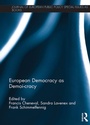
Francis Cheneval | Sandra Lavenex | Frank Schimmelfennig
European Democracy as Demoi-cracy
E-Book
10/2017
1st Edition
Routledge
€69.99
Available for download
Francis Cheneval | Sandra Lavenex | Frank Schimmelfennig
European Democracy as Demoi-cracy
E-Book
10/2017
1st Edition
Routledge
€69.99
Available for download

Francis Cheneval | Sandra Lavenex | Frank Schimmelfennig
European Democracy as Demoi-cracy
Book
05/2015
1st Edition
Routledge
€205.90
Shipment within 10-20 days
Persons
Francis Cheneval is Professor of Political Philosophy at the University of Zurich, Switzerland.
Sandra Lavenex is Professor of International Relations at the University of Lucerne, Switzerland.
Frank Schimmelfennig is Professor of European Politics at ETH Zurich, Switzerland.
Sandra Lavenex is Professor of International Relations at the University of Lucerne, Switzerland.
Frank Schimmelfennig is Professor of European Politics at ETH Zurich, Switzerland.
Content
1. Demoi-cracy in the European Union: Principles, Institutions, Policies 2. Demoi-cratic citizenship in Europe: an impossible ideal? 3. Stuck on the Rubicon? The Resonance of the Idea of Demoi-cracy in Media Debates on EU Legitimacy 4. Union Citizenship as a Demoi-cratic Institution: Increasing the EU's Subjective Legitimacy through Supranational Citizenship? 5. Parliamentary Co-Evolution: National Parliamentary Reactions to the Empowerment of the European Parliament 6. European Union Agencies and their Management Boards: an Assessment of Accountability and Demoi-cratic Legitimacy 7. Squaring the Circle with Mutual Recognition? Demoi-cratic Governance in Practice 8. Open Method of Coordination for Demoi-cracy? Standards and Purposes 9. Epilogue: The Challenge of European Demoi-cratization