

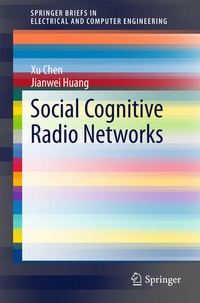
Social Cognitive Radio Networks
Published on 28. January 2015
Book
Paperback/Softback
XI, 83 pages
978-3-319-15214-1 (ISBN)
Description
This brief presents research results on social cognitive radio networks, a transformational and innovative networking paradigm that promotes the nexus between social interactions and cognitive radio networks. Along with a review of the research literature, the text examines the key motivation and challenges of social cognitive radio network design. Three socially inspired distributed spectrum sharing mechanisms are introduced: adaptive channel recommendation mechanism, imitation-based social spectrum sharing mechanism, and evolutionarily stable spectrum access mechanism. The brief concludes with a discussion of future research directions which ascertains that exploiting social interactions for distributed spectrum sharing will advance the state-of-the-art of cognitive radio network design, spur a new line of thinking for future wireless networks, and enable novel wireless service and applications.
More details
Series
Edition
2015 ed.
Language
English
Place of publication
Cham
Switzerland
Publishing group
Springer International Publishing
Target group
Professional and scholarly
Research
Illustrations
32 s/w Abbildungen
XI, 83 p. 32 illus.
Dimensions
Height: 235 mm
Width: 155 mm
Thickness: 6 mm
Weight
160 gr
ISBN-13
978-3-319-15214-1 (9783319152141)
DOI
10.1007/978-3-319-15215-8
Schweitzer Classification
Other editions
Additional editions
Xu Chen | Jianwei Huang
Social Cognitive Radio Networks
E-Book
01/2015
1st Edition
Springer
€53.49
Available for download
Persons
Sen Lin, Ph.D., is an Assistant Professor in the Department of Computer Science at the University of Houston. He received his Ph.D. degree from Arizona State University, M.S. from HKUST and B.E. from Zhejiang University. His research interests broadly fall in the intersection of machine learning and wireless networking. Currently, his research focuses on developing algorithms and theories in continual learning, meta-learning, reinforcement learning, adversarial machine learning and bilevel optimization, with applications in multiple domains, e.g., edge computing, security, network control.
Zhi Zhou, Ph.D., is an Associate Professor in the School of Computer Science and Engineering at Sun Yat-sen University. He earned his B.S., M.E., and Ph.D. degrees from Huazhong University of Science and Technology. His primary research interests encompass cloud computing, edge computing, and distributed systems.
Zhaofeng Zhang, Ph.D., isa Postdoctoral Researcher at School of Computing and Augmented Intelligence at Arizona State University. He received his B.Eng. degree in Electrical Engineering from Huazhong University of Science and Technology. He received his M.S. and Ph.D. degree in Electrical Engineering from Arizona State University. His research interests include edge computing, statistical machine learning, deep learning, and optimization.
Xu Chen, Ph.D., is a Full Professor and Assistant Dean at the School of Computer Science and Engineering at Sun Yat-sen University. He received his Ph.D. in Information Engineering from The Chinese University of Hong Kong. His research interests include edge computing, AI for networking, game theory, deep learning, and dynamic optimization.
Junshan Zhang, Ph.D. is a Professor in the Electrical and Computer Engineering Department at the University of California, Davis. He received his Ph.D. from the School of ECE at Purdue University. His research interests fall in the general field of information networks and data science, including edge intelligence, reinforcement learning, continual learning, network optimization and control, and game theory, with applications in connected and automated vehicles, 5G and beyond, wireless networks, IoT data privacy/security, and smart grid.
Content
Overview.- Adaptive Channel Recommendation Mechanism.- Imitative Spectrum Access Mechanism.- Evolutionarily Stable Spectrum Access Mechanism.- Conclusion.