

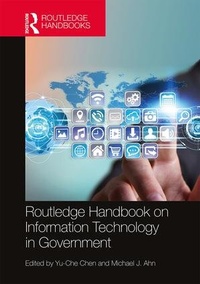
Routledge Handbook on Information Technology in Government
1st Edition
Published on 24. February 2017
Book
Hardback
416 pages
978-1-138-92567-0 (ISBN)
Description
The explosive growth in information technology has ushered in unparalleled new opportunities for advancing public service. Featuring 24 chapters from foremost experts in the field of digital government, this Handbook provides an authoritative survey of key emerging technologies, their current state of development and use in government, and insightful discussions on how they are reshaping and influencing the future of public administration. This Handbook explores:
Key emerging technologies (i.e., big data, social media, Internet of Things (IOT), GIS, smart phones & mobile technologies) and their impacts on public administration
The impacts of the new technologies on the relationships between citizens and their governments with the focus on collaborative governance
Key theories of IT innovations in government on the interplay between technological innovations and public administration
The relationship between technology and democratic accountability and the various ways of harnessing the new technologies to advance public value
Key strategies and conditions for fostering success in leveraging technological innovations for public service
This Handbook will prove to be an invaluable guide and resource for students, scholars and practitioners interested in this growing field of technological innovations in government.
Key emerging technologies (i.e., big data, social media, Internet of Things (IOT), GIS, smart phones & mobile technologies) and their impacts on public administration
The impacts of the new technologies on the relationships between citizens and their governments with the focus on collaborative governance
Key theories of IT innovations in government on the interplay between technological innovations and public administration
The relationship between technology and democratic accountability and the various ways of harnessing the new technologies to advance public value
Key strategies and conditions for fostering success in leveraging technological innovations for public service
This Handbook will prove to be an invaluable guide and resource for students, scholars and practitioners interested in this growing field of technological innovations in government.
Reviews / Votes
'IT remains underemphasized in government. Finally, an invaluable source taking a comprehensive view on this topic. Governments are information intensive by nature. This book contains amazing insights from theory, stories and cases. IT is at the very heart of government functioning. Advancing this requires combining theoretical and practical insights which are covered in this book.' - Marijn Janssen, Delft University of Technology'Ubiquitous computing means the transformation of government for the information age. This volume brings together a wide range of expert research and reflections on innovative practice across the spectrum of digital government. It covers issues from smart cities to emergency management, from citizen participation to hacking, and includes conceptual frameworks as well as detailed case studies. It brings the reader a bird's eye view of the current state of play regarding information technology in government. Every serious researcher will want to consult this volume'. - Jane Fountain, University of Massachusetts Amherst and National Center for Digital Government 'IT remains underemphasized in government. Finally, an invaluable source taking a comprehensive view on this topic. Governments are information intensive by nature. This book contains amazing insights from theory, stories and cases. IT is at the very heart of government functioning. Advancing this requires combining theoretical and practical insights which are covered in this book.' - Marijn Janssen, Delft University of Technology
'Ubiquitous computing means the transformation of government for the information age. This volume brings together a wide range of expert research and reflections on innovative practice across the spectrum of digital government. It covers issues from smart cities to emergency management, from citizen participation to hacking, and includes conceptual frameworks as well as detailed case studies. It brings the reader a bird's eye view of the current state of play regarding information technology in government. Every serious researcher will want to consult this volume'. - Jane Fountain, University of Massachusetts Amherst and National Center for Digital Government
'In summary, I find this book very informative. It includes many topical subjects that simply are not found in most books. This book provides an excellent overall summary, and compiles a lot of world-class thinking about delivering information technology in to governments. For that reason is an excellent reference in addition to being a high quality text useful for civic and government studies where technology and techno-social issues are being discussed. This book can serve as the basis for beginning many discussions and for providing training and education in government information technology needs and approaches. In my view, this is essential reading and readers will learn a lot from it.' - Jeff Thurston, 3D Visualization World Magazine
More details
Language
English
Place of publication
London
United Kingdom
Publishing group
Taylor & Francis Ltd
Target group
College/higher education
Postgraduate and Undergraduate
Illustrations
36 s/w Abbildungen, 2 s/w Photographien bzw. Rasterbilder, 34 s/w Zeichnungen, 49 s/w Tabellen
49 Tables, black and white; 34 Line drawings, black and white; 2 Halftones, black and white; 36 Illustrations, black and white
Dimensions
Height: 254 mm
Width: 178 mm
Weight
858 gr
ISBN-13
978-1-138-92567-0 (9781138925670)
Copyright in bibliographic data and cover images is held by Nielsen Book Services Limited or by the publishers or by their respective licensors: all rights reserved.
Schweitzer Classification
Other editions
Additional editions
Yu-Che Chen | Michael J. Ahn
Routledge Handbook on Information Technology in Government
Book
12/2019
1st Edition
Routledge
€69.70
Shipment within 15-20 days
Yu-Che Chen | Michael J. Ahn
Routledge Handbook on Information Technology in Government
E-Book
02/2017
Routledge
€64.49
Available for download
Yu-Che Chen | Michael J. Ahn
Routledge Handbook on Information Technology in Government
E-Book
02/2017
Routledge
€64.49
Available for download
Persons
Yu-Che Chen is the director of the Global Digital Governance Lab and associate professor of digital governance in the School of Public Administration at University of Nebraska at Omaha. His current research interests are collaborative digital governance, big data analytics, cyberinfrastructure, smart city, and digital government performance.
Michael J. Ahn is an assistant professor of public policy and public affairs in UMass Boston's McCormack Graduate School of Policy and Global Studies. His research interests include: digital government, technological innovations in government, public policy communication, and public affairs education. Michael's current research projects on digital government focus on topics such as civic technology, smart city, technology-enabled government call centers, social media use in government, and the effectiveness of IT training in public administration programs.
Michael J. Ahn is an assistant professor of public policy and public affairs in UMass Boston's McCormack Graduate School of Policy and Global Studies. His research interests include: digital government, technological innovations in government, public policy communication, and public affairs education. Michael's current research projects on digital government focus on topics such as civic technology, smart city, technology-enabled government call centers, social media use in government, and the effectiveness of IT training in public administration programs.
Content
Introduction
Chapter 1: The Promises and Opportunities of Information Technology in Government
Section I: Theories of Information Technology (IT) Innovations in Government
Chapter 2: Transforming Government Services over Time: Meanings, Impacts, and Implications for Citizen - Government Relationships
Chapter 3: Information Policies: Value-oriented, Instrumental and Managerial Choices for Governing an Information Society
Chapter 4: An Integrative Framework for Effective Use of Information and Communication Technologies (ICTs) for Collaborative Public Service Networks
Chapter 5: Using System Dynamics for the Analysis of Complex Social Problems and Public Policy Alternatives: Fundamentals and Recommendations
Section II: Emerging Technologies and Their Applications for Government
Chapter 6: Big data and local performance management: the Experience of Kansas City, Missouri
Chapter 7: Mobile Location Based Service (LBS) Apps for Public Sector: Prospects and Challenges
Chapter 8: Internet of Things for Public Service: Innovative Practice in China
Chapter 9: Big Data Analysis on Public Opinion: A Case Study on the Policy Formation of Free Economic Pilot Zones in Taiwan
Section III: Technology-enabled Cross-boundary Collaboration and Governance
Chapter 10: Citizen Trust in Government as a Two-way Process: The Role of Government Performance, E-Government and Citizen Attributes
Chapter 11: Social Media Communication Modes in Government
Chapter 12: Resident-Government Engagement via New Technologies
Chapter 13: Civic Hacking: Citizens Creating New Digital Government Interfaces
Section IV: Advancement of Democratic Accountability and Public Values
Chapter 14: Catching On and Catching Up: Developments and Challenges in E-Participation in Major U.S. Cities
Chapter 15: Navigating the Open Government Comfort Zone for the Effective Use of Open Data
Chapter 16: Technology, Transparency, and Local Government: Assessing the Opportunities and Challenges
Chapter 17: Protection of Personally Identifiable Information in Government: A Survey of US Regulatory Framework and Emerging Technological Challenges
Chapter 18: An Exploratory Study of E-participation Technology Adoption by Citizens
Section V: Advancement of Public Service through Technological Innovations
Chapter 19: Providing Critical Emergency Communications via Social Media Platforms: Multiple Case Study
Chapter 20: An Analysis of Main Attributes for Governance in Smart Cities
Chapter 21: Cyberinfrastructure for Collaborative Scientific Networks: Institutional Design and Management Strategies
Chapter 22: E-Government in China
Chapter 23: E-government Innovations in South Korea: Lessons from the Leading E-government Nation
Conclusion
Chapter 24: Conclusion - The Future of Information Technology and Government
Chapter 1: The Promises and Opportunities of Information Technology in Government
Section I: Theories of Information Technology (IT) Innovations in Government
Chapter 2: Transforming Government Services over Time: Meanings, Impacts, and Implications for Citizen - Government Relationships
Chapter 3: Information Policies: Value-oriented, Instrumental and Managerial Choices for Governing an Information Society
Chapter 4: An Integrative Framework for Effective Use of Information and Communication Technologies (ICTs) for Collaborative Public Service Networks
Chapter 5: Using System Dynamics for the Analysis of Complex Social Problems and Public Policy Alternatives: Fundamentals and Recommendations
Section II: Emerging Technologies and Their Applications for Government
Chapter 6: Big data and local performance management: the Experience of Kansas City, Missouri
Chapter 7: Mobile Location Based Service (LBS) Apps for Public Sector: Prospects and Challenges
Chapter 8: Internet of Things for Public Service: Innovative Practice in China
Chapter 9: Big Data Analysis on Public Opinion: A Case Study on the Policy Formation of Free Economic Pilot Zones in Taiwan
Section III: Technology-enabled Cross-boundary Collaboration and Governance
Chapter 10: Citizen Trust in Government as a Two-way Process: The Role of Government Performance, E-Government and Citizen Attributes
Chapter 11: Social Media Communication Modes in Government
Chapter 12: Resident-Government Engagement via New Technologies
Chapter 13: Civic Hacking: Citizens Creating New Digital Government Interfaces
Section IV: Advancement of Democratic Accountability and Public Values
Chapter 14: Catching On and Catching Up: Developments and Challenges in E-Participation in Major U.S. Cities
Chapter 15: Navigating the Open Government Comfort Zone for the Effective Use of Open Data
Chapter 16: Technology, Transparency, and Local Government: Assessing the Opportunities and Challenges
Chapter 17: Protection of Personally Identifiable Information in Government: A Survey of US Regulatory Framework and Emerging Technological Challenges
Chapter 18: An Exploratory Study of E-participation Technology Adoption by Citizens
Section V: Advancement of Public Service through Technological Innovations
Chapter 19: Providing Critical Emergency Communications via Social Media Platforms: Multiple Case Study
Chapter 20: An Analysis of Main Attributes for Governance in Smart Cities
Chapter 21: Cyberinfrastructure for Collaborative Scientific Networks: Institutional Design and Management Strategies
Chapter 22: E-Government in China
Chapter 23: E-government Innovations in South Korea: Lessons from the Leading E-government Nation
Conclusion
Chapter 24: Conclusion - The Future of Information Technology and Government