

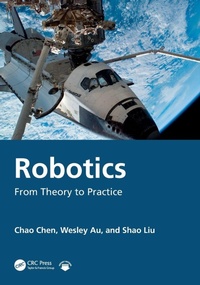
Robotics
From Theory to Practice
1st Edition
Published on 29. June 2025
Book
Paperback/Softback
438 pages
978-1-041-01323-5 (ISBN)
Description
Robotics: From Theory to Practice introduces robotic theories and technologies to audiences, including university students, professionals with engineering backgrounds, and even high-school students interested in building their own robots. We aim to bridge the gap between classic theories and real-world applications of robotic manipulators, which, to date, have far exceeded the domain of conventional industry.
The contents are divided into three parts. The first two cover classic theories of robotics, including kinematics, dynamics, path planning, control, and programming. Specifically, Part I is an introduction targeting junior students, featuring more simplistic topics and examples. Part II provides the senior students and professionals with more in-depth discussions on critical topics and more comprehensive examples. In Part III, we demonstrate how classic robotics theory can be extended to more advanced theoretical frameworks and adopted in real-world applications beyond conventional industries.
This textbook is valuable to broad readers, including those who have limited background in general engineering and wish to explore non-conventional applications of robotic manipulators. The scaffolded contents from Part I to Part III are created to lower the prerequisites and smooth the learning curve.
The contents are divided into three parts. The first two cover classic theories of robotics, including kinematics, dynamics, path planning, control, and programming. Specifically, Part I is an introduction targeting junior students, featuring more simplistic topics and examples. Part II provides the senior students and professionals with more in-depth discussions on critical topics and more comprehensive examples. In Part III, we demonstrate how classic robotics theory can be extended to more advanced theoretical frameworks and adopted in real-world applications beyond conventional industries.
This textbook is valuable to broad readers, including those who have limited background in general engineering and wish to explore non-conventional applications of robotic manipulators. The scaffolded contents from Part I to Part III are created to lower the prerequisites and smooth the learning curve.
Reviews / Votes
"The authors very clearly and comprehensively present the fundamentals of robotics, with an emphasis on thorough understanding and rigorous - yet accessible - mathematical support. The book contains many illustrative examples that will guide the readers through the learning journey. An outstanding text for anyone interested in robotics."Clement Gosselin, Universite Laval, Quebec, Canada
"The contributors are experienced scholars in the field. The book will be greatly valuable to grad students, researchers, and practitioners."
Yu Sun, University of Toronto, Ontario, Canada
"This book is an indispensable resource for a wide range of readers, from those seeking to conduct their first robotics project to those who desire to deepen their understanding of robotic theories and practical implementation. The author's clear and concise presentation of classic robotics theories lays a solid groundwork for readers with minimum prerequisite knowledge. The inclusion of case studies on real-world robots of medical, agricultural, and soft robots further illustrates the book's core concepts in action of effectively bridging the gap between theoretical understanding and practical application in robotics."
Jian Dai, King's college London, UK
More details
Language
English
Place of publication
London
United Kingdom
Publishing group
Taylor & Francis Ltd
Target group
College/higher education
Professional and scholarly
Professional Training, Undergraduate Advanced, and Undergraduate Core
Illustrations
38 s/w Tabellen, 252 s/w Abbildungen, 22 s/w Photographien bzw. Rasterbilder, 230 s/w Zeichnungen
38 Tables, black and white; 230 Line drawings, black and white; 22 Halftones, black and white; 252 Illustrations, black and white
Dimensions
Height: 254 mm
Width: 178 mm
Thickness: 25 mm
Weight
858 gr
ISBN-13
978-1-041-01323-5 (9781041013235)
Copyright in bibliographic data and cover images is held by Nielsen Book Services Limited or by the publishers or by their respective licensors: all rights reserved.
Schweitzer Classification
Other editions
Additional editions
E-Book
06/2025
1st Edition
CRC Press
€68.49
Available for download
E-Book
06/2025
1st Edition
CRC Press
€68.49
Available for download
Book
06/2025
1st Edition
CRC Press
€132.00
Shipment within 15-20 days
Persons
Chao Chen is the Director of the Laboratory of Motion Generation and Analysis (LMGA), the Academic Supervisor of the Monash Nova Rover Team, and was the Course Director of Robotics and Mechatronics in the Department of Mechanical and Aerospace Engineering at Monash University. His research in robotics was well recognised by a number of awards including Excellence Award of Project of Year 2023 for his harvesting robot by Engineers Australia (Victoria).
Wesley Au is a robotics and automation research engineer at Boeing Research and Technology Australia, designing advanced production systems for the automation of precise and high-rate manufacturing in the aerospace industry. He has a strong background in robotics, especially in intelligent path planning within complex and dynamic workspaces.
Shao Liu is a research fellow in the LMGA at Monash University. He has extensive expertise in robotic design, modelling, and analysis, and has conducted a number of research projects and industry projects in medical robots, manufacturing robots, and special-purpose robots.
Wesley Au is a robotics and automation research engineer at Boeing Research and Technology Australia, designing advanced production systems for the automation of precise and high-rate manufacturing in the aerospace industry. He has a strong background in robotics, especially in intelligent path planning within complex and dynamic workspaces.
Shao Liu is a research fellow in the LMGA at Monash University. He has extensive expertise in robotic design, modelling, and analysis, and has conducted a number of research projects and industry projects in medical robots, manufacturing robots, and special-purpose robots.
Content
Contents
Dedications
Preface
Glossary
I. Basics of Robotics
1. Introduction
2. Planar Kinetics, Velocity, And Statics
3. Trajectory Generation
4. Control Schemes
II. Key Topics
5. General Rotations and Transformations
6. Forward Kinematics
7. Inverse Kinematics
8. Jacobian Analysis
9. Path Planning
10. Programming
11. Lagrangian Dynamics
12. Newton-Euler Dynamics
13. Joint Control
14. Computed Torque Control
15. Force Control
III. Advanced Analysis and Case Studies
16. Mobility Analysis
17. Orientation Workspace
18. Constraint Analysis for Underactuated Systems
19. Concentric Tube Robot
20. Path Planning of Parallel Manipulators
21. Minimally-Invasive Surgical Robot with Remote Centre of Motion
22. MARS: The Monash Apple Retrieving System
IV. Appendix
23. Appendices for Chapter 5
24. Appendices for Chapter 8
25. Appendices for Chapter 11
Index
Dedications
Preface
Glossary
I. Basics of Robotics
1. Introduction
2. Planar Kinetics, Velocity, And Statics
3. Trajectory Generation
4. Control Schemes
II. Key Topics
5. General Rotations and Transformations
6. Forward Kinematics
7. Inverse Kinematics
8. Jacobian Analysis
9. Path Planning
10. Programming
11. Lagrangian Dynamics
12. Newton-Euler Dynamics
13. Joint Control
14. Computed Torque Control
15. Force Control
III. Advanced Analysis and Case Studies
16. Mobility Analysis
17. Orientation Workspace
18. Constraint Analysis for Underactuated Systems
19. Concentric Tube Robot
20. Path Planning of Parallel Manipulators
21. Minimally-Invasive Surgical Robot with Remote Centre of Motion
22. MARS: The Monash Apple Retrieving System
IV. Appendix
23. Appendices for Chapter 5
24. Appendices for Chapter 8
25. Appendices for Chapter 11
Index