

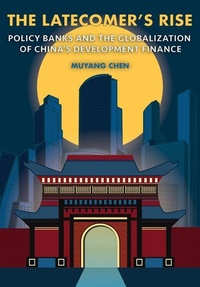
The Latecomer's Rise
Policy Banks and the Globalization of China's Development Finance
Published on 15. May 2026
Book
Paperback/Softback
240 pages
978-1-5017-8687-7 (ISBN)
Description
In The Latecomer's Rise, Muyang Chen reveals the nature and impact of a rapidly growing form of international lending: Chinese development finance.
Over the past few decades, China has become the world's largest provider of bilateral development finance. Through its two national policy banks, the China Development Bank (CDB) and the Export-Import Bank of China (China Exim), it has funded infrastructure and industrial projects in numerous emerging markets and developing countries. Yet this very surge and magnitude of capital has raised questions about the characteristics of Chinese bilateral lending and its repercussions on the international order.
Drawing on a variety of novel Chinese primary sources, including interviews and official bank documents, Chen pinpoints the distinctiveness of Chinese bilateral development finance, explains its origins, and analyzes its effects. She compares Chinese policy banks with their foreign counterparts to show that the CDB and China Exim, while state-supported, are in fact also market-oriented - they are as much government organs as they are profit-driven financial agencies that serve both state and firms' interests. This approach, which emerged out of China's particular economic history, suggests that Chinese overseas lending is not merely a tool of economic statecraft that challenges Western-led economic regimes. Instead, China's responses to extant rules, norms, and practices across given issue areas have varied between contestation and convergence.
Rich with empirical detail and penetrating insights, The Latecomer's Rise demystifies the little-known workings of Chinese development finance to revise our conceptions of China's role in the international financial system.
Over the past few decades, China has become the world's largest provider of bilateral development finance. Through its two national policy banks, the China Development Bank (CDB) and the Export-Import Bank of China (China Exim), it has funded infrastructure and industrial projects in numerous emerging markets and developing countries. Yet this very surge and magnitude of capital has raised questions about the characteristics of Chinese bilateral lending and its repercussions on the international order.
Drawing on a variety of novel Chinese primary sources, including interviews and official bank documents, Chen pinpoints the distinctiveness of Chinese bilateral development finance, explains its origins, and analyzes its effects. She compares Chinese policy banks with their foreign counterparts to show that the CDB and China Exim, while state-supported, are in fact also market-oriented - they are as much government organs as they are profit-driven financial agencies that serve both state and firms' interests. This approach, which emerged out of China's particular economic history, suggests that Chinese overseas lending is not merely a tool of economic statecraft that challenges Western-led economic regimes. Instead, China's responses to extant rules, norms, and practices across given issue areas have varied between contestation and convergence.
Rich with empirical detail and penetrating insights, The Latecomer's Rise demystifies the little-known workings of Chinese development finance to revise our conceptions of China's role in the international financial system.
Reviews / Votes
"It should be essential reading for scholars of modern China, as well as policymakers and financial practitioners seeking to understand the implications of China's rise. As China's influence in global finance grows, The Latecomer's Rise will remain a seminal text for years to come." - China Journal"The Latecomer's Rise is an excellent book that introduces the reader to China's two main policy banks active in global development: the China Development Bank (CDB) and China Exim Bank. It is a very valuable source for scholars, policymakers, business professionals, development practitioners, students, and everyone interested in China's rise." - The Review of International Organizations
"China's policy banks are distinctive in seeking to simultaneously advance public policy goals and make a profit. Conflicts arise from these mixed motives, which include underwriting infrastructure investment and financing Chinese exports but also advancing Beijing's geopolitical interests. According to Chen, China can reduce this tension by more clearly distinguishing policy and commercial lending, including by establishing separate financial accounts for the two activities." - Foreign Affairs
More details
Series
Language
English
Place of publication
Ithaca
United States
Target group
College/higher education
Product notice
Paperback (trade)
Illustrations
16 Charts - 17 Graphs
Dimensions
Height: 151 mm
Width: 229 mm
Thickness: 17 mm
Weight
368 gr
ISBN-13
978-1-5017-8687-7 (9781501786877)
Copyright in bibliographic data and cover images is held by Nielsen Book Services Limited or by the publishers or by their respective licensors: all rights reserved.
Schweitzer Classification
Other editions
Additional editions
E-Book
06/2024
Cornell University Press
€21.49
Available for download
Person
Muyang Chen is Associate Professor at Peking University's School of International Studies. She has published in World Development, International Affairs, European Journal of International Relations, and Review of International Political Economy.
Content
Introduction
1. Capitalizing Development: From Tax Revenue to Bonds
2. Debt For Growth? : The Domestic Origin of the Chinese Pathway
3. Globalizing Late Development: What Makes China's Industrial Catch-up Special?
4. The Latecomer's Challenge: China and the West
5. What's Next: China's Development Finance at a Crossroads
Conclusion
1. Capitalizing Development: From Tax Revenue to Bonds
2. Debt For Growth? : The Domestic Origin of the Chinese Pathway
3. Globalizing Late Development: What Makes China's Industrial Catch-up Special?
4. The Latecomer's Challenge: China and the West
5. What's Next: China's Development Finance at a Crossroads
Conclusion