

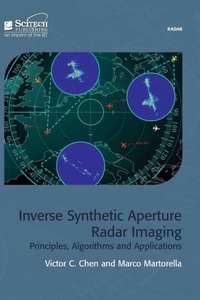
Inverse Synthetic Aperture Radar Imaging
Principles, algorithms and applications
Published on 1. September 2014
Book
Hardback
304 pages
978-1-61353-013-9 (ISBN)
Description
Based on the authors' 20 years' research work on Inverse Synthetic Aperture Radar (ISAR) imaging of moving targets and non-cooperative target recognition, this book provides readers with knowledge of various algorithms of ISAR imaging of targets and implementation with MATLAB. It introduces basic principles of radar backscattering, radar imaging, and signal analysis. It describes the characteristics of radar returns from targets, how to produce well-focused ISAR images of moving targets, and what features that can extracted from ISAR images. Also introduced are several important algorithms for ISAR image formation, ISAR image auto-focusing, and applications of ISAR imaging to air targets, sea vessels and ground moving targets. Examples of ISAR imaging of ground moving targets, air targets, and sea vessels are discussed in detail.
Reviews / Votes
'This new text is an excellent addition to the radar literature for both students and experienced practitioners. Both Dr Chen and Prof. Martorella are mature lecturers, and this shows in the development of the algorithms from the basic physics to the advanced radar applications. Most importantly, their MATLAB code closely follows the chapters, and demystifies the science. This text can be equally used for both graduate level courses and for development of radar applications in industry.' -- Mark E. Davis, Life Fellow IEEEMore details
Series
Language
English
Place of publication
New York
United States
Target group
College/higher education
Professional and scholarly
Product notice
sewn/stitched
Cloth over boards
Dimensions
Height: 257 mm
Width: 178 mm
Thickness: 23 mm
Weight
771 gr
ISBN-13
978-1-61353-013-9 (9781613530139)
Copyright in bibliographic data and cover images is held by Nielsen Book Services Limited or by the publishers or by their respective licensors: all rights reserved.
Schweitzer Classification
Other editions
Additional editions
Victor C. Chen | Marco Martorella
Inverse Synthetic Aperture Radar Imaging
Principles, algorithms and applications
E-Book
09/2014
1st Edition
SciTech Publishing Inc
€151.79
Available for download
Persons
Victor C. Chen is internationally recognized for his work on radar micro-Doppler signatures and timefrequency analysis. Dr. Chen received a Ph.D. in Electrical Engineering from Case Western Reserve University, Ohio. Since 1982, he has worked with several companies in the United States and the Radar Division at the U.S. Naval Research Laboratory in Washington, D.C. He has worked on ISAR imaging, time-frequency analysis for radar signal and imaging, and radar micro-Doppler signature analysis. He has published more than 150 papers in journals and proceedings. He has authored, co-authored, and edited several books, including Time-Frequency Transforms for Radar Imaging and Signal Analysis (Artech House, 2002) and The micro-Doppler Effect in Radar (Artech House, 2011). Dr. Chen is a Fellow of the Institute of Electrical and Electronics Engineers.
Marco Martorella is a Professor at the Department of Information Engineering of the University of Pisa and an external Professor at the University of Cape Town where he leads lectures on high resolution and imaging radar within the Masters in Radar and Electronic Defence course. He is author of more than 120 international journal and conference papers and three book chapters. He has presented several tutorials and short courses on ISAR at international radar conferences and in several research institutions in US, Australia, South Africa and Europe. He is a member of the IET Radar Sonar and Navigation Editorial Board and chair of the NATO SET-196 on multichannel/multistatic radar imaging of noncooperative targets. He has been recipient of the IEEE 2013 Fred Nathanson Memorial Radar Award.
Marco Martorella is a Professor at the Department of Information Engineering of the University of Pisa and an external Professor at the University of Cape Town where he leads lectures on high resolution and imaging radar within the Masters in Radar and Electronic Defence course. He is author of more than 120 international journal and conference papers and three book chapters. He has presented several tutorials and short courses on ISAR at international radar conferences and in several research institutions in US, Australia, South Africa and Europe. He is a member of the IET Radar Sonar and Navigation Editorial Board and chair of the NATO SET-196 on multichannel/multistatic radar imaging of noncooperative targets. He has been recipient of the IEEE 2013 Fred Nathanson Memorial Radar Award.
Content
Chapter 1: Introduction to ISAR Imaging
Chapter 2: Basic Principles of ISAR Imaging
Chapter 3: ISAR Image Formation
Chapter 4: ISAR Motion Compensation
Chapter 5: ISAR Autofocus Algorithms
Chapter 6: Signal Processing Issues in ISAR Imaging
Chapter 7: ISAR Target Feature Extraction
Chapter 8: ISAR Imaging for Refocusing Moving Targets in SAR Images
Chapter 9: FMCW ISAR
Chapter 10: Bistatic ISAR
Chapter 11: Polarimetric ISAR
Chapter 12: Applications of ISAR Imaging
Chapter 2: Basic Principles of ISAR Imaging
Chapter 3: ISAR Image Formation
Chapter 4: ISAR Motion Compensation
Chapter 5: ISAR Autofocus Algorithms
Chapter 6: Signal Processing Issues in ISAR Imaging
Chapter 7: ISAR Target Feature Extraction
Chapter 8: ISAR Imaging for Refocusing Moving Targets in SAR Images
Chapter 9: FMCW ISAR
Chapter 10: Bistatic ISAR
Chapter 11: Polarimetric ISAR
Chapter 12: Applications of ISAR Imaging