

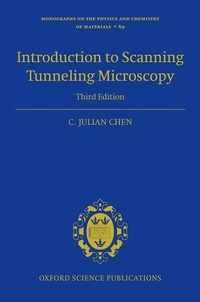
Introduction to Scanning Tunneling Microscopy Third Edition
3rd Edition
Published on 30. March 2021
Book
Hardback
492 pages
978-0-19-885655-9 (ISBN)
Description
The scanning tunnelling microscope (STM) was invented by Binnig and Rohrer and received a Nobel Prize of Physics in 1986. Together with the atomic force microscope (AFM), it provides non-destructive atomic and subatomic resolution on surfaces. Especially, in recent years, internal details of atomic and molecular wavefunctions are observed and mapped with negligible disturbance. Since the publication of its first edition, this book has been the standard reference book and a graduate-level textbook educating several generations of nano-scientists. In Aug. 1992, the co-inventor of STM, Nobelist Heinrich Rohrer recommended: "The Introduction to Scanning tunnelling Microscopy by C.J. Chen provides a good introduction to the field for newcomers and it also contains valuable material and hints for the experts". For the second edition, a 2017 book review published in the Journal of Applied Crystallography said "Introduction to Scanning tunnelling Microscopy is an excellent book that can serve as a standard introduction for everyone that starts working with scanning probe microscopes, and a useful reference book for those more advanced in the field". The third edition is a thoroughly updated and improved version of the recognized "Bible" of the field.
Additions to the third edition include: theory, method, results, and interpretations of the non-destructive observation and mapping of atomic and molecular wavefunctions; elementary theory and new verifications of equivalence of chemical bond interaction and tunnelling; scanning tunnelling spectroscopy of high Tc superconductors; imaging of self-assembled organic molecules on the solid-liquid interfaces. Some key derivations are rewritten using mathematics at an undergraduate level to make it pedagogically sound.
Additions to the third edition include: theory, method, results, and interpretations of the non-destructive observation and mapping of atomic and molecular wavefunctions; elementary theory and new verifications of equivalence of chemical bond interaction and tunnelling; scanning tunnelling spectroscopy of high Tc superconductors; imaging of self-assembled organic molecules on the solid-liquid interfaces. Some key derivations are rewritten using mathematics at an undergraduate level to make it pedagogically sound.
Reviews / Votes
An excellent starting point to familiarize newcomers with the field, and an in-depth account of theoretical and practical aspects for the more experienced user. [...] Very useful as a textbook for teaching single-molecule studies, at both the beginners and the advanced level. * J. Elemans, Journal of Applied Crystallography, 2017 * One of the most authoritative volumes in the field. * Martin Castell, University of Oxford *More details
Series
Edition
3rd Revised edition
Language
English
Place of publication
Oxford
United Kingdom
Target group
College/higher education
Edition type
Revised edition
Product notice
sewn/stitched
Cloth over boards
Illustrations
275
Dimensions
Height: 236 mm
Width: 150 mm
Thickness: 23 mm
Weight
998 gr
ISBN-13
978-0-19-885655-9 (9780198856559)
Copyright in bibliographic data and cover images is held by Nielsen Book Services Limited or by the publishers or by their respective licensors: all rights reserved.
Schweitzer Classification
Other editions
Additional editions
C. Julian Chen
Introduction to Scanning Tunneling Microscopy Third Edition
E-Book
03/2021
3rd Edition
OUP eBook
€97.49
Available for download
Person
C. Julian Chen received a PhD in Physics from Columbia University in 1985, and then joined the Department of Physical Sciences of IBM Watson Research Centre. In 1993, he published Introduction to Scanning Tunnelling Microscopy, and received a National Outstanding Book Award from China in 1997. From 1993 to 2003 he joined the Department of Human Language Technology of IBM Research. In 1998 he received an Outstanding Innovation Award from IBM for inventing practical recognition technology for Chinese speech. From 2004 to 2006 he was a Guest Scientist at Hamburg University. In 2007 he joined the Department of Applied Physics and Applied Mathematics at Columbia University.
Content
1: Overview
Part 1: Principles
2: Tunneling Phenomenon
3: Tunneling Matrix Elements
4: Atomic Forces
5: Atomic Forces and Tunneling
6: Nanometer-Scale Imaging
7: Atomic-Scale Imaging
8: Imaging Wavefunctions
9: Nanomechanical Eects
Part 2: Instrumentation
10: Piezoelectric Scanner
11: Vibration Isolation
12: Electronics and Control
13: Mechanical design
14: Tip Treatment
Part 3: Related Methods
15: Scanning Tunneling Spectroscopy
16: Atomic Force Microscopy
Appendix
Appendix A: Green's Functions
Appendix B: Real Spherical Harmonics
Appendix C: Spherical Modied Bessel Functions
Appendix D: Plane Groups and Invariant Functions
Appendix E: Elementary Elasticity Theory
Part 1: Principles
2: Tunneling Phenomenon
3: Tunneling Matrix Elements
4: Atomic Forces
5: Atomic Forces and Tunneling
6: Nanometer-Scale Imaging
7: Atomic-Scale Imaging
8: Imaging Wavefunctions
9: Nanomechanical Eects
Part 2: Instrumentation
10: Piezoelectric Scanner
11: Vibration Isolation
12: Electronics and Control
13: Mechanical design
14: Tip Treatment
Part 3: Related Methods
15: Scanning Tunneling Spectroscopy
16: Atomic Force Microscopy
Appendix
Appendix A: Green's Functions
Appendix B: Real Spherical Harmonics
Appendix C: Spherical Modied Bessel Functions
Appendix D: Plane Groups and Invariant Functions
Appendix E: Elementary Elasticity Theory