

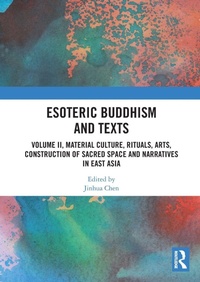
Esoteric Buddhism and Texts
Volume II, Material Culture, Rituals, Arts, Construction of Sacred Space and Narratives in East Asia
1st Edition
Published on 30. July 2025
Book
Paperback/Softback
224 pages
978-1-032-56310-7 (ISBN)
Description
This book explores trans-cultural and cross-border transformation of Esoteric Buddhism in East Asia, focusing on the significance of Esoteric Buddhism in relation to some forms of material culture, including rituals, arts, and the construction of sacred space and narratives.
In East Asia, Esoteric Buddhism's influences can be seen across all levels of society: not only in that it achieved a recognizable sectarian identity, but also because elements of esoteric teachings were absorbed by other religious schools, influencing their philosophical tenets and everyday practices. The influence was not confined to the religious sphere: scholars have been paying more and more attention to the significance of Tang Esoteric Buddhism in relation to material culture and the dissemination of Esoteric Buddhist technologies in South, Central, and East Asia. No matter how one looks at a ma??ala-an integral feature of esoteric practice-or the uncannily expressive statues of Buddhas, Bodhisattvas or Yidam that come in all shapes and sizes, or the murals that depict the variegated, mysterious themes of the esoteric tradition, one can always recognise the profound connection between art and Esoteric Buddhism. Esoteric Influences also abound in East Asian literature across different genres, displaying its unique characters both in poetry and prose. Likewise, in architecture, one can readily make out the enigmatic, colorful and distinctive elements characteristic of the esoteric tradition. Monks initiated into the esoteric lineages not only brought Buddhist classics and practices to China, but also advanced knowledge in astronomy, calendarial calculations and mathematical theories.
The chapters in this volume investigate the profound and far-reaching impacts wrought by Esoteric Buddhism on rituals, arts, and the construction of sacred space and narratives in East Asia. This book will be beneficial to advanced students and researchers interested in Religious Studies, History and Buddhist studies. It was originally published as a special issue of Studies in Chinese Religions.
In East Asia, Esoteric Buddhism's influences can be seen across all levels of society: not only in that it achieved a recognizable sectarian identity, but also because elements of esoteric teachings were absorbed by other religious schools, influencing their philosophical tenets and everyday practices. The influence was not confined to the religious sphere: scholars have been paying more and more attention to the significance of Tang Esoteric Buddhism in relation to material culture and the dissemination of Esoteric Buddhist technologies in South, Central, and East Asia. No matter how one looks at a ma??ala-an integral feature of esoteric practice-or the uncannily expressive statues of Buddhas, Bodhisattvas or Yidam that come in all shapes and sizes, or the murals that depict the variegated, mysterious themes of the esoteric tradition, one can always recognise the profound connection between art and Esoteric Buddhism. Esoteric Influences also abound in East Asian literature across different genres, displaying its unique characters both in poetry and prose. Likewise, in architecture, one can readily make out the enigmatic, colorful and distinctive elements characteristic of the esoteric tradition. Monks initiated into the esoteric lineages not only brought Buddhist classics and practices to China, but also advanced knowledge in astronomy, calendarial calculations and mathematical theories.
The chapters in this volume investigate the profound and far-reaching impacts wrought by Esoteric Buddhism on rituals, arts, and the construction of sacred space and narratives in East Asia. This book will be beneficial to advanced students and researchers interested in Religious Studies, History and Buddhist studies. It was originally published as a special issue of Studies in Chinese Religions.
More details
Language
English
Place of publication
London
United Kingdom
Publishing group
Taylor & Francis Ltd
Target group
College/higher education
Postgraduate and Undergraduate
Dimensions
Height: 246 mm
Width: 174 mm
Thickness: 13 mm
Weight
439 gr
ISBN-13
978-1-032-56310-7 (9781032563107)
Copyright in bibliographic data and cover images is held by Nielsen Book Services Limited or by the publishers or by their respective licensors: all rights reserved.
Schweitzer Classification
Other editions
Additional editions
Jinhua Chen
Esoteric Buddhism and Texts
Volume II, Material Culture, Rituals, Arts, Construction of Sacred Space and Narratives in East Asia
E-Book
02/2024
1st Edition
Taylor & Francis
€60.99
Available for download
Jinhua Chen
Esoteric Buddhism and Texts
Volume II, Material Culture, Rituals, Arts, Construction of Sacred Space and Narratives in East Asia
E-Book
02/2024
1st Edition
Taylor & Francis
€60.99
Available for download
Jinhua Chen
Esoteric Buddhism and Texts
Volume II, Material Culture, Rituals, Arts, Construction of Sacred Space and Narratives in East Asia
Book
02/2024
1st Edition
Routledge
€206.40
Shipment within 10-20 days
Person
Jinhua Chen, Fellow of Royal Society of Canada, is Professor of East Asian Religions at the University of British Columbia, Vancouver, Canada, and a Visiting Professor at several major universities, including TokyoU (2003-04) and Stanford (2012). He has published extensively on state-church relationships, monastic biographical literature, sacred sites, relic veneration, Buddhism and technology.
Content
Part 1: Mantra/Dhara?i and Esoteric Rituals 1. Image, ritual and mantra: a study on Esoteric rituals of Dipper Mother Marici 2. Chinese and Tibetan Sources on the Dhara?i in Roll Seven of the *Sura?gama-sutra 3. Interpretation of the Unique Dhara?is: focusing on the Shi Moheyan lun ????? Part 2: Esoteric Arts 4. Chinese visual texts, Japanese spatial contexts: Mandala installation and the reading of empowered space in Japan 5. Dome of Heaven: the role of esoteric Buddhism in the Hall of Heavenly Kings at Mogao 6. Images of thousand-armed and Ttousand-eyed Avalokitesvara with Cintama?icakra and Amoghapasa as attendants: references to the chanting of the 'Dabeixin Dhara?i' ?????? Part 3: Sacred Space and Narratives 7. Examining Amoghavajra's flat-earth cosmology: religious vs. scientific worldviews in Buddhist astrology 8. Ximing monastery's esoteric Buddhist traditions 9. Eison, Monkan, and the cult of founders in medieval Japan: on the construction of narrative and material selves in East Asian Buddhism