

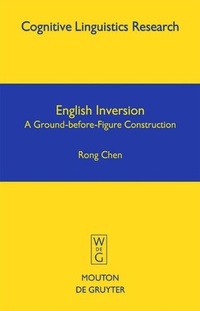
English Inversion
A Ground-before-Figure Construction
1st Edition
Published on 19. June 2003
Book
Hardback
XI, 333 pages
978-3-11-017810-4 (ISBN)
Description
The book provides an account of English inversion, a construction that displays perplexing idiosyncrasies at the level of semantics, phonology, syntax, and pragmatics. Basing his central argument on the claim that inversion is a linguistic representation of a Ground-before-Figure model, the author develops an elegant solution to a hitherto unsolved multidimensional linguistic puzzle and, in the process, supports the theoretical position that a cognitive approach best suits the multidimensionality of language itself. Engagingly written, the book will appeal to linguists of all persuasions and to any reader curious about the relationship between language and cognition.
More details
Series
Edition
Reprint 2013
Language
English
Place of publication
Berlin/Boston
Germany
Publishing group
de Gruyter Mouton
Target group
Professional and scholarly
US School Grade: College Graduate Student
Illustrations
8 Abbildungen
8 ill.
Dimensions
Height: 236 mm
Width: 160 mm
Thickness: 24 mm
Weight
673 gr
ISBN-13
978-3-11-017810-4 (9783110178104)
Schweitzer Classification
Other editions
Additional editions
E-Book
03/2013
1st Edition
De Gruyter Mouton
€129.95
Available for download
Person
Rong Chen is Professor at California State University, San Bernardino, USA.
Content
Chapter 1: Preliminaries
1. Issues of inversion
1.1. Types of inversion
1.2. Peculiarities of inversion
2. Previous research
2.1. Syntactic accounts
2.2. Functional accounts
2.3. Information packaging: Birner (1996)
2.4. Subjectivity and emotivity: Dorgeloh (1997)
3. Relevant tenets of cognitive linguistics
4. Other issues
4.1. Inversion as a construction
4.2. Data and judgment of acceptability
Chapter 2: Inversion as GbF instantiation
1. The GbF model
2. LOC BE: The prototype
2.1. LOC BE as the prototype
2.2. LOC BE as instantiation of GbF
2.3. Variations of LOC BE
3. PATH Vm: From existence to motion
3.1. PATH Vm: The central type
3.2. TEMP Vm: From space to time
4. NSPAT BE: From spatiality to nonspatiality
5. A radial classification
6. The phonology of inversion: A matter of focus
6.1. Stress
6.2. Intonation
7. GbF and information packaging: A comparison
Chapter 3: Syntactic constraints
1. Polarity
2. Transitivity
3. Embeddedness
3.1. Previous research
3.2. Embeddability
3.3. Embedded inversion
4. Auxiliaries
5. Weight
6. Summary
Chapter 4: Inversion in discourse
1. Discourse types: A tripartite
2. Inversion in description
2.1. General discussion
2.2. Ground-chaining
2.3. Center-linking
2.4. Multiple-anchoring
2.5. Other approaches
3. Inversion in narration
4. Inversion in exposition
5. Summary
6. Inversion in parody
Chapter 5: Conclusion
1. Summary
2. GbF representation in other languages
1. Issues of inversion
1.1. Types of inversion
1.2. Peculiarities of inversion
2. Previous research
2.1. Syntactic accounts
2.2. Functional accounts
2.3. Information packaging: Birner (1996)
2.4. Subjectivity and emotivity: Dorgeloh (1997)
3. Relevant tenets of cognitive linguistics
4. Other issues
4.1. Inversion as a construction
4.2. Data and judgment of acceptability
Chapter 2: Inversion as GbF instantiation
1. The GbF model
2. LOC BE: The prototype
2.1. LOC BE as the prototype
2.2. LOC BE as instantiation of GbF
2.3. Variations of LOC BE
3. PATH Vm: From existence to motion
3.1. PATH Vm: The central type
3.2. TEMP Vm: From space to time
4. NSPAT BE: From spatiality to nonspatiality
5. A radial classification
6. The phonology of inversion: A matter of focus
6.1. Stress
6.2. Intonation
7. GbF and information packaging: A comparison
Chapter 3: Syntactic constraints
1. Polarity
2. Transitivity
3. Embeddedness
3.1. Previous research
3.2. Embeddability
3.3. Embedded inversion
4. Auxiliaries
5. Weight
6. Summary
Chapter 4: Inversion in discourse
1. Discourse types: A tripartite
2. Inversion in description
2.1. General discussion
2.2. Ground-chaining
2.3. Center-linking
2.4. Multiple-anchoring
2.5. Other approaches
3. Inversion in narration
4. Inversion in exposition
5. Summary
6. Inversion in parody
Chapter 5: Conclusion
1. Summary
2. GbF representation in other languages