

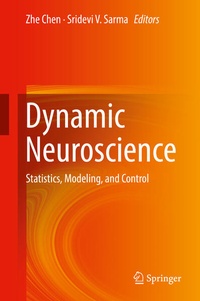
Dynamic Neuroscience
Statistics, Modeling, and Control
Published on 9. March 2018
Book
Hardback
XXI, 327 pages
978-3-319-71975-7 (ISBN)
Description
This book shows how to develop efficient quantitative methods to characterize neural data and extra information that reveals underlying dynamics and neurophysiological mechanisms. Written by active experts in the field, it contains an exchange of innovative ideas among researchers at both computational and experimental ends, as well as those at the interface. Authors discuss research challenges and new directions in emerging areas with two goals in mind: to collect recent advances in statistics, signal processing, modeling, and control methods in neuroscience; and to welcome and foster innovative or cross-disciplinary ideas along this line of research and discuss important research issues in neural data analysis. Making use of both tutorial and review materials, this book is written for neural, electrical, and biomedical engineers; computational neuroscientists; statisticians; computer scientists; and clinical engineers.
Reviews / Votes
"This is a short monograph on the computational neurosciences of single and populations of neurons. . This serves as a reference for advanced engineers and mathematical neurobiologists primarily. Dayan's Theoretical Neuroscience, and Neural Engineering by MIT Press are useful for more background material. Brain Machine and Brain-Computer interfacing is also considered here." (Joseph Grenier, Amazon.com, June, 2018)More details
Edition
2018 ed.
Language
English
Place of publication
Cham
Switzerland
Publishing group
Springer International Publishing
Target group
Professional and scholarly
Illustrations
18 s/w Abbildungen, 62 farbige Abbildungen
XXI, 327 p. 80 illus., 62 illus. in color.
Dimensions
Height: 241 mm
Width: 160 mm
Thickness: 25 mm
Weight
694 gr
ISBN-13
978-3-319-71975-7 (9783319719757)
DOI
10.1007/978-3-319-71976-4
Schweitzer Classification
Other editions
Additional editions
Book
02/2019
Springer
€171.19
Shipment within 7-9 days
E-Book
12/2017
1st Edition
Springer
€160.49
Available for download
Persons
Zhe Chen
is Assistant Professor in the Departments of Psychiatry and Neuroscience and Physiology at New York University School of Medicine, having previously worked at the RIKEN Brain Science Institute, Harvard Medical School, and Massachusetts Institute of Technology. He is a Senior Member of the IEEE, and an editorial board member of
Neural Networks
(Elsevier) and
Journal of Neural Engineering
(IOP). Professor Chen has received a number of awards including the Early Career Award from the Mathematical Biosciences Institute, and has had his work funded by the US National Science Foundation and the National Institutes of Health. He is the lead author of the book
Correlative Learning: A Basis for Brain and Adaptive Systems
(Johns & Wiley, 2007) and the editor of the book
Advanced State Space Methods for Neural and Clinical Data
(Cambridge University Press, 2015).
Sridevi Sarma is Associate Professor in the Department of Biomedical Engineering at Johns Hopkins University (JHU), having previously worked at Massachusetts Institute of Technology and Harvard Medical School. She is the Associate Director of the Institute for Computational Medicine at JHU. Professor Sarma is a recipient of the GE faculty for the future scholarship, a L'Oreal For Women in Science fellow, the Burroughs Wellcome Fund Careers at the Scientific Interface Award, the Krishna Kumar New Investigator Award from the North American Neuromodulation Society (NANS), and the Presidential Early Career Award for Scientists and Engineers (PECASE).
Sridevi Sarma is Associate Professor in the Department of Biomedical Engineering at Johns Hopkins University (JHU), having previously worked at Massachusetts Institute of Technology and Harvard Medical School. She is the Associate Director of the Institute for Computational Medicine at JHU. Professor Sarma is a recipient of the GE faculty for the future scholarship, a L'Oreal For Women in Science fellow, the Burroughs Wellcome Fund Careers at the Scientific Interface Award, the Krishna Kumar New Investigator Award from the North American Neuromodulation Society (NANS), and the Presidential Early Career Award for Scientists and Engineers (PECASE).
Content
Introduction.- Part I Statistics & Signal Processing.- Characterizing Complex, Multi-scale Neural Phenomena Using State-Space Models.- Latent Variable Modeling of Neural Population Dynamics.- What Can Trial-to-Trial Variability Tell Us? A Distribution-Based Approach to Spike Train Decoding in the Rat Hippocampus and Entorhinal Cortex.- Sparsity Meets Dynamics: Robust Solutions to Neuronal Identification and Inverse Problems.- Artifact Rejection for Concurrent TMS-EEG Data.- Part II Modeling & Control Theory.- Characterizing Complex Human Behaviors and Neural Responses Using Dynamic Models.- Brain-Machine Interfaces.- Control-theoretic Approaches for Modeling, Analyzing and Manipulating Neuronal (In)activity.- From Physiological Signals to Pulsatile Dynamics: A Sparse System Identification Approach.- Neural Engine Hypothesis.- Inferring Neuronal Network Mechanisms Underlying Anesthesia induced Oscillations Using Mathematical Models.- Epilogue.