

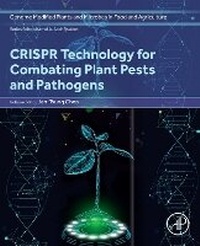
CRISPR Technology for Combating Plant Pests and Pathogens
Published on 17. September 2025
Book
Paperback/Softback
332 pages
978-0-443-43920-9 (ISBN)
Description
CRISPR Technology for Combating Plant Pests and Pathogens improves the understanding of CRISPR-mediated crop protection, presenting innovative strategies for developing disease-resistant crops that can withstand a variety of biotic stresses.
In agricultural food production, a range of stressors continues to challenge crop production globally. Fortunately, modern crop breeding approaches have developed rapidly, including the promising technology of plant genome editing. Leading to improvements in disease resilience or stress-tolerant crops, CRISPR/Cas9 is among the mainstream genome editing technologies for plant breeding precision and efficiency.
CRISPR Technology for Combating Plant Pests and Pathogens offers in-depth summaries curated by leading experts and professors in the field of agricultural biotechnology, providing the essential knowledge needed to advance research and applications in crop resilience.
In agricultural food production, a range of stressors continues to challenge crop production globally. Fortunately, modern crop breeding approaches have developed rapidly, including the promising technology of plant genome editing. Leading to improvements in disease resilience or stress-tolerant crops, CRISPR/Cas9 is among the mainstream genome editing technologies for plant breeding precision and efficiency.
CRISPR Technology for Combating Plant Pests and Pathogens offers in-depth summaries curated by leading experts and professors in the field of agricultural biotechnology, providing the essential knowledge needed to advance research and applications in crop resilience.
More details
Series
Language
English
Place of publication
San Diego
United States
Publishing group
Elsevier Science Publishing Co Inc
Target group
Professional and scholarly
Dimensions
Height: 233 mm
Width: 191 mm
Thickness: 21 mm
Weight
692 gr
ISBN-13
978-0-443-43920-9 (9780443439209)
Copyright in bibliographic data and cover images is held by Nielsen Book Services Limited or by the publishers or by their respective licensors: all rights reserved.
Schweitzer Classification
Other editions
Additional editions
Jen-Tsung Chen
CRISPR Technology for Combating Plant Pests and Pathogens
E-Book
09/2025
Elsevier
€163.99
Available for download
Person
Jen-Tsung Chen is a Professor of Cell Biology at the National University of Kaohsiung in Taiwan. He teaches cell biology, genomics, proteomics, plant physiology, and plant biotechnology. His research spans bioactive compounds, chromatography techniques, plant molecular biology and biotechnology, bioinformatics, and systems pharmacology. An active book and journal editor, he serves on editorial boards and has guest-edited special issues for several international journals. Dr. Chen has authored and edited books with international publishers on diverse topics including drug discovery, herbal medicine, medicinal biotechnology, nanotechnology, bioengineering, plant functional genomics, plant speed breeding, CRISPR-based plant genome editing, and artificial intelligence. In 2023 and 2024, he was listed by Elsevier and Stanford University among the 'World's Top 2% Scientists' and also received the Springer Nature Editor of Distinction Award in 2025.
Content
1. CRISPR/Cas systems for advancing plant disease and pest management: Advances and prospects
2. CRISPR/Cas techniques for developing biotic stress-tolerant plants: Advances, limitations, and future perspectives
3. CRISPR-edited plants for pest resistance: Methods and applications
4. CRISPR-edited plants for resistance to insect herbivores: Methods and applications
5. CRISPR-edited plants for resistance to fungal diseases: Methods and applications
6. CRISPR-edited plants for resistance to bacterial diseases: Methods and applications
7. CRISPR-edited plants for resistance to viral diseases: Methods and applications
8. CRISPR-edited plants for herbicide resistance: Methods and applications
9. CRISPR to enhance biological nitrogen fixation (BNF) and nitrogen use efficiency (NUE): Methods and applications
10. CRISPR-edited plants for enhanced secondary metabolism: Methods and applications
11. CRISPR-edited plants for disease resistance in horticultural crops: Methods and applications
12. Emerging plant CRISPR technologies for improved efficiency and reduced off-targets effects
13. Ethical, societal issues, and future challenges of plant CRISPR technologies
2. CRISPR/Cas techniques for developing biotic stress-tolerant plants: Advances, limitations, and future perspectives
3. CRISPR-edited plants for pest resistance: Methods and applications
4. CRISPR-edited plants for resistance to insect herbivores: Methods and applications
5. CRISPR-edited plants for resistance to fungal diseases: Methods and applications
6. CRISPR-edited plants for resistance to bacterial diseases: Methods and applications
7. CRISPR-edited plants for resistance to viral diseases: Methods and applications
8. CRISPR-edited plants for herbicide resistance: Methods and applications
9. CRISPR to enhance biological nitrogen fixation (BNF) and nitrogen use efficiency (NUE): Methods and applications
10. CRISPR-edited plants for enhanced secondary metabolism: Methods and applications
11. CRISPR-edited plants for disease resistance in horticultural crops: Methods and applications
12. Emerging plant CRISPR technologies for improved efficiency and reduced off-targets effects
13. Ethical, societal issues, and future challenges of plant CRISPR technologies