

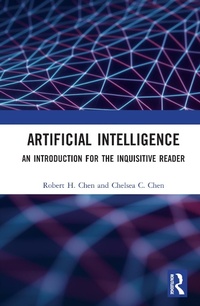
Artificial Intelligence
An Introduction for the Inquisitive Reader
1st Edition
Published on 9. June 2022
Book
Hardback
344 pages
978-1-032-10347-1 (ISBN)
Description
Artificial Intelligence: An Introduction for the Inquisitive Reader guides readers through the history and development of AI, from its early mathematical beginnings through to the exciting possibilities of its potential future applications. To make this journey as accessible as possible, the authors build their narrative around accounts of some of the more popular and well-known demonstrations of artificial intelligence including Deep Blue, AlphaGo and even Texas Hold'em, followed by their historical background, so that AI can be seen as a natural development of mathematics and computer science. As the book moves forward, more technical descriptions are presented at a pace that should be suitable for all levels of readers, gradually building a broad and reasonably deep understanding and appreciation for the basic mathematics, physics, and computer science that is rapidly developing artificial intelligence as it is today.
Features:
Only mathematical prerequisite is an elementary knowledge of calculus
Accessible to anyone with an interest in AI and its mathematics and computer science
Suitable as a supplementary reading for a course in AI or the History of Mathematics and Computer Science in regard to artificial intelligence.
Features:
Only mathematical prerequisite is an elementary knowledge of calculus
Accessible to anyone with an interest in AI and its mathematics and computer science
Suitable as a supplementary reading for a course in AI or the History of Mathematics and Computer Science in regard to artificial intelligence.
More details
Series
Language
English
Place of publication
Oxford
United Kingdom
Publishing group
Taylor & Francis Ltd
Target group
Professional and scholarly
General and Professional Practice & Development
Product notice
sewn/stitched
Cloth over boards
Illustrations
39 s/w Abbildungen, 1 s/w Photographie bzw. Rasterbild, 38 s/w Zeichnungen
38 Line drawings, black and white; 1 Halftones, black and white; 39 Illustrations, black and white
Dimensions
Height: 234 mm
Width: 156 mm
Thickness: 21 mm
Weight
676 gr
ISBN-13
978-1-032-10347-1 (9781032103471)
Copyright in bibliographic data and cover images is held by Nielsen Book Services Limited or by the publishers or by their respective licensors: all rights reserved.
Schweitzer Classification
Other editions
New editions

Robert H. Chen | Chelsea Chen
Artificial Intelligence
An Introduction to the Big Ideas and their Development
Book
09/2024
2nd Edition
Chapman & Hall/CRC
€242.50
Shipment within 10-20 days
Additional editions
Book
06/2022
1st Edition
Chapman & Hall/CRC
€47.50
Article exhausted; check for reprint
Persons
Robert H. Chen is the author of three books in English on Personal Computers, Liquid Crystal Displays, and Einstein's Relativity, and four books in Chinese on LCDs & Intellectual Property, Patents, Anglo-American Contract Law, and Technology & Copyright Law, and many scholarly articles in physics and the law. He has a Ph.D. in Space Physics and a J.D. in law and is a member of the California Bar. He divides his time between California and Taiwan with his wife and daughter.
Chelsea C. Chen graduated in physics and computer science from U.C Berkeley and is a software development engineer at a major tech company in Silicon Valley. She presently lives in Northern California.
Chelsea C. Chen graduated in physics and computer science from U.C Berkeley and is a software development engineer at a major tech company in Silicon Valley. She presently lives in Northern California.
Content
PART I: The Arrival of AI in the Human World. 1. Game-Playing. 2. Working Machines. 3. Intelligence. 4. The AI Singularity. PART II: The Artificial Intelligence Infrastructure. 5. Hardware. 6. Software. 7. Computer Communications. 8. Open Source Software. PART III: From Top to Bottom. 9. Top-Down Artificial Intelligence. 10. Bottom-Up Artificial Intelligence. 11. Machine Learning Modeling. 12. Markov Chain Monte Carlo Simulation. PART IV: Structure and Operation. 13. Artificial Neural Networks. 14. Pattern Recognition. 15. Parameterization. 16. Gradient Descent. 17. Backpropagation. 18. Convolutional Neural Networks. PART V: Progression. 19. The Cross-Entropy Cost Function. 20. Hyperparameterization. 21. Big Data. 22. Massively Parallel Processing. PART VI: Powers of Prediction. 23. Predictive Analytics. 24. Restricted Boltzmann Machine. 25. Latent Factors in Collaborative Filtering. 26. Support Vector Machines. 27. Reinforcement Learning. 28. AlphaGo and AlphaStar. 29. Game Theory. PART VII: Natural Language Processing. 30. Top-Down Speech Recognition. 31. Bottom-Up Speech Recognition. 32. Speech Synthesis. PART VIII: The Robotworld. 33. Robots at Work. 34. The Robot Millennial. 35. The Robot Future