

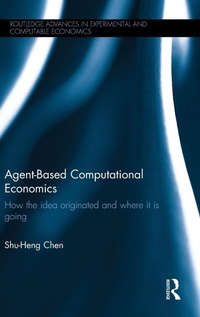
Agent-Based Computational Economics
How the idea originated and where it is going
1st Edition
Published on 24. August 2015
Book
Hardback
528 pages
978-0-415-61488-7 (ISBN)
Description
This book aims to answer two questions that are fundamental to the study of agent-based economic models: what is agent-based computational economics and why do we need agent-based economic modelling of economy? This book provides a review of the development of agent-based computational economics (ACE) from a perspective on how artificial economic agents are designed under the influences of complex sciences, experimental economics, artificial intelligence, evolutionary biology, psychology, anthropology and neuroscience.
This book begins with a historical review of ACE by tracing its origins. From a modelling viewpoint, ACE brings truly decentralized procedures into market analysis, from a single market to the whole economy. This book also reviews how experimental economics and artificial intelligence have shaped the development of ACE. For the former, the book discusses how ACE models can be used to analyse the economic consequences of cognitive capacity, personality and cultural inheritance. For the latter, the book covers the various tools used to construct artificial adaptive agents, including reinforcement learning, fuzzy decision rules, neural networks, and evolutionary computation.
This book will be of interest to graduate students researching computational economics, experimental economics, behavioural economics, and research methodology.
This book begins with a historical review of ACE by tracing its origins. From a modelling viewpoint, ACE brings truly decentralized procedures into market analysis, from a single market to the whole economy. This book also reviews how experimental economics and artificial intelligence have shaped the development of ACE. For the former, the book discusses how ACE models can be used to analyse the economic consequences of cognitive capacity, personality and cultural inheritance. For the latter, the book covers the various tools used to construct artificial adaptive agents, including reinforcement learning, fuzzy decision rules, neural networks, and evolutionary computation.
This book will be of interest to graduate students researching computational economics, experimental economics, behavioural economics, and research methodology.
Reviews / Votes
"Chen's book is a meticulous scholarly study that should be of particular interest to economists with a good analytical background, a broad acquaintance with economic research, a strong interest in empirically grounded economic modeling, and a willingness to consider alternative viewpoints with an open mind."Leigh Tesfatsion, Iowa State University, Journal of Economic Literature
More details
Series
Language
English
Place of publication
London
United Kingdom
Publishing group
Taylor & Francis Ltd
Target group
College/higher education
Illustrations
21 s/w Tabellen, 82 s/w Abbildungen, 82 s/w Zeichnungen
21 Tables, black and white; 82 Line drawings, black and white; 82 Illustrations, black and white
Dimensions
Height: 240 mm
Width: 161 mm
Thickness: 33 mm
Weight
954 gr
ISBN-13
978-0-415-61488-7 (9780415614887)
Copyright in bibliographic data and cover images is held by Nielsen Book Services Limited or by the publishers or by their respective licensors: all rights reserved.
Schweitzer Classification
Other editions
Additional editions
Book
02/2018
1st Edition
Routledge
€75.40
Shipment within 10-20 days
E-Book
09/2017
Routledge
€66.99
Available for download
E-Book
09/2017
Routledge
€67.49
Available for download
Person
Shu-Heng Chen is Distinguished Professor at the Department of Economics at National Chengchi University, Taiwan.
Content
Part I. Ideas and Structures of the Book 1. Economics in an Interdisciplinary Context 2. Agent-Based Modeling in the Social Sciences Part II. Origins of ACE 3. The Markets Origin 4. Cellular Automata 5. Economic Tournament Origin 6. Agent-Based Modeling of Economic Experiments Part III. Designing Artificial Economic Agents 7. Calibrated Artificial 8. Zero-Intelligence Agents in the DA Markets 9. Autonomous Agents in the DA Part IV. Computational Intelligence 10. Reinforcement Learning 11. Fuzzy Logic and Rough Sets 12. Artificial Neural Networks 13. Evolutionary Part V. Agent-Based Financial Markets 14. Artificial Financial Markets with Programmed Agents 15. Artificial Financial Markets with Autonomous 16. Empirically-Based Agent-Based Models Part VI. Cognitive and Psychological Agent-Based Modeling 17. Economic Significance of Personal Traits 18. Neuroeconomic 19. Cognitive Agents 20. Culturally Sensitive Agents 21. Agent-Based Lottery Market Part VII. Networks 22. Graphs and Social Part VIII. Economics of Changes 23. Agent-Based Modular Economy 24. Epilogue