

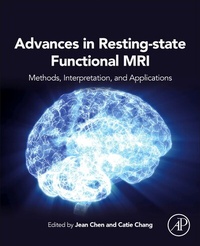
Advances in Resting-State Functional MRI
Methods, Interpretation, and Applications
Published on 30. June 2023
Book
Paperback/Softback
425 pages
978-0-323-91688-2 (ISBN)
Description
Advances in Resting-State Functional MRI: Methods, Interpretation, and Applications gives readers with basic neuroimaging experience an up-to-date and in-depth understanding of the methods, opportunities, and challenges in rs-fMRI. The book covers current knowledge gaps in rs-fMRI, including "what are biologically plausible brain networks," "how to tell what part is noise," "how to perform quality assurance on the data," "what are the spatial and temporal limits of our ability to resolve FC," and "how to best identify network features related to individual differences or disease state".
This book is an ideal reference for neuroscientists, computational neuroscientists, psychologists, biomedical engineers, physicists and medical physicists. Both new and more advanced researchers alike will be able to discover new information distilled from the past decade of research to become well-versed in rs-fMRI-related topics.
This book is an ideal reference for neuroscientists, computational neuroscientists, psychologists, biomedical engineers, physicists and medical physicists. Both new and more advanced researchers alike will be able to discover new information distilled from the past decade of research to become well-versed in rs-fMRI-related topics.
More details
Series
Language
English
Place of publication
Oxford
United Kingdom
Publishing group
Elsevier Science & Technology
Target group
Professional and scholarly
Illustrations
65 illustrations (40 in full color); Illustrations
Dimensions
Height: 235 mm
Width: 191 mm
Weight
790 gr
ISBN-13
978-0-323-91688-2 (9780323916882)
Copyright in bibliographic data and cover images is held by Nielsen Book Services Limited or by the publishers or by their respective licensors: all rights reserved.
Schweitzer Classification
Other editions
Additional editions
Jean Chen | Catie Chang
Advances in Resting-State Functional MRI
Methods, Interpretation, and Applications
E-Book
07/2023
Academic Press
€99.95
Available for download
Persons
Dr. Jean Chen is a Senior Scientist at the Rotman Research Institute and Tier II Canada Research Chair in Neuroimaging of Aging. She is also faculty in Medical Biophysics at the University of Toronto. She received her PhD (2009) in Biomedical Engineering from McGill University, and completed her postdoctoral work on multimodal MRI of brain aging at the Martinos Center for Biomedical Imaging, Harvard Medical School (2011). She is best known for her work on fMRI measurements of brain physiology and physiology of the aging brain. Catie Chang received her Ph.D. in Electrical Engineering from Stanford University, in the Radiological Sciences Lab. She was then a Postdoctoral Fellow in the Intramural Research Program of the National Institutes of Health. In 2018, she joined Vanderbilt University as an Assistant Professor. Her lab seeks to advance understanding of human brain function by developing techniques for analyzing and interpreting neuroimaging data.
Content
1. Introduction to resting-state fMRI
2. Evolutionary context for functional connectivity
3. Structural vs. functional connectivity
4. Brain network atlases
5. Neuronal significance of physiological effects and the global signal
6. Head-motion effects
7. Vascular contributions and vasomotion effects
8. Vigilance and mental-state effects
9. Multimodal methods to help interpret resting-state fMRI
10. Quality assurance: best practices
11. Multi-echo BOLD fMRI and highly accelerated fMRI
12. Laminar/layer functional connectivity and blood volume rs-fMRI
13. Dynamic functional connectivity
14. Parcellation and fingerprinting
15. Resting-state CVR
16. Clinical applications of rs-fMRI
2. Evolutionary context for functional connectivity
3. Structural vs. functional connectivity
4. Brain network atlases
5. Neuronal significance of physiological effects and the global signal
6. Head-motion effects
7. Vascular contributions and vasomotion effects
8. Vigilance and mental-state effects
9. Multimodal methods to help interpret resting-state fMRI
10. Quality assurance: best practices
11. Multi-echo BOLD fMRI and highly accelerated fMRI
12. Laminar/layer functional connectivity and blood volume rs-fMRI
13. Dynamic functional connectivity
14. Parcellation and fingerprinting
15. Resting-state CVR
16. Clinical applications of rs-fMRI