

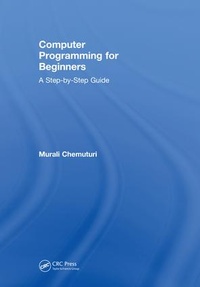
Computer Programming for Beginners
A Step-By-Step Guide
1st Edition
Published on 15. August 2018
Book
Hardback
258 pages
978-1-138-48096-4 (ISBN)
Description
This book aims to capture the fundamentals of computer programming without tying the topic to any specific programming language. To the best of the authors' knowledge there is no such book in the market.
More details
Language
English
Place of publication
London
United Kingdom
Publishing group
Taylor & Francis Ltd
Target group
College/higher education
Illustrations
21 s/w Abbildungen
21 Illustrations, black and white
Dimensions
Height: 254 mm
Width: 178 mm
Weight
640 gr
ISBN-13
978-1-138-48096-4 (9781138480964)
Copyright in bibliographic data and cover images is held by Nielsen Book Services Limited or by the publishers or by their respective licensors: all rights reserved.
Schweitzer Classification
Other editions
Additional editions
E-Book
09/2018
1st Edition
Chapman & Hall/CRC
€69.99
Available for download
E-Book
09/2018
Chapman & Hall/CRC
€69.99
Available for download
Book
08/2018
1st Edition
CRC Press
€75.80
Shipment within 10-20 days
Person
Murali Chemuturi is an information technology and software development subject matter expert, hands-on programmer, author, consultant and trainer. Since 2001, he is offering consultancy on information technology and training to organizations in India and USA from Chemuturi Consultants. Chemuturi Consultants also offers a number of products to aid project managers and software development professionals such as PMPal, a software project management tool; and EstimatorPal, FPAPal & UCPPal, a set of software estimation tools.
Content
Introduction to computers. Introduction to data and data types. Data storage and retrieval. Introduction to computer programs. Algorithms and flowcharts. Statements and assignment statements. Arithmetic, relational, and logical expressions. Control statements. Input statements. Output statements. Other statements. Error handling. Inter-program communication. Coding, debugging and performance tuning. Subroutines. Building and using libraries. Programming device drivers. Programming multi-language software. Programming languages and their evolution. Programming standards. Personal software process.