

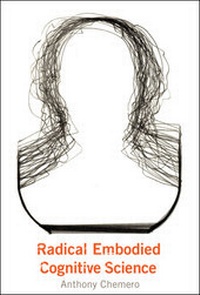
Radical Embodied Cognitive Science
Published on 1. October 2009
Book
Hardback
272 pages
978-0-262-01322-2 (ISBN)
Description
While philosophers of mind have been arguing over the status of mental representations in cognitive science, cognitive scientists have been quietly engaged in studying perception, action, and cognition without explaining them in terms of mental representation. In this book, Anthony Chemero describes this nonrepresentational approach (which he terms radical embodied cognitive science), puts it in historical and conceptual context, and applies it to traditional problems in the philosophy of mind.
Radical embodied cognitive science is a direct descendant of the American naturalist psychology of William James and John Dewey, and it follows them in viewing perception and cognition to be understandable only in terms of action in the environment. Chemero argues that cognition should be described in terms of agent-environment dynamics rather than in terms of computation and representation. After outlining this orientation to cognition, Chemero proposes a methodology: dynamical systems theory, which would explain things dynamically and without reference to representation. He also advances a background theory: Gibsonian ecological psychology, "shored up" and clarified. Chemero then looks at some traditional philosophical problems (reductionism, epistemological skepticism, metaphysical realism, consciousness) through the lens of radical embodied cognitive science and concludes that the comparative ease with which it resolves these problems, combined with its empirical promise, makes this approach to cognitive science a rewarding one.
"Jerry Fodor is my favorite philosopher," Chemero writes in his preface, adding, "I think that Jerry Fodor is wrong about nearly everything." With this book, Chemero explains nonrepresentational, dynamical, ecological cognitive science as clearly and as rigorously as Jerry Fodor explained computational cognitive science in his classic work The Language of Thought.
Radical embodied cognitive science is a direct descendant of the American naturalist psychology of William James and John Dewey, and it follows them in viewing perception and cognition to be understandable only in terms of action in the environment. Chemero argues that cognition should be described in terms of agent-environment dynamics rather than in terms of computation and representation. After outlining this orientation to cognition, Chemero proposes a methodology: dynamical systems theory, which would explain things dynamically and without reference to representation. He also advances a background theory: Gibsonian ecological psychology, "shored up" and clarified. Chemero then looks at some traditional philosophical problems (reductionism, epistemological skepticism, metaphysical realism, consciousness) through the lens of radical embodied cognitive science and concludes that the comparative ease with which it resolves these problems, combined with its empirical promise, makes this approach to cognitive science a rewarding one.
"Jerry Fodor is my favorite philosopher," Chemero writes in his preface, adding, "I think that Jerry Fodor is wrong about nearly everything." With this book, Chemero explains nonrepresentational, dynamical, ecological cognitive science as clearly and as rigorously as Jerry Fodor explained computational cognitive science in his classic work The Language of Thought.
More details
Series
Language
English
Place of publication
Cambridge, Mass.
United States
Publishing group
MIT Press Ltd
Target group
Professional and scholarly
Interest Age: From 18 years
Illustrations
19 Schaubilder, 1 Tabelle
19 figures, 1 tables, 19 figures, 1 table
Dimensions
Height: 229 mm
Width: 152 mm
Thickness: 0 mm
Weight
522 gr
ISBN-13
978-0-262-01322-2 (9780262013222)
Copyright in bibliographic data and cover images is held by Nielsen Book Services Limited or by the publishers or by their respective licensors: all rights reserved.
Schweitzer Classification
Other editions
New editions
Anthony Chemero
Radical Embodied Cognitive Science
Book
08/2011
MIT Press
€36.80
Article exhausted; check different version
Additional editions
Anthony Chemero
Radical Embodied Cognitive Science
E-Book
08/2011
Bradford Books
€38.99
Available for download
Anthony Chemero
Radical Embodied Cognitive Science
Book
08/2011
MIT Press
€36.80
Article exhausted; check different version
Person
Anthony Chemero is Associate Professor in the Scientific and Philosophical Studies of Mind Program at Franklin and Marshall College.
Content
Preface: In Praise of Dr. Fodor ix
Acknowledgments xiii
I Stage Setting 1
1 Hegel, Behe, Chomsky, Fodor 3
2 Embodied Cognition and Radical Embodied Cognition 17
II Representation and Dynamics 45
3 Theories of Representation 47
4 The Dynamical Stance 67
5 Guides to Discovery 85
III Ecological Psychology 103
6 Information and Direct Perception 105
7 Affordances, etc. 135
IV Philosophical Consequences 163
8 Neurophilosophy Meets Radical Embodied Cognitive Science 165
9 The Metaphysics of Radical Embodiment 183
10 Coda 207
Notes 209
References 221
Index 245
Acknowledgments xiii
I Stage Setting 1
1 Hegel, Behe, Chomsky, Fodor 3
2 Embodied Cognition and Radical Embodied Cognition 17
II Representation and Dynamics 45
3 Theories of Representation 47
4 The Dynamical Stance 67
5 Guides to Discovery 85
III Ecological Psychology 103
6 Information and Direct Perception 105
7 Affordances, etc. 135
IV Philosophical Consequences 163
8 Neurophilosophy Meets Radical Embodied Cognitive Science 165
9 The Metaphysics of Radical Embodiment 183
10 Coda 207
Notes 209
References 221
Index 245