

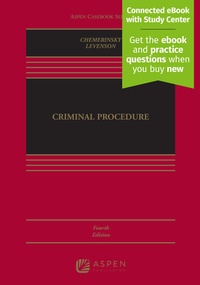
Criminal Procedure
[Connected eBook with Study Center]
4th Edition
Published on 3. December 2021
Book
Hardback
1536 pages
978-1-5438-4605-8 (ISBN)
Description
Buy a new version of this textbook and receive access to the Connected eBook with Study Center on CasebookConnect, including: lifetime access to the online ebook with highlight, annotation, and search capabilities; practice questions from your favorite study aids; an outline tool and other helpful resources. Connected eBooks provide what you need most to be successful in your law school classes. Learn more about Connected eBooks.
Written in a student-friendly manner, the fourth edition of Criminal Procedure eschews excessive reliance on rhetorical questions and law review excerpts in favor of comprehensive exploration of black letter law and current policy issues. Authored by a pair of well-respected criminal and constitutional law scholars, Criminal Procedure utilizes a chronological approach that guides students through criminal procedure doctrine from rules governing law enforcement investigation to doctrine concerning habeas corpus relief. In addition to presenting the perspectives from various stakeholders (e.g. defense attorneys, judges, prosecutors, and victims), the authors take care to provide students with useful, practice-oriented materials, including pleadings and motions papers. Criminal Procedure not only employs a systemic approach that takes students through each step of criminal adjudication, but also introduces issues at the forefront of modern criminal procedure debates. New to the Fourth Edition: - The Fourth Editionhas been thoroughly updated to provide analysis of important, recent decisions in the area of Criminal Procedure, including several decisions from the Supreme Court's most recent terms and discussion of policy issues at the forefront of criminal law.
- Changes in Investigations chapters: - New sections on excessive police force and on damage remedies for Fourth Amendment violations
- New cases, including Carpenter v. United States (application of the Fourth Amendment to cellular location information); Torres v. Madrid (what is a seizure); Virginia v. Collins (automobile exception to the Fourth Amendment); United States v. Byrd (exclusionary rule case about the ability of an unauthorized driver of a rental car to challenge a police search); Kansas v. Glover (reasonable suspicion for a car stop); and additional cases (yet to be decided)
- Changes in Adjudication chapters: - New cases, including McCoy v. Louisiana (Sixth Amendment right to counsel); Ramos v. Louisiana (trial by jury); Flowers v. Mississippi (jury composition and selection); Jones v. Mississippi (sentencing); Bucklew v. Precythe (the death penalty); and Gamble v. United States (the dual sovereignty doctrine in double jeopardy)
Professors and students will benefit from: - Straightforward writing style and dynamic text - Clear and not cluttered with law reviews excerpts
- Relies on cases and author essays rather than excerpts and rhetoric questions
- Presents thoughtfully edited principal and note cases
- Intuitive organization and chronological presentation - Presents topics in easy-to-understand approach from investigation to prosecution to post-conviction relief
- Approachable organization based on common progression through criminal justice system
- Systematic and cohesive presentation of topics - Explores underlying policy before heading into doctrinal specifics
- Practice-oriented features - Discussion of important, modern criminal procedure issues
- Useful examples for future and current criminal law practitioners
Written in a student-friendly manner, the fourth edition of Criminal Procedure eschews excessive reliance on rhetorical questions and law review excerpts in favor of comprehensive exploration of black letter law and current policy issues. Authored by a pair of well-respected criminal and constitutional law scholars, Criminal Procedure utilizes a chronological approach that guides students through criminal procedure doctrine from rules governing law enforcement investigation to doctrine concerning habeas corpus relief. In addition to presenting the perspectives from various stakeholders (e.g. defense attorneys, judges, prosecutors, and victims), the authors take care to provide students with useful, practice-oriented materials, including pleadings and motions papers. Criminal Procedure not only employs a systemic approach that takes students through each step of criminal adjudication, but also introduces issues at the forefront of modern criminal procedure debates. New to the Fourth Edition: - The Fourth Editionhas been thoroughly updated to provide analysis of important, recent decisions in the area of Criminal Procedure, including several decisions from the Supreme Court's most recent terms and discussion of policy issues at the forefront of criminal law.
- Changes in Investigations chapters: - New sections on excessive police force and on damage remedies for Fourth Amendment violations
- New cases, including Carpenter v. United States (application of the Fourth Amendment to cellular location information); Torres v. Madrid (what is a seizure); Virginia v. Collins (automobile exception to the Fourth Amendment); United States v. Byrd (exclusionary rule case about the ability of an unauthorized driver of a rental car to challenge a police search); Kansas v. Glover (reasonable suspicion for a car stop); and additional cases (yet to be decided)
- Changes in Adjudication chapters: - New cases, including McCoy v. Louisiana (Sixth Amendment right to counsel); Ramos v. Louisiana (trial by jury); Flowers v. Mississippi (jury composition and selection); Jones v. Mississippi (sentencing); Bucklew v. Precythe (the death penalty); and Gamble v. United States (the dual sovereignty doctrine in double jeopardy)
Professors and students will benefit from: - Straightforward writing style and dynamic text - Clear and not cluttered with law reviews excerpts
- Relies on cases and author essays rather than excerpts and rhetoric questions
- Presents thoughtfully edited principal and note cases
- Intuitive organization and chronological presentation - Presents topics in easy-to-understand approach from investigation to prosecution to post-conviction relief
- Approachable organization based on common progression through criminal justice system
- Systematic and cohesive presentation of topics - Explores underlying policy before heading into doctrinal specifics
- Practice-oriented features - Discussion of important, modern criminal procedure issues
- Useful examples for future and current criminal law practitioners
More details
Series
Edition
4th ed.
Language
English
Product notice
sewn/stitched
Paper over boards
Weight
2291 gr
ISBN-13
978-1-5438-4605-8 (9781543846058)
Copyright in bibliographic data and cover images is held by Nielsen Book Services Limited or by the publishers or by their respective licensors: all rights reserved.
Schweitzer Classification