

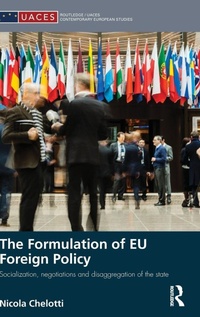
The Formulation of EU Foreign Policy
Socialization, negotiations and disaggregation of the state
1st Edition
Published on 4. February 2016
Book
Hardback
216 pages
978-1-138-83057-8 (ISBN)
Description
EU foreign and defence policy is largely formulated in the working parties and committees of the Council of the EU and the vast majority of decisions in this field are made by the national diplomats working in the around 35 groups of the CFSP/CSDP.
Although the importance of these committees and their participants has been increasingly recognised, we still know relatively little about them. Using an original database of 138 questionnaires and 37 interviews, this book addresses this lack of knowledge, studying what these committees do and how they negotiate and resolve issues. It explores three key areas:
the formulation of the national position;
the identity of CFSP/CSDP policy-makers;
negotiation practices and outputs.
In doing so, it provides an innovative observation point from which EU foreign policy can be analysed.
This book will be of key interest to scholars and students of EU foreign and defence policy, external relations of the EU, European integration and politics, diplomacy and more broadly international relations.
Although the importance of these committees and their participants has been increasingly recognised, we still know relatively little about them. Using an original database of 138 questionnaires and 37 interviews, this book addresses this lack of knowledge, studying what these committees do and how they negotiate and resolve issues. It explores three key areas:
the formulation of the national position;
the identity of CFSP/CSDP policy-makers;
negotiation practices and outputs.
In doing so, it provides an innovative observation point from which EU foreign policy can be analysed.
This book will be of key interest to scholars and students of EU foreign and defence policy, external relations of the EU, European integration and politics, diplomacy and more broadly international relations.
Reviews / Votes
'EU foreign policy has always been a secretive, elite-driven phenomenon, and many scholars have suggested that these officials have their own unique working methods to build consensus in the face of competing national perspectives. Yet until now we have lacked a comprehensive study of these processes, their relationship to national positions, and their impact on the international role of the EU. The Formulation of EU Foreign Policy admirably fills that gap, and is a very welcome addition to the literature.' - Prof. M.E. Smith, University of Aberdeen, UK.More details
Series
Language
English
Place of publication
London
United Kingdom
Publishing group
Taylor & Francis Ltd
Target group
College/higher education
Illustrations
31 s/w Tabellen, 5 s/w Abbildungen, 5 s/w Zeichnungen
31 Tables, black and white; 5 Line drawings, black and white; 5 Illustrations, black and white
Dimensions
Height: 240 mm
Width: 161 mm
Thickness: 16 mm
Weight
496 gr
ISBN-13
978-1-138-83057-8 (9781138830578)
Copyright in bibliographic data and cover images is held by Nielsen Book Services Limited or by the publishers or by their respective licensors: all rights reserved.
Schweitzer Classification
Other editions
Additional editions
Nicola Chelotti
The Formulation of EU Foreign Policy
Socialization, negotiations and disaggregation of the state
Book
10/2017
1st Edition
Routledge
€76.30
Shipment within 15-20 days
Nicola Chelotti
The Formulation of EU Foreign Policy
Socialization, negotiations and disaggregation of the state
E-Book
01/2016
Routledge
€69.99
Available for download
Nicola Chelotti
The Formulation of EU Foreign Policy
Socialization, negotiations and disaggregation of the state
E-Book
01/2016
Routledge
€69.99
Available for download
Person
Nicola Chelotti is LSE Fellow in the Department of International Relations at the London School of Economics and Political Science, UK.
Content
Introduction 1 Actors and decision-making processes of EU foreign and defence policy 2 Theories and the CFSP/CSDP decision-making process 3 Profiles, Working Habits and Experience of EU Diplomats 4 Preparing the national position: the capital-Brussels nexus 5 Identities: a diplomatic republic of Europe? 6 Decision-making styles and practices Conclusion