

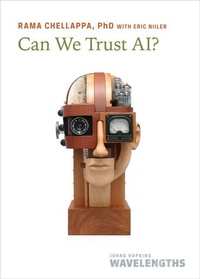
Can We Trust AI?
Published on 10. January 2023
Book
Paperback/Softback
224 pages
978-1-4214-4530-4 (ISBN)
Description
Artificial intelligence is part of our daily lives. How can we address its limitations and guide its use for the benefit of communities worldwide?
Artificial intelligence (AI) has evolved from an experimental computer algorithm used by academic researchers to a commercially reliable method of sifting through large sets of data that detect patterns not readily apparent through more rudimentary search tools. As a result, AI-based programs are helping doctors make more informed decisions about patient care, city planners align roads and highways to reduce traffic congestion with better efficiency, and merchants scan financial transactions to quickly flag suspicious purchases. But as AI applications grow, concerns have increased, too, including worries about applications that amplify existing biases in business practices and about the safety of self-driving vehicles.
In Can We Trust AI?, Dr. Rama Chellappa, a researcher and innovator with 40 years in the field, recounts the evolution of AI, its current uses, and how it will drive industries and shape lives in the future. Leading AI researchers, thought leaders, and entrepreneurs contribute their expertise as well on how AI works, what we can expect from it, and how it can be harnessed to make our lives not only safer and more convenient but also more equitable.
Can We Trust AI? is essential reading for anyone who wants to understand the potential-and pitfalls-of artificial intelligence. The book features:
* an exploration of AI's origins during the post-World War II era through the computer revolution of the 1960s and 1970s, and its explosion among technology firms since 2012;
* highlights of innovative ways that AI can diagnose medical conditions more quickly and accurately;
* explanations of how the combination of AI and robotics is changing how we drive; and
* interviews with leading AI researchers who are pushing the boundaries of AI for the world's benefit and working to make its applications safer and more just.
Johns Hopkins Wavelengths
In classrooms, field stations, and laboratories in Baltimore and around the world, the Bloomberg Distinguished Professors of Johns Hopkins University are opening the boundaries of our understanding of many of the world's most complex challenges. The Johns Hopkins Wavelengths book series brings readers inside their stories, illustrating how their pioneering discoveries and innovations benefit people in their neighborhoods and across the globe in artificial intelligence, cancer research, food systems' environmental impacts, health equity, planetary science, science diplomacy, and other critical arenas of study. Through these compelling narratives, their insights will spark conversations from dorm rooms to dining rooms to boardrooms.
Artificial intelligence (AI) has evolved from an experimental computer algorithm used by academic researchers to a commercially reliable method of sifting through large sets of data that detect patterns not readily apparent through more rudimentary search tools. As a result, AI-based programs are helping doctors make more informed decisions about patient care, city planners align roads and highways to reduce traffic congestion with better efficiency, and merchants scan financial transactions to quickly flag suspicious purchases. But as AI applications grow, concerns have increased, too, including worries about applications that amplify existing biases in business practices and about the safety of self-driving vehicles.
In Can We Trust AI?, Dr. Rama Chellappa, a researcher and innovator with 40 years in the field, recounts the evolution of AI, its current uses, and how it will drive industries and shape lives in the future. Leading AI researchers, thought leaders, and entrepreneurs contribute their expertise as well on how AI works, what we can expect from it, and how it can be harnessed to make our lives not only safer and more convenient but also more equitable.
Can We Trust AI? is essential reading for anyone who wants to understand the potential-and pitfalls-of artificial intelligence. The book features:
* an exploration of AI's origins during the post-World War II era through the computer revolution of the 1960s and 1970s, and its explosion among technology firms since 2012;
* highlights of innovative ways that AI can diagnose medical conditions more quickly and accurately;
* explanations of how the combination of AI and robotics is changing how we drive; and
* interviews with leading AI researchers who are pushing the boundaries of AI for the world's benefit and working to make its applications safer and more just.
Johns Hopkins Wavelengths
In classrooms, field stations, and laboratories in Baltimore and around the world, the Bloomberg Distinguished Professors of Johns Hopkins University are opening the boundaries of our understanding of many of the world's most complex challenges. The Johns Hopkins Wavelengths book series brings readers inside their stories, illustrating how their pioneering discoveries and innovations benefit people in their neighborhoods and across the globe in artificial intelligence, cancer research, food systems' environmental impacts, health equity, planetary science, science diplomacy, and other critical arenas of study. Through these compelling narratives, their insights will spark conversations from dorm rooms to dining rooms to boardrooms.
Reviews / Votes
Drawing on interviews with researchers pushing the boundaries of AI for the world's benefit and working to make its applications safer and more just, Can We Trust AI? responds with a qualified affirmative.-Inside Higher Ed In Can We Trust AI?, Chellappa explores both the promise and peril of AI. For readers searching for an understanding how AI came to be...Chellappa situates AI in an historical context that is thorough, and thoroughly fascinating. Most refreshing is his current assessment of AI that dispels the hype of AI's world takeover....Chellappa gracefully moves among AI's past, present, and future.
-Technical Communication
More details
Series
Language
English
Place of publication
Baltimore, MD
United States
Product notice
Paperback (trade)
Dimensions
Height: 165 mm
Width: 132 mm
Thickness: 30 mm
Weight
227 gr
ISBN-13
978-1-4214-4530-4 (9781421445304)
DOI
10.1353/book.100180
Copyright in bibliographic data and cover images is held by Nielsen Book Services Limited or by the publishers or by their respective licensors: all rights reserved.
Schweitzer Classification
Other editions
Additional editions
Rama Chellappa | Eric Niiler
Can We Trust AI?
E-Book
01/2023
Johns Hopkins University Press
€16.99
Available for download
Persons
Rama Chellappa, PhD, is a pioneering researcher and inventor in the fields of artificial intelligence, computer vision, and machine learning. A Bloomberg Distinguished Professor in electrical, computer, and biomedical engineering, he is also a member of the Johns Hopkins Center for Imaging Science, the Center for Language and Speech Processing, the Institute for Assured Autonomy, and the Mathematical Institute for Data Science. A Fellow of the Association for the Advancement of Artificial Intelligence, the Institute for Electrical and Electronics Engineers, and the National Academy of Inventors, Dr. Chellappa holds eight patents. He is a member of the National Academy of Engineering and the recipient of the 2020 IEEE Jack S. Kilby Medal for Signal Processing. His work has been featured by the Associated Press, the BBC, and Popular Science (Discovery Channel). Eric Niiler (CHEVY CHASE, MD) is a science writer for The Wall Street Journal and an adjunct faculty member in the Johns Hopkins University Graduate Program in Science Writing. His work has appeared in WIRED, National Geographic, The Washington Post, and on NPR and BBC/PRI's The World.
Content
Preface
Chapter 1. The Birth and Growth of AI
Chapter 2. Saving Lives with Artificial Intelligence
Chapter 3. The Complexities and Contributions of Facial Recognition
Chapter 4. The Promise of Autonomous Vehicles
Chapter 5. AI's Futurescape
Acknowledgments
Glossary
Notes
Index
Chapter 1. The Birth and Growth of AI
Chapter 2. Saving Lives with Artificial Intelligence
Chapter 3. The Complexities and Contributions of Facial Recognition
Chapter 4. The Promise of Autonomous Vehicles
Chapter 5. AI's Futurescape
Acknowledgments
Glossary
Notes
Index