

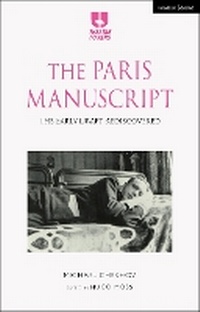
The Paris Manuscript
The Early Draft Rediscovered
Published on 23. January 2025
Book
Hardback
208 pages
978-1-350-43738-8 (ISBN)
Description
In the early 1930s, during his first years of exile and 20 years before the publication of his seminal work To the Actor, Michael Chekhov made his first incursion into the challenging task of writing about an actor's experience and his vision of the craft.
This important, though largely forgotten, work (the so-called 'Paris Manuscript') was handwritten in German and in it we find Chekhov laying the groundwork for the canon of exercises and practices that, nearly a century later, has widely become known as the Michael Chekhov Technique. Although never completed, the manuscript affords a privileged fly-on-the-wall glimpse of the dawning of an artistic genius's creative vision.
This manuscript was the result of Chekhov's rich collaboration with Swiss theatre director, painter and illustrator Georgette Boner, and the text itself is supplemented with facsimile scans of manuscript pages, photographs, correspondence and other material from Boner's personal archive.
As the popularity of the Michael Chekhov Technique continues to spread globally, the 'Paris Manuscript' offers a timely invitation for actors to take a step back and (re)discover for themselves the structural foundations of Michael Chekhov's vision.
Chekhov's text has been translated, edited and abridged by Hugo Moss, co-founder and director of Michael Chekhov Brasil, who has written an introduction and a series of short essays, 'Reflections From the Studio', which build on a few key elements emerging from the manuscript and over a decade of exploring Chekhov's artistic legacy in the studio environment and in performance.
This important, though largely forgotten, work (the so-called 'Paris Manuscript') was handwritten in German and in it we find Chekhov laying the groundwork for the canon of exercises and practices that, nearly a century later, has widely become known as the Michael Chekhov Technique. Although never completed, the manuscript affords a privileged fly-on-the-wall glimpse of the dawning of an artistic genius's creative vision.
This manuscript was the result of Chekhov's rich collaboration with Swiss theatre director, painter and illustrator Georgette Boner, and the text itself is supplemented with facsimile scans of manuscript pages, photographs, correspondence and other material from Boner's personal archive.
As the popularity of the Michael Chekhov Technique continues to spread globally, the 'Paris Manuscript' offers a timely invitation for actors to take a step back and (re)discover for themselves the structural foundations of Michael Chekhov's vision.
Chekhov's text has been translated, edited and abridged by Hugo Moss, co-founder and director of Michael Chekhov Brasil, who has written an introduction and a series of short essays, 'Reflections From the Studio', which build on a few key elements emerging from the manuscript and over a decade of exploring Chekhov's artistic legacy in the studio environment and in performance.
More details
Series
Language
English
Place of publication
London
United Kingdom
Publishing group
Bloomsbury Publishing PLC
Target group
College/higher education
Illustrations
40 bw
Dimensions
Height: 216 mm
Width: 146 mm
Thickness: 18 mm
Weight
380 gr
ISBN-13
978-1-350-43738-8 (9781350437388)
Copyright in bibliographic data and cover images is held by Nielsen Book Services Limited or by the publishers or by their respective licensors: all rights reserved.
Schweitzer Classification
Persons
Michael Chekhov is generally acknowledged as one of the greatest actors of the 20th century. Born in Russia in 1891, he was one of the prominent members of the Moscow Art Theatre's First Studio and in the 1920s he directed the Second Studio himself. The political turbulence of his times took him from Russia to Germany, France, Latvia and Lithuania, the UK and America, working for a period in Hollywood. He died in 1955 in Los Angeles, aged 64.
Hugo Moss is director of Michael Chekhov Brasil, which he co-founded with Thais Loureiro, a studio that since the early 2010s has been exploring Chekhov's artistic legacy.
Hugo Moss is director of Michael Chekhov Brasil, which he co-founded with Thais Loureiro, a studio that since the early 2010s has been exploring Chekhov's artistic legacy.
Content
List of Illustrations
Preface
Acknowledgements
Introduction
Editing and Abridging Chekhov's Text
Translating Chekhov's German
Seelisch, geistig
Gestalt
Weltanschauung & Weltempfindung
A Memo to the Reader
THE 'PARIS MANUSCRIPT'
Attention
Movement
Imagination
Speech
Seelisch Atmospheres
Rhythm
Artistic Individuality
Weltanschauung
Theatre Now and in the Future
Character & Destiny
Gestalt
A Path - First Stage
A Path - Second Stage
A Path - Third Stage
A Path - Fourth Stage
Afterword
REFLECTIONS FROM THE STUDIO
La petite bergere
The First Condition
A Gift Received
More Concrete Than a Memory, More Organized Than a Dream
Goethe's Method for Observing Natural Phenomena
Seelische Geste
A Play Going on in my Head
Course Made Good
Thinking Feeling Willing
A Meditation
From The Metamorphosis of Artists
APPENDIX
Georgette Boner
Michael Chekhov Brasil
The Four Manuscripts
Further Study
NOTES
Bibliography
Index
Preface
Acknowledgements
Introduction
Editing and Abridging Chekhov's Text
Translating Chekhov's German
Seelisch, geistig
Gestalt
Weltanschauung & Weltempfindung
A Memo to the Reader
THE 'PARIS MANUSCRIPT'
Attention
Movement
Imagination
Speech
Seelisch Atmospheres
Rhythm
Artistic Individuality
Weltanschauung
Theatre Now and in the Future
Character & Destiny
Gestalt
A Path - First Stage
A Path - Second Stage
A Path - Third Stage
A Path - Fourth Stage
Afterword
REFLECTIONS FROM THE STUDIO
La petite bergere
The First Condition
A Gift Received
More Concrete Than a Memory, More Organized Than a Dream
Goethe's Method for Observing Natural Phenomena
Seelische Geste
A Play Going on in my Head
Course Made Good
Thinking Feeling Willing
A Meditation
From The Metamorphosis of Artists
APPENDIX
Georgette Boner
Michael Chekhov Brasil
The Four Manuscripts
Further Study
NOTES
Bibliography
Index