

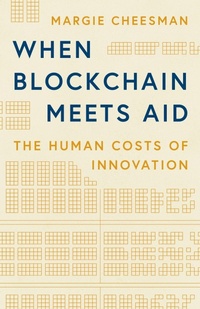
When Blockchain Meets Aid
The Human Costs of Innovation
Will be published approx. on 2. February 2027
Book
Hardback
256 pages
978-0-691-29167-3 (ISBN)
Description
Inside a landmark financial technology experiment in humanitarian aid
Blockchain-the digital infrastructure behind cryptocurrencies-promises financial freedom and borderless exchange, by circumventing traditional intermediaries like banks. Humanitarian organizations have embraced blockchain as a tool to fix broken payment systems, cut transfer costs, and empower refugees. But what happens when these promises meet the frontline realities of aid delivery? In this first in-depth ethnographic study of blockchain's use in humanitarian aid, Margie Cheesman examines the human costs of technological intervention. She shows that blockchain does not operate as a revolutionary solution but as part of a web of institutions, infrastructures, and practices held together by competing priorities.
Drawing on extensive fieldwork with Syrian refugee women, aid workers, project managers, and technology designers, Cheesman explores how blockchain's decentralized financial utopia morphs into the machinery of migration management and economic control. In Jordan, the Za'atari and Azraq refugee camps-temporary home to 130,000 people and surrounded by military tanks-became unlikely laboratories for testing blockchain's humanitarian potential. Cheesman finds this experiment imposes new burdens on refugees and aid workers, depends on continuous and unevenly valued labor, introduces new forms of surveillance, and recenters power in distant and commercial actors. As funding cuts and a legitimacy crisis reshape humanitarian aid around an efficiency imperative, Cheesman exposes the limits of technological fixes and points beyond them, grounding debates on digital economies and global governance in the everyday conditions under which survival and inequality are lived and managed.
Blockchain-the digital infrastructure behind cryptocurrencies-promises financial freedom and borderless exchange, by circumventing traditional intermediaries like banks. Humanitarian organizations have embraced blockchain as a tool to fix broken payment systems, cut transfer costs, and empower refugees. But what happens when these promises meet the frontline realities of aid delivery? In this first in-depth ethnographic study of blockchain's use in humanitarian aid, Margie Cheesman examines the human costs of technological intervention. She shows that blockchain does not operate as a revolutionary solution but as part of a web of institutions, infrastructures, and practices held together by competing priorities.
Drawing on extensive fieldwork with Syrian refugee women, aid workers, project managers, and technology designers, Cheesman explores how blockchain's decentralized financial utopia morphs into the machinery of migration management and economic control. In Jordan, the Za'atari and Azraq refugee camps-temporary home to 130,000 people and surrounded by military tanks-became unlikely laboratories for testing blockchain's humanitarian potential. Cheesman finds this experiment imposes new burdens on refugees and aid workers, depends on continuous and unevenly valued labor, introduces new forms of surveillance, and recenters power in distant and commercial actors. As funding cuts and a legitimacy crisis reshape humanitarian aid around an efficiency imperative, Cheesman exposes the limits of technological fixes and points beyond them, grounding debates on digital economies and global governance in the everyday conditions under which survival and inequality are lived and managed.
More details
Series
Language
English
Place of publication
New Jersey
United States
Target group
College/higher education
Professional and scholarly
Product notice
Trade binding
Illustrations
19 b/w illus.
Dimensions
Height: 216 mm
Width: 140 mm
ISBN-13
978-0-691-29167-3 (9780691291673)
Copyright in bibliographic data and cover images is held by Nielsen Book Services Limited or by the publishers or by their respective licensors: all rights reserved.
Schweitzer Classification
Person
Margie Cheesman is assistant professor of digital economy at King's College London.