

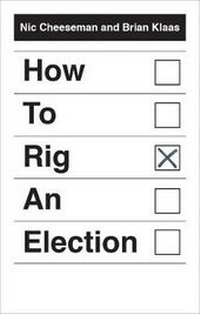
How to Rig an Election
Published on 24. April 2018
Book
Hardback
320 pages
978-0-300-20443-8 (ISBN)
Description
An engrossing analysis of the pseudo-democratic methods employed by despots around the world to retain control
Contrary to what is commonly believed, authoritarian leaders who agree to hold elections are generally able to remain in power longer than autocrats who refuse to allow the populace to vote. In this engaging and provocative book, Nic Cheeseman and Brian Klaas expose the limitations of national elections as a means of promoting democratization, and reveal the six essential strategies that dictators use to undermine the electoral process in order to guarantee victory for themselves. Based on their firsthand experiences as election watchers and their hundreds of interviews with presidents, prime ministers, diplomats, election officials, and conspirators, Cheeseman and Klaas document instances of election rigging from Argentina to Zimbabwe, including notable examples from Brazil, India, Nigeria, Russia, and the United States-touching on the 2016 election. This eye-opening study offers a sobering overview of corrupted professional politics, while providing fertile intellectual ground for the development of new solutions for protecting democracy from authoritarian subversion.
Contrary to what is commonly believed, authoritarian leaders who agree to hold elections are generally able to remain in power longer than autocrats who refuse to allow the populace to vote. In this engaging and provocative book, Nic Cheeseman and Brian Klaas expose the limitations of national elections as a means of promoting democratization, and reveal the six essential strategies that dictators use to undermine the electoral process in order to guarantee victory for themselves. Based on their firsthand experiences as election watchers and their hundreds of interviews with presidents, prime ministers, diplomats, election officials, and conspirators, Cheeseman and Klaas document instances of election rigging from Argentina to Zimbabwe, including notable examples from Brazil, India, Nigeria, Russia, and the United States-touching on the 2016 election. This eye-opening study offers a sobering overview of corrupted professional politics, while providing fertile intellectual ground for the development of new solutions for protecting democracy from authoritarian subversion.
Reviews / Votes
"Democracy is in a worldwide recession dating back at least a decade, as unscrupulous and powerful people successfully abuse every part of the electoral process. That is the depressing message of this lively book. . . . [Cheesman and Klaas's] chirpy tone belies the thorough research and bleak message."-Edward Lucas, Times (UK)"Excellent."-Richard Cockett, Literary Review
"In How to Rig an Election, Nic Cheeseman and Brian Klaas describe how-in contrast to historic autocrats who boosted their status by bumping off their opponents-modern ones do so by holding cosmetic, compromised elections; 'by using the image of democracy to entrench authoritarian rule.'"-Eliane Glaser, Times Literary Supplement
"How to Rig an Election is not just a fascinating read, but offers opposition parties, civil society and voters precious tools to preempt the worst abuses."-Michela Wrong, The Spectator (Books of the Year 2018)
"This book is a thoroughly documented, broadly accessible, and timely contribution that calls new attention to the problem of counterfeit democracy." -Alberto Simpser, Journal of Democracy
"Accessible and engaging, it clearly lays out why we should be interested in . . . election (mis)management in its myriad forms, and is thus essential reading for even the most casual student of democracy."- Anna C. Rader, African Affairs Review
"By highlighting the shambolic tactics, [this book] provides genuine hope that democracy can take root across the world."-David Hallam, Methodist Recorder
"Essential reading for everyone who wants to get democracy right again."-A. C. Grayling, author of War
"Cheeseman and Klaas hit the nail on the head: in many countries elections are a sham. The problem is getting worse, while the international community connives at being deceived. The implications for public policy are profound and will take years to digest. An excellent book."-Sir Paul Collier, author of Wars, Guns and Votes
"A concise, penetrating examination of why and how a growing number of governments are rigging elections, brimming with telling examples and practical recommendations for how concerned international actors can do more to help reverse this disturbing global trend."-Thomas Carothers, Carnegie Endowment for International Peace
"Rigging elections has become an art to which the most impressive array of resources are brought to bear even in the poorest countries. This work is a most timely addition to all who care about this important piece in the great democratic jigsaw on which so many basic freedoms depend."-John Githongo
"Drawing on a rich evidence base, Nic Cheeseman and Brian Klaas explain why authoritarian leaders can get away with setting up counterfeit democracies, and how to put an end to this facade. This book adopts a novel approach and is clear, engaging, beautifully written, and utterly compelling. One of my favourite books of the year."-Alice Evans, King's College, London
More details
Language
English
Place of publication
United States
Product notice
Cloth over boards
Illustrations
12 figs.
Dimensions
Height: 216 mm
Width: 140 mm
Weight
499 gr
ISBN-13
978-0-300-20443-8 (9780300204438)
Copyright in bibliographic data and cover images is held by Nielsen Book Services Limited or by the publishers or by their respective licensors: all rights reserved.
Schweitzer Classification
Other editions
New editions
Nic Cheeseman | Brian Klaas
How to Rig an Election
Book
08/2024
Yale University Press
€14.00
Available immediately
Persons
Nic Cheeseman is professor of democracy at the University of Birmingham and founding editor of the Oxford Encyclopedia of African Politics. Brian Klaas is assistant professor of global politics at University College London and a weekly columnist for the Washington Post.