

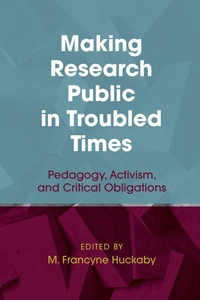
Making Research Public in Troubled Times
Pedagogy, Activism, and Critical Obligations
Will be published approx. on 30. October 2018
Book
Hardback
170 pages
978-1-9755-0027-6 (ISBN)
Description
These are certainly troubled times in which neoliberal capitalist patriarchy and the tyranny of racism and domination are continually reinscribed on the bodies and lives of so many. However, critical researchers understand the necessity for, as well as the difficulty of, using research to facilitate public transformations that lead to increased justice and equity. The authors contributing to Making Research Public in Troubled Times recognize the importance of diverse pedagogies, activism, and ethical choices regarding an environment that supports critical research in such oppressive times.
Diverse pedagogies that can facilitate the education of critical public researchers across disciplines are illustrated in the first set of chapters addressing questions like: What is important in teaching critical qualitative inquiry? How do students, materials, histories, and the public influence this teaching? What have we learned over years of attempting to teach critical qualitative research methods? The authors in the second section are activist local scholars sharing their projects and explaining what this work means for critical qualitative inquiry. This work includes methods used to incorporate critical qualitative inquiry into community activism. Finally, chapters in the last section focus on future steps and most important actions for the ways critical qualitative inquiry can be conceptualized to address concerns in these troubled times.
Diverse pedagogies that can facilitate the education of critical public researchers across disciplines are illustrated in the first set of chapters addressing questions like: What is important in teaching critical qualitative inquiry? How do students, materials, histories, and the public influence this teaching? What have we learned over years of attempting to teach critical qualitative research methods? The authors in the second section are activist local scholars sharing their projects and explaining what this work means for critical qualitative inquiry. This work includes methods used to incorporate critical qualitative inquiry into community activism. Finally, chapters in the last section focus on future steps and most important actions for the ways critical qualitative inquiry can be conceptualized to address concerns in these troubled times.
More details
Series
Language
English
Place of publication
Gorham
United States
Target group
Professional and scholarly
Product notice
sewn/stitched
Cloth over boards
Dimensions
Height: 231 mm
Width: 160 mm
Thickness: 15 mm
Weight
363 gr
ISBN-13
978-1-9755-0027-6 (9781975500276)
Copyright in bibliographic data and cover images is held by Nielsen Book Services Limited or by the publishers or by their respective licensors: all rights reserved.
Schweitzer Classification
Persons
M. Francyne Huckaby is Associate Dean of the School of Interdisciplinary Studies, Professor of Curriculum Studies, former Director of the Center for Public Education, and core faculty of Women and Gender Studies, Africana and African American Studies, and Comparative Race and Ethnic Studies at Texas Christian University. Her honors include the TCU Deans' Teaching Award for the College of Education, TCU Mortar Board Preferred Professor, and Straight for Equality from Fort Worth's PFLAG chapter, as well as Outstanding Dissertation (2007 AERA, Qualitative Research SIG) for Challenging the Hegemony in Education: Specific Parrhesiastic Scholars, Care of the Self, and Relations of Power.
Content
Series Editor Foreword
Acknowledgments
List of Images
Introduction: M. Francyne Huckaby
Section I
(How to) Educating(e) Critical Public Researchers: Pedagogies Across Disciplines
1. Thinking, Willing, and Judging in (Post)Qualitative Research: A Series of Resettings
Mirka Koro-Ljungberg
2. Unruly Considerations for a Critical Qualitative Classroom: Teaching Well
Jasmine B. Ulmer
3. Learning Is a Two-Way Street: Crossing Sociocultural Boundaries Through Critical Qualitative Research
Joy Pierce and Luz Zareth Moreno
Section II
Sharing Local Critical Activism: What It Means for How we Conduct Scholarship
4. Research as Solutionless Participation
Franklin Vernon
5. Their Own Ways of Knowing: Art-Based Participatory Action Research with Refugee Women from Burma
Hillary Rubesin and Madison Hayes
6. Cyborg Scholarship: Films for the People
M. Francyne Huckaby
Section III
Strategic Next Steps and Obligations for Critical Qualitative Scholars
7. The Play of Seduction and Desire in the Making of a President
Bronwyn Davies
8. Nurturing Our Critical Relations: Research to Facilitate Justice Through Postanthropocentric Transformation
Gaile S. Cannella
AFTERWORD
Pedagogies of Hope for Dark Days: Talking Points
Norman K. Denzin
List of Contributors
Acknowledgments
List of Images
Introduction: M. Francyne Huckaby
Section I
(How to) Educating(e) Critical Public Researchers: Pedagogies Across Disciplines
1. Thinking, Willing, and Judging in (Post)Qualitative Research: A Series of Resettings
Mirka Koro-Ljungberg
2. Unruly Considerations for a Critical Qualitative Classroom: Teaching Well
Jasmine B. Ulmer
3. Learning Is a Two-Way Street: Crossing Sociocultural Boundaries Through Critical Qualitative Research
Joy Pierce and Luz Zareth Moreno
Section II
Sharing Local Critical Activism: What It Means for How we Conduct Scholarship
4. Research as Solutionless Participation
Franklin Vernon
5. Their Own Ways of Knowing: Art-Based Participatory Action Research with Refugee Women from Burma
Hillary Rubesin and Madison Hayes
6. Cyborg Scholarship: Films for the People
M. Francyne Huckaby
Section III
Strategic Next Steps and Obligations for Critical Qualitative Scholars
7. The Play of Seduction and Desire in the Making of a President
Bronwyn Davies
8. Nurturing Our Critical Relations: Research to Facilitate Justice Through Postanthropocentric Transformation
Gaile S. Cannella
AFTERWORD
Pedagogies of Hope for Dark Days: Talking Points
Norman K. Denzin
List of Contributors