

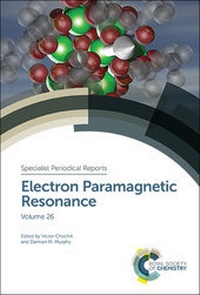
Electron Paramagnetic Resonance
Volume 26
Will be published approx. on 6. November 2018
Book
Hardback
192 pages
978-1-78801-372-7 (ISBN)
Description
Electron Paramagnetic Resonance (EPR) applications remain very significant in modern analytical science and this volume compiles critical coverage of developments in the recent literature by a handpicked group of researchers at the cutting-edge of the field. The topics covered in this volume describe contrasting types of EPR application, including light induced hyperpolarization and disordered proteins to spin labels and nanomaterials. Providing a snap shot of the area, this book is a useful addition to any library supporting this research.
More details
Series
Language
English
Place of publication
Cambridge
United Kingdom
Target group
Professional and scholarly
Product notice
Unsewn / adhesive bound
Dimensions
Height: 234 mm
Width: 156 mm
Thickness: 13 mm
Weight
429 gr
ISBN-13
978-1-78801-372-7 (9781788013727)
Copyright in bibliographic data and cover images is held by Nielsen Book Services Limited or by the publishers or by their respective licensors: all rights reserved.
Schweitzer Classification
Other editions
Additional editions
E-Book
11/2018
1st Edition
Royal Society of Chemistry
€433.99
Available for download
E-Book
11/2018
1st Edition
Royal Society of Chemistry
€433.99
Available for download
Persons
Content
Intrinsically disordered proteins (IDPs) studied by EPR and in-cell EPR;
EPR spectroscopy in the study of 2D graphene-based nanomaterials and nanographites;
Nitroxide spin labels: fabulous spy spins for biostructural EPR applications;
Applications of light-induced hyperpolarization in EPR and NMR;
Applications of electron paramagnetic respnance spectroscopy for interrogating catalytic systems
EPR spectroscopy in the study of 2D graphene-based nanomaterials and nanographites;
Nitroxide spin labels: fabulous spy spins for biostructural EPR applications;
Applications of light-induced hyperpolarization in EPR and NMR;
Applications of electron paramagnetic respnance spectroscopy for interrogating catalytic systems