

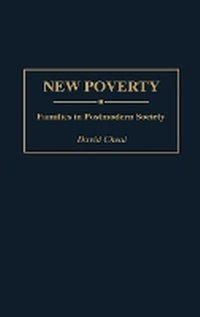
New Poverty
Families in Postmodern Society
Published on 30. June 1996
Book
Hardback
232 pages
978-0-313-29444-0 (ISBN)
Description
Cheal argues that the sociology of poverty has entered a new postmodern phase. The new poverty is about loss of faith-in relationships that were once believed to last a lifetime, and in government programs that we used to think would last for generations.
The new poverty is about the economic fall of individuals and countries who used to be affluent and who once dreamed that their affluence would go on forever. It is about the experience of free-falling, without a parachute and without much of a safety net. The new poverty is about people who lose their jobs when their company downsizes. It is about people whose hours of employment are cut in half when the work runs out. And it is about couples who separate, thereby plunging one of them-and probably their children-into a low income level that they had never anticipated.
What is new about the new poverty is the sense of surprise-that poverty can hit so suddenly, that people can fall so far before they are caught and lifted up, that the poverty of children still troubles us after a century of progress. The new poverty is about our loss of faith not only in relationships that were once thought to last a lifetime, but also in government programs that we believed would last for generations. Cheal translates the experience of the new poverty into sociological theory and into social statistics. His purpose is to provoke serious, critical reflection about families today and the risks of being poor. An important study for scholars and researchers involved with family issues and social policy.
The new poverty is about the economic fall of individuals and countries who used to be affluent and who once dreamed that their affluence would go on forever. It is about the experience of free-falling, without a parachute and without much of a safety net. The new poverty is about people who lose their jobs when their company downsizes. It is about people whose hours of employment are cut in half when the work runs out. And it is about couples who separate, thereby plunging one of them-and probably their children-into a low income level that they had never anticipated.
What is new about the new poverty is the sense of surprise-that poverty can hit so suddenly, that people can fall so far before they are caught and lifted up, that the poverty of children still troubles us after a century of progress. The new poverty is about our loss of faith not only in relationships that were once thought to last a lifetime, but also in government programs that we believed would last for generations. Cheal translates the experience of the new poverty into sociological theory and into social statistics. His purpose is to provoke serious, critical reflection about families today and the risks of being poor. An important study for scholars and researchers involved with family issues and social policy.
More details
Language
English
Place of publication
United States
Publishing group
Bloomsbury Publishing Plc
Target group
College/higher education
Professional and scholarly
Dimensions
Height: 235 mm
Width: 157 mm
Thickness: 18 mm
Weight
533 gr
ISBN-13
978-0-313-29444-0 (9780313294440)
Copyright in bibliographic data and cover images is held by Nielsen Book Services Limited or by the publishers or by their respective licensors: all rights reserved.
Schweitzer Classification
Other editions
Additional editions
E-Book
06/1996
1st Edition
Praeger Publishers Inc
€38.49
Available for download
Person
DAVID CHEAL is a Professor of Sociology, University of Winnipeg./e Among his earlier publications are The Gift Economy (1988) and Family and the State of Theory (1991).
Content
Illustrations Preface Families in Postmodernity Poverty and Progress Sorting Out the Poor Marriage and its Aftermath The Birth of Poverty Family Work Systems Shallow Income Pools The Economic Life Course Shifting Entitlements The Postmodernization of Poverty Bibliography