

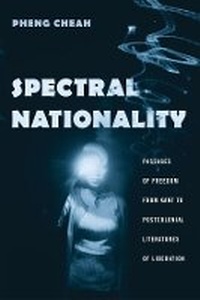
Spectral Nationality
Passages of Freedom from Kant to Postcolonial Literatures of Liberation
Will be published approx. on 24. December 2003
Book
Hardback
432 pages
978-0-231-13018-9 (ISBN)
Description
This far-ranging and ambitious attempt to rethink postcolonial theory's discussion of the nation and nationalism brings the problems of the postcolonial condition to bear on the philosophy of freedom. Closely identified with totalitarianism and fundamentalism, the nation-state has a tainted history of coercion, ethnic violence, and even, as in ultranationalist Nazi Germany, genocide. Most contemporary theorists are therefore skeptical, if not altogether dismissive, of the idea of the nation and the related metaphor of the political body as an organism. Going against orthodoxy, Pheng Cheah retraces the universal-rationalist foundations and progressive origins of political organicism in the work of Kant and its development in philosophers in the German tradition such as Fichte, Hegel, and Marx. Cheah argues that the widespread association of freedom with the self-generating dynamism of life and culture's power of transcendence is the most important legacy of this tradition.
Addressing this legacy's manifestations in Fanon and Cabral's theories of anticolonial struggle and contemporary anticolonial literature, including the Buru Quartet by Indonesian writer Pramoedya Ananta Toer, and the Kenyan writer Ngugi Wa Thiong'o's nationalist novels, Cheah suggests that the profound difficulties of achieving freedom in the postcolonial world indicate the need to reconceptualize freedom in terms of the figure of the specter rather than the living organism.
Addressing this legacy's manifestations in Fanon and Cabral's theories of anticolonial struggle and contemporary anticolonial literature, including the Buru Quartet by Indonesian writer Pramoedya Ananta Toer, and the Kenyan writer Ngugi Wa Thiong'o's nationalist novels, Cheah suggests that the profound difficulties of achieving freedom in the postcolonial world indicate the need to reconceptualize freedom in terms of the figure of the specter rather than the living organism.
Reviews / Votes
The book offers a coherent argument against inherited theories of "organismic vitalism"...and evinces the literary idiom of postmodernism. Choice Cheah's text is one of those rare occasions where scholarship and political commitment become supplementary to each other. -- Baidik Bhattcharya Interventions Cheah does a superb job in outlining the organic and ultimately cultural forms the struggle for freedom has taken. -- Gregory Jusdanis Research in African Literatures Pheng Cheah traces a constellation of concepts...with confidence -- Matthew Scherer MLNMore details
Language
English
Place of publication
New York
United States
Target group
Professional and scholarly
Product notice
Trade binding
Weight
694 gr
ISBN-13
978-0-231-13018-9 (9780231130189)
Copyright in bibliographic data and cover images is held by Nielsen Book Services Limited or by the publishers or by their respective licensors: all rights reserved.
Schweitzer Classification
Other editions
Additional editions
Pheng Cheah
Spectral Nationality
Passages of Freedom from Kant to Postcolonial Literatures of Liberation
E-Book
09/2015
1st Edition
De Gruyter
from
€33.95
Available for download
Pheng Cheah
Spectral Nationality
Passages of Freedom from Kant to Postcolonial Literatures of Liberation
Book
12/2003
Columbia University Press
€39.62
Article not available at the moment
Person
Pheng Cheah is assistant professor in the department of rhetoric at the University of California at Berkeley. He is co-editor of Cosmopolitics: Thinking and Feeling beyond the Nation, Thinking through the Body of the Law and Grounds of Comparison: Around the Work of Benedict Anderson (forthcoming).
Content
Introduction: The Death of the Nation? Part I: Culture as Freedom: Territorializations and Deterritorializations The Rationality of Life: On the Organismic Metaphor of the Social and Political Body Kant's Cosmopolitanism and the Technic of Nature Incarnations of the Ideal: Nation and State in Fichte and Hegel Revolutions That Take Place in the Head: Marx and the National Question in Socialist Decolonizaton Part II: Surviving (Postcoloniality) Novel Nation: The Buildung of the Postcolonial Nation as Sociological Organism The Haunting of the People: The Spectral Public Sphere in Pramoedya Ananta Toer's Buru Quartet Afterlives: The Mutual Haunting of the State and Nation The Neocolonial State and Other Prostheses of the Postcolonial National Body: Ngugi wa Thiong'o's Project of Revolutionary National Culture Epilogue. Spectral Nationality: The Living-On of the Postcolonial Nation in Globalization