

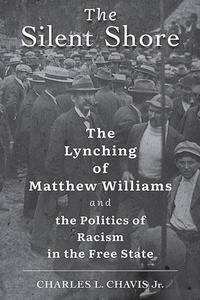
The Silent Shore
The Lynching of Matthew Williams and the Politics of Racism in the Free State
Published on 8. March 2022
Book
Hardback
304 pages
978-1-4214-4292-1 (ISBN)
Description
The definitive account of the lynching of twenty-three-year-old Matthew Williams in Maryland, the subsequent investigation, and the legacy of "modern-day" lynchings.
On December 4, 1931, a mob of white men in Salisbury, Maryland, lynched and set ablaze a twenty-three-year-old Black man named Matthew Williams. His gruesome murder was part of a wave of silent white terrorism in the wake of the stock market crash of 1929, which exposed Black laborers to white rage in response to economic anxieties. For nearly a century, the lynching of Matthew Williams has lived in the shadows of the more well-known incidents of racial terror in the deep South, haunting both the Eastern Shore and the state of Maryland as a whole. In The Silent Shore, author Charles L. Chavis Jr. draws on his discovery of previously unreleased investigative documents to meticulously reconstruct the full story of one of the last lynchings in Maryland.
Bringing the painful truth of anti-Black violence to light, Chavis breaks the silence that surrounded Williams's death. Though Maryland lacked the notoriety for racial violence of Alabama or Mississippi, he writes, it nonetheless was the site of at least 40 spectacle lynchings after the abolition of slavery in 1864. Families of lynching victims rarely obtained any form of actual justice, but Williams's death would have a curious afterlife: Maryland's politically ambitious governor Albert C. Ritchie would, in an attempt to position himself as a viable challenger to FDR, become one of the first governors in the United States to investigate the lynching death of a Black person. Ritchie tasked Patsy Johnson, a member of the Pinkerton detective agency and a former prizefighter, with going undercover in Salisbury and infiltrating the mob that murdered Williams. Johnson would eventually befriend a young local who admitted to participating in the lynching and who also named several local law enforcement officers as ringleaders. Despite this, a grand jury, after hearing 124 witness statements, declined to indict the perpetrators. But this denial of justice galvanized Governor Ritchie's Interracial Commission, which would become one of the pioneering forces in the early civil rights movement in Maryland.
Complicating historical narratives associated with the history of lynching in the city of Salisbury, The Silent Shore explores the immediate and lingering effect of Williams's death on the politics of racism in the United States, the Black community in Salisbury, the broader Eastern Shore, the state of Maryland, and the legacy of "modern-day lynchings."
On December 4, 1931, a mob of white men in Salisbury, Maryland, lynched and set ablaze a twenty-three-year-old Black man named Matthew Williams. His gruesome murder was part of a wave of silent white terrorism in the wake of the stock market crash of 1929, which exposed Black laborers to white rage in response to economic anxieties. For nearly a century, the lynching of Matthew Williams has lived in the shadows of the more well-known incidents of racial terror in the deep South, haunting both the Eastern Shore and the state of Maryland as a whole. In The Silent Shore, author Charles L. Chavis Jr. draws on his discovery of previously unreleased investigative documents to meticulously reconstruct the full story of one of the last lynchings in Maryland.
Bringing the painful truth of anti-Black violence to light, Chavis breaks the silence that surrounded Williams's death. Though Maryland lacked the notoriety for racial violence of Alabama or Mississippi, he writes, it nonetheless was the site of at least 40 spectacle lynchings after the abolition of slavery in 1864. Families of lynching victims rarely obtained any form of actual justice, but Williams's death would have a curious afterlife: Maryland's politically ambitious governor Albert C. Ritchie would, in an attempt to position himself as a viable challenger to FDR, become one of the first governors in the United States to investigate the lynching death of a Black person. Ritchie tasked Patsy Johnson, a member of the Pinkerton detective agency and a former prizefighter, with going undercover in Salisbury and infiltrating the mob that murdered Williams. Johnson would eventually befriend a young local who admitted to participating in the lynching and who also named several local law enforcement officers as ringleaders. Despite this, a grand jury, after hearing 124 witness statements, declined to indict the perpetrators. But this denial of justice galvanized Governor Ritchie's Interracial Commission, which would become one of the pioneering forces in the early civil rights movement in Maryland.
Complicating historical narratives associated with the history of lynching in the city of Salisbury, The Silent Shore explores the immediate and lingering effect of Williams's death on the politics of racism in the United States, the Black community in Salisbury, the broader Eastern Shore, the state of Maryland, and the legacy of "modern-day lynchings."
Reviews / Votes
For Marylanders and other concerned readers, Chavis presents a disturbing indictment of the Free State.-Maryland Historical Magazine The Silent Shore is a tour de force in the realm of historical scholarship related to lynching violence in the United States. Chavis's work is not just an academic endeavour; it is a clarion call, urging us to confront the spectres of our past and to chart a course toward a more unbiased and equitable future....this book stands as an indispensable beacon, illuminating the path forward.
-Journal of Social Science, Humanities and Arts
More details
Language
English
Place of publication
Baltimore, MD
United States
Product notice
sewn/stitched
Cloth over boards
Illustrations
10 s/w Abbildungen, 26 s/w Abbildungen
26 Illustrations, black and white; 5 Illustrations, black and white
Dimensions
Height: 226 mm
Width: 152 mm
Thickness: 28 mm
Weight
544 gr
ISBN-13
978-1-4214-4292-1 (9781421442921)
DOI
10.56021/9781421442938
Copyright in bibliographic data and cover images is held by Nielsen Book Services Limited or by the publishers or by their respective licensors: all rights reserved.
Schweitzer Classification
Other editions
Additional editions
Charles L. Chavis
The Silent Shore
The Lynching of Matthew Williams and the Politics of Racism in the Free State
E-Book
03/2022
Johns Hopkins University Press
€28.99
Available for download
Person
Charles L. Chavis Jr. is the director of African and African American Studies at George Mason University. He is also an assistant professor of conflict resolution and history and the founding director of the John Mitchell, Jr. Program for History, Justice, and Race at the Jimmy and Rosalynn Carter School for Peace and Conflict Resolution. The national co-chair for the United States Truth, Racial Healing, and Transformation Movement and the vice chair of the Maryland Lynching Truth and Reconciliation Commission, he is the coeditor of For the Sake of Peace: Africana Perspectives on Racism, Justice, and Peace in America.
Content
Foreword
Preface
Introduction
Part I
Chapter 1. Matthew Williams: His Family, His Community, His Humanity
Chapter 2. "The Blood Lust of the Eastern Shore": The Crime, the Kidnapping, and the Spectacle
Chapter 3. Governor Albert C. Ritchie Confronts Judge Lynch: The Politics of Anti-Black Racism in the Free State and Beyond
Part II
Chapter 4. From Pugilist to Private Eye: A Former Prizefighter Infiltrates the Mob
Chapter 5. Truth, Lies, and Somewhere in Between: Unmasking the Mob and Breaking the System of Silence
Chapter 6. Maryland's Disgrace: The Denial of Justice
Part III
Chapter 7. A Blot on the Tapestry of the Free State
Chapter 8. Confronting the Legacy of Judge Lynch in the Age of Fracture
Afterword. A Message from a Living Relative, by Tracey "Jeannie" Jones
Acknowledgments
Appendix
Notes
Bibliography
Index
Preface
Introduction
Part I
Chapter 1. Matthew Williams: His Family, His Community, His Humanity
Chapter 2. "The Blood Lust of the Eastern Shore": The Crime, the Kidnapping, and the Spectacle
Chapter 3. Governor Albert C. Ritchie Confronts Judge Lynch: The Politics of Anti-Black Racism in the Free State and Beyond
Part II
Chapter 4. From Pugilist to Private Eye: A Former Prizefighter Infiltrates the Mob
Chapter 5. Truth, Lies, and Somewhere in Between: Unmasking the Mob and Breaking the System of Silence
Chapter 6. Maryland's Disgrace: The Denial of Justice
Part III
Chapter 7. A Blot on the Tapestry of the Free State
Chapter 8. Confronting the Legacy of Judge Lynch in the Age of Fracture
Afterword. A Message from a Living Relative, by Tracey "Jeannie" Jones
Acknowledgments
Appendix
Notes
Bibliography
Index