

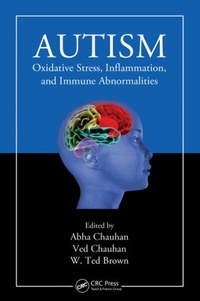
Autism
Oxidative Stress, Inflammation, and Immune Abnormalities
1st Edition
Published on 26. October 2009
Book
Hardback
456 pages
978-1-4200-6881-8 (ISBN)
Description
In 2007, the Centers for Disease Control and Prevention issued an autism alarm, estimating that one in 150 children may be affected by autism spectrum disorder. Autism has been treated mainly with technical approaches: principally applied behavior analysis and psychopharmacology. The findings in this book implicate oxidative stress as a common feature in autism, and support the claim that oxidative stress and intracellular redox imbalance can be induced or triggered in autism by exposure to certain environmental agents. Such findings could point the way to new treatment approaches in autism.
Autism: Oxidative Stress, Inflammation, and Immune Abnormalities brings together a wealth of cutting-edge evidence that is already influencing how we treat this serious condition. It looks at the role of neuropathological abnormalities, genetics, and those factors common to oxidative stress such as inflammation, immune dysfunction, aberrant cellular signaling, and gene-environment interactions. Among dozens of research topics, this volume -
Looks at interactions between genetic and environmental factors such as the maternal immune environment and prenatal/postnatal environmental stressors
Summarizes evidence for oxidative damage and inflammation in autism
Introduces a PDD behavior inventory as a tool for assessing autism
Considers autism as an aberrant adaptive response to neuroinflammation and oxidative stress
Examines the role of abnormal calcium signaling and the hypothesis that it may represent a target for novel therapeutics
Presents a hypothesis that autism arises from the dysregulation of a unified gut/brain system rather than originating in the brain alone
Proposes the utility of using a biopsychosocial method to treat autism
This book shows us that autism is not only developmental but also a chronic condition based on active pathophysiology, and that it is not only behavioral but also presents somatic and systemic features. The findings in these chapters support the theory that oxidative stress plays an important role in autism. They also point to the value of conducting in-depth mechanistic studies as a way to uncover new targets for therapeutic intervention in autism.
Autism: Oxidative Stress, Inflammation, and Immune Abnormalities brings together a wealth of cutting-edge evidence that is already influencing how we treat this serious condition. It looks at the role of neuropathological abnormalities, genetics, and those factors common to oxidative stress such as inflammation, immune dysfunction, aberrant cellular signaling, and gene-environment interactions. Among dozens of research topics, this volume -
Looks at interactions between genetic and environmental factors such as the maternal immune environment and prenatal/postnatal environmental stressors
Summarizes evidence for oxidative damage and inflammation in autism
Introduces a PDD behavior inventory as a tool for assessing autism
Considers autism as an aberrant adaptive response to neuroinflammation and oxidative stress
Examines the role of abnormal calcium signaling and the hypothesis that it may represent a target for novel therapeutics
Presents a hypothesis that autism arises from the dysregulation of a unified gut/brain system rather than originating in the brain alone
Proposes the utility of using a biopsychosocial method to treat autism
This book shows us that autism is not only developmental but also a chronic condition based on active pathophysiology, and that it is not only behavioral but also presents somatic and systemic features. The findings in these chapters support the theory that oxidative stress plays an important role in autism. They also point to the value of conducting in-depth mechanistic studies as a way to uncover new targets for therapeutic intervention in autism.
More details
Language
English
Place of publication
Bosa Roca
United States
Publishing group
Taylor & Francis Inc
Target group
Professional and scholarly
Professional
Product notice
Paper over boards
Illustrations
31 s/w Abbildungen, 8 farbige Abbildungen, 5 s/w Tabellen
5 Tables, black and white; 8 Illustrations, color; 31 Illustrations, black and white
Dimensions
Height: 234 mm
Width: 156 mm
Weight
1000 gr
ISBN-13
978-1-4200-6881-8 (9781420068818)
Copyright in bibliographic data and cover images is held by Nielsen Book Services Limited or by the publishers or by their respective licensors: all rights reserved.
Schweitzer Classification
Other editions
Additional editions
Abha Chauhan | Ved Chauhan | Ted Brown
Autism
Oxidative Stress, Inflammation, and Immune Abnormalities
E-Book
10/2009
1st Edition
CRC Press
€291.99
Available for download
Abha Chauhan | Ved Chauhan | Ted Brown
Autism
Oxidative Stress, Inflammation, and Immune Abnormalities
E-Book
10/2009
CRC Press
€291.99
Available for download
Persons
Ved Chauhan, Abha Chauhan, Ted Brown
Content
Type, Topography, and Sequelae of Neuropathological Changes Shaping Clinical Phenotype of Autism. Evidence for Oxidative Damage in the Autistic Brain. Oxidative Stress and Neurotrophin Signaling in Autism. Genetics of Autism. Phenotypic Expression of Autism, Maternal Depression, and the Monoamine Oxidase-A Gene. Paraoxonase 1 Status, Environmental Exposures, and Oxidative Stress in Autism Spectrum Disorders. The RedoxMethylation Hypothesis of Autism: A Molecular Mechanism for Heavy Metal-Induced Neurotoxicity. Autism and Oxidative Stress: Evidence from an Animal Model. Neurotoxic Brainstem Impairment as Proposed Threshold Event in Autistic Regression. Abnormalities in Membrane Lipids, Membrane-Associated Proteins, and Signal Transduction in Autism. Mitochondrial Component of Calcium Signaling Abnormality in Autism. Inflammation and Neuroimmunity in the Pathogenesis of Autism: Neural and Immune Network Interactions. Possible Impact of Innate Immunity on Autism. Autism, Gastrointestinal Disturbance, and Immune Dysfunction: What Is the Link. Possible Mechanism Involving Intestinal Oxytocin, Oxidative Stress, and Signaling Pathways in a Subset of Autism with Gut Symptoms. Cytokine Polymorphisms in Autism: Their Role in Immune Alterations. Autism, Teratogenic Alleles, HLA-DR4, and Immune Function. Autism: The Centrality of Active Pathophysiology and the Shift from Static to Chronic Dynamic Encephalopathy. A Reevaluation of the State of Autism Treatment: The Need for a Biopsychosocial Perspective.