

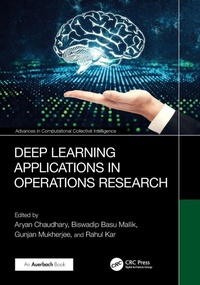
Deep Learning Applications in Operations Research
1st Edition
Will be published approx. on 20. July 2026
Book
Paperback/Softback
262 pages
978-1-032-72545-1 (ISBN)
Description
The model-based approach for carrying out the classification and identification of tasks has led to progression of the machine learning paradigm in diversified fields of technology. Deep Learning Applications in Operations Research presents the varied applications of this model-based approach. Apart from the classification process, the machine learning (ML) model has become effective enough to predict future trends of any sort of phenomenon. Such fields as object classification, speech recognition, and face detection have sought extensive applications of artificial intelligence (AI) and machine learning as well. The application of AI and ML has also become increasingly common in the domains of agriculture, health sectors, and insurance.
Operations research is the branch of mathematics used to perform many operational tasks in other allied domains, and the book explains how the implementation of automated strategies in optimization and parameter selection can be carried out by AI and ML. Operations research has many beneficial aspects to aid in decision making. Arriving at the proper decision depends on a number of factors; this book examines how AI and ML can be used to model equations and define constraints to solve problems more easily and discover proper and valid solutions. This book also looks at how automation plays a significant role in minimizing human labor and thereby minimizes overall time and cost. Case studies examine how to streamline operations and unearth data to make better business decisions. The concepts presented in this book can bring about and guide unique research directions to the future application of AI-enabled technologies.
Operations research is the branch of mathematics used to perform many operational tasks in other allied domains, and the book explains how the implementation of automated strategies in optimization and parameter selection can be carried out by AI and ML. Operations research has many beneficial aspects to aid in decision making. Arriving at the proper decision depends on a number of factors; this book examines how AI and ML can be used to model equations and define constraints to solve problems more easily and discover proper and valid solutions. This book also looks at how automation plays a significant role in minimizing human labor and thereby minimizes overall time and cost. Case studies examine how to streamline operations and unearth data to make better business decisions. The concepts presented in this book can bring about and guide unique research directions to the future application of AI-enabled technologies.
More details
Series
Language
English
Place of publication
London
United Kingdom
Publishing group
Taylor & Francis Ltd
Target group
College/higher education
Postgraduate
Illustrations
44 s/w Tabellen, 146 s/w Zeichnungen, 146 s/w Abbildungen
44 Tables, black and white; 146 Line drawings, black and white; 146 Illustrations, black and white
Dimensions
Height: 254 mm
Width: 178 mm
ISBN-13
978-1-032-72545-1 (9781032725451)
Copyright in bibliographic data and cover images is held by Nielsen Book Services Limited or by the publishers or by their respective licensors: all rights reserved.
Schweitzer Classification
Other editions
Additional editions
Aryan Chaudhary | Biswadip Basu Mallik | Gunjan Mukherjee
Deep Learning Applications in Operations Research
E-Book
12/2024
1st Edition
Auerbach
€264.99
Available for download
Aryan Chaudhary | Biswadip Basu Mallik | Gunjan Mukherjee
Deep Learning Applications in Operations Research
Book
12/2024
1st Edition
Auerbach
€256.50
Shipment within 10-20 days
Aryan Chaudhary | Biswadip Basu Mallik | Gunjan Mukherjee
Deep Learning Applications in Operations Research
E-Book
12/2024
1st Edition
Auerbach
€264.99
Available for download
Persons
Content
1. Predicting Crop Yield Using Quantum Neural Networks, 2. A Comprehensive Survey on Risk Factor Monitoring Using Deep Learning Methods on Electrocardiogram Data, 3. AI-Powered Data-Centric Approaches: Enhancing Information Quality for Deep Learning Algorithms, 4. Multi-Attribute Decision Modeling, 5. Unmasking Transformations: CNNs for Detecting Land Cover Changes in Satellite Imagery, 6. Leafine: An AI Tool to Recognize and Perceive Leaf Illness with Manure Suggestions, 7. An Expansive Performance Analysis and Comparison between Different Supervised and Unsupervised ML Algorithms for Categorization of ICU Patients at an Indian Hospital, 8. Darknet for Gun and Suspicious Activity Detection and Crime Prediction, 9. Image Edge Detection Using Fireflies to Fine-Tuned Deep Convolution Networks, 10. Application of Machine Learning, Deep Learning, and Econometric Models in Stock Price Movement of Rain Industries: An In-Depth Analysis, 11. Performance Analysis of U-Net and Fully Convolutional Regression Network on Jetson Nano for Real-Time Inventory Analysis, 12. Clinical Decision Support System for Prevention of Puberty Disorders and Fertility Issues due to Noyyal River Pollution using Ensemble Learning Techniques, 13. Obesity Prediction Using Machine Learning, 14. Intuitionistic Fuzzy Dombi-Archimedean Weighted Aggregation Operators and Their Applications in Sustainable Material Selection, 15. Identification of Rice Leaf Disease Using Gaussian Mixture Model: A Machine Learning Approach Using Image Classification Techniques, 16. Multi-Objective Optimization of Economic Development and Environmental Issues in the Yangtze River Basin, China, 17. Qualitative Study on E-Commerce and Brick-and-Mortar Stores: A Machine Learning Approach, 18. Design of Novel Energy Management System in Solar PV Powered EV Charging Station Using Artificial Gorilla Troops Optimization, 19. School Students' Cataract Prediction Using Machine Learning, 20. Minimization of the Threat of Diabetic Kidney Disease through the Lens of Machine Learning, 21. A Novel Segmentation and Feature Extraction-Based Plant Disease Diagnosis Method Based on Stacked Ensemble Learning