

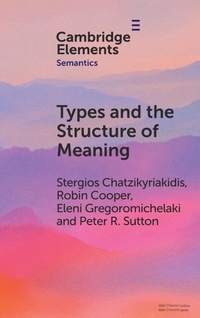
Types and the Structure of Meaning
Issues in Compositional and Lexical Semantics
Published on 5. June 2025
Book
Hardback
78 pages
978-1-009-61935-6 (ISBN)
Description
Addresses the role of structure in semantic analysis from the perspective of theories of meaning using rich theories of types. Also relates the theory of frames to these type theories as introducing, to some extent, similar structure into semantic analysis. The authors show how a structured approach is necessary to appropriately analyse phenomena in areas as diverse as lexical semantics and the semantics of attitudinal constructions referring to psychological states. In particular, these are: polysemy taken together with copredication, and attitudes such as belief and knowledge. The authors argue that the very same structure required to define a rich system of types enables them to adequately analyse both of these phenomena, thus revealing similarities in two otherwise apparently unrelated topics in semantics. They also argue that such theories facilitate a semantic theory oriented towards a psychological and contextually situated view of meaning. This title is also available as open access on Cambridge Core.
More details
Series
Language
English
Place of publication
Cambridge
United Kingdom
Illustrations
Worked examples or Exercises
Dimensions
Height: 235 mm
Width: 157 mm
Thickness: 9 mm
Weight
280 gr
ISBN-13
978-1-009-61935-6 (9781009619356)
Copyright in bibliographic data and cover images is held by Nielsen Book Services Limited or by the publishers or by their respective licensors: all rights reserved.
Schweitzer Classification
Other editions
Additional editions
Stergios Chatzikyriakidis | Robin Cooper | Eleni Gregoromichelaki
Types and the Structure of Meaning
Issues in Compositional and Lexical Semantics
Book
06/2025
Cambridge University Press
€26.50
Shipment within 15-20 days
Persons
Content
1. The nature of structure in semantics; 2. Structure in the attitudes; 3. Structure in polysemy and copredication; 4. Summary: adding structure to semantics?; References.