

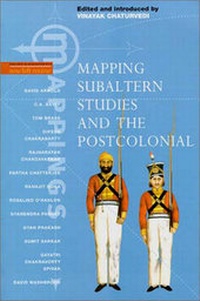
Mapping Subaltern Studies and the Postcolonial
Published on 17. July 2000
Book
Hardback
384 pages
978-1-85984-723-7 (ISBN)
Description
Initially inspired by Antonio Gramsci's writings on the history of subaltern classes, the Subaltern Studies authors adopted a "history from below" paradigm to contest "elite" history writing of Indian nationalists. Later the Project shifted away from its social history origins by drawing upon eclectic thinkers such as Edward Said, Roland Barthes, Michel Foucault, and Jacques Derrida. This volume is the first comprehensive balance-sheet of the project, presenting a collection of the most important writing from the last two decades and focusing the key debates between the main scholars in the field.
The collection begins with the original manifesto of the Subaltern Studies project, by Ranajit Guha. In the following contributions Partha Catterjee and David Arnold, two of the founding members of the Subaltern Studies collective, examine concepts from Marx to Gramsci embedded in the writing of Indian peasant history. Critiques of the Subaltern project from C. A. Bayly, Rajnarayan Chandavarka, Rosalind O'Hanlon and Tom Brass set the terms for the controversies around which the book is organized. Marxist and deconstructionist tendencies cross and clash in the exchange between O'Hanlon, David Washbrook and the Subalternist Gyan Prakash. Sumit Sarkar charts the contemporary direction of Subaltern Studies in its movement away from a set of Marxist concerns, and Dipesh Chakrabarty and Gyanendra Pandey respond with a spirited defence of these new directions, criticizing not only Marxism but the whole idea of history as Eurocentric. The volume concludes with an interview with Gayatri Chakravorty Spivak on the future of the Subaltern Studies project and its vexed relationship with Marxism and Feminism
The collection begins with the original manifesto of the Subaltern Studies project, by Ranajit Guha. In the following contributions Partha Catterjee and David Arnold, two of the founding members of the Subaltern Studies collective, examine concepts from Marx to Gramsci embedded in the writing of Indian peasant history. Critiques of the Subaltern project from C. A. Bayly, Rajnarayan Chandavarka, Rosalind O'Hanlon and Tom Brass set the terms for the controversies around which the book is organized. Marxist and deconstructionist tendencies cross and clash in the exchange between O'Hanlon, David Washbrook and the Subalternist Gyan Prakash. Sumit Sarkar charts the contemporary direction of Subaltern Studies in its movement away from a set of Marxist concerns, and Dipesh Chakrabarty and Gyanendra Pandey respond with a spirited defence of these new directions, criticizing not only Marxism but the whole idea of history as Eurocentric. The volume concludes with an interview with Gayatri Chakravorty Spivak on the future of the Subaltern Studies project and its vexed relationship with Marxism and Feminism
More details
Series
Language
English
Place of publication
London
United Kingdom
Target group
College/higher education
Dimensions
Height: 241 mm
Width: 163 mm
Thickness: 33 mm
Weight
760 gr
ISBN-13
978-1-85984-723-7 (9781859847237)
Copyright in bibliographic data and cover images is held by Nielsen Book Services Limited or by the publishers or by their respective licensors: all rights reserved.
Schweitzer Classification
Other editions
New editions
Vinayak Chaturvedi
Mapping Subaltern Studies and the Postcolonial
Book
11/2012
Verso Books
€33.50
Shipment within 3-4 weeks
Persons
Vinayak Chaturvedi is a Professor of History at the University of California in Irvine. Gyan Prakash (Ph.D. University of Pennsylvania) is professor of modern Indian history at Princeton University and a member of the Subaltern Studies Editorial Collective. He is the author of Bonded Histories: Genealogies of Labor Servitude in Colonial India (1990), Another Reason: Science and the Imagination of Modern India (1999) and Mumbai Fables (2010). Professor Prakash edited After Colonialism: Imperial Histories and Postcolonial Displacements (1995) and Noir Urbanisms (2010), codited The Space of the Modern City (2008) and Utopia/Dystopia (2010), and has written a number of articles on colonialism and history writing. He is currently working on a history of the city of Bombay. With Robert Tignor, he introduced the modern world history course at Princeton University.