

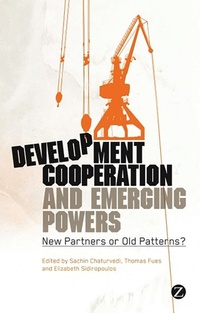
Development Cooperation and Emerging Powers
New Partners or Old Patterns?
Published on 10. May 2012
Book
Paperback/Softback
288 pages
978-1-78032-063-2 (ISBN)
Description
The current framework of development cooperation is dominated by the experiences of industrialized countries. But emerging economies have begun to accelerate their own development programmes, and attempts to bring them into existing aid models have been met with caution and reservation.
This expert, topical volume explores the development policies of Brazil, China, India, Mexico and South Africa, analysing how South-South cooperation has evolved and where it differs from traditional development cooperation. This vital new collection brings together first-hand experience from these countries to provide a forward-looking analysis of the current global architecture of development cooperation and of the possible convergence of traditional and emerging development actors.
This expert, topical volume explores the development policies of Brazil, China, India, Mexico and South Africa, analysing how South-South cooperation has evolved and where it differs from traditional development cooperation. This vital new collection brings together first-hand experience from these countries to provide a forward-looking analysis of the current global architecture of development cooperation and of the possible convergence of traditional and emerging development actors.
Reviews / Votes
This is a fascinating and informative book: nothing less than a new guide to modern development cooperation. It shows us how the fight against poverty works in a world barreling towards multipolarity. It foretells a new paradigm based on the experiences of the old and the new approaches of the emerging economies in the world Provocative and challenging. * Bert Koenders, UN Undersecretary General and former Minister of Development Cooperation, The Netherlands * This book describes the political vision changing the lives of millions in Latin America. It is a manual of thrilling example for us all. * John Pilger * With some large emerging economies assuming an active role alongside traditional 'donors', global development discourse has become more contentious. Featuring top experts from seven countries, this excellent collection reflects these debates. It also explores what values and institutions might realistically coordinate the development efforts of disparate partners which might otherwise impede, cancel or duplicate one another. * Thomas Pogge, Leitner Professor of Philosophy and International Affairs, Yale University *More details
Language
English
Place of publication
United Kingdom
Publishing group
Bloomsbury Publishing PLC
Target group
College/higher education
Dimensions
Height: 216 mm
Width: 140 mm
Thickness: 17 mm
Weight
412 gr
ISBN-13
978-1-78032-063-2 (9781780320632)
Copyright in bibliographic data and cover images is held by Nielsen Book Services Limited or by the publishers or by their respective licensors: all rights reserved.
Schweitzer Classification
Other editions
Additional editions
Sachin Chaturvedi | Thomas Fues | Elizabeth Sidiropoulos
Development Cooperation and Emerging Powers
New Partners or Old Patterns?
E-Book
05/2012
1st Edition
Zed Books Ltd
€27.49
Available for download
Persons
Elizabeth Sidiropoulos is the national director of the South African Institute of International Affairs (SAIIA) and the editor-in-chief of the South African Journal of International Affairs.
Thomas Fues, trained as an economist, has been with the German Development Institute (DIE) as senior fellow since 2004. Since 2009 he has headed the training department at DIE and he has worked for the German parliament, the Institute of Peace and Development (University Duisburg-Essen), the government of North Rhine Westphalia and the German Advisory Council on Global Change, as well as acting as a freelance consultant.
Dr Sachin Chaturvedi is a senior fellow at the Research and Information System for Developing Countries, a think tank sponsored by the Indian Ministry of External Affairs. Until recently he was Global Justice Fellow at the MacMillan Center for International Affairs at Yale University.
Thomas Fues, trained as an economist, has been with the German Development Institute (DIE) as senior fellow since 2004. Since 2009 he has headed the training department at DIE and he has worked for the German parliament, the Institute of Peace and Development (University Duisburg-Essen), the government of North Rhine Westphalia and the German Advisory Council on Global Change, as well as acting as a freelance consultant.
Dr Sachin Chaturvedi is a senior fellow at the Research and Information System for Developing Countries, a think tank sponsored by the Indian Ministry of External Affairs. Until recently he was Global Justice Fellow at the MacMillan Center for International Affairs at Yale University.
Content
Foreword by Jomo Kwame Sundaram
Introduction - Elizabeth Sidiropoulos, Thomas Fues, Sachin Chaturvedi
Part One: South-South cooperation
1. Development cooperation: contours, evolution and scope - Sachin Chaturvedi
2. South-South economic cooperation for a better future - Manmohan Agarwal
Part Two: Lessons from the experiences of traditional aid policies
3. Sixty years of development aid: shifting goals and perverse incentives - Ross Herbert
4. Aid effectiveness and emerging donors: lessons from the EU experience - James Mackie
Part Three: New actors, new innovations
5. Brazil: towards innovation in development cooperation - Enrique Saravia
6. China's evolving aid landscape: crossing the river by feeling the stones - Zhou Hong
7. India and development cooperation: expressing Southern solidarity - Sachin Chaturvedi
8. Mexico: linking Mesoamerica - Maximo Romero
9. South Africa: development, international cooperation and soft power - Elizabeth Sidiropoulos
Conclusion: towards a global consensus on development cooperation - Thomas Fues, Sachin Chaturvedi and Elizabeth Sidiropoulos
Afterword by Adolf Kloke-Lesch
Introduction - Elizabeth Sidiropoulos, Thomas Fues, Sachin Chaturvedi
Part One: South-South cooperation
1. Development cooperation: contours, evolution and scope - Sachin Chaturvedi
2. South-South economic cooperation for a better future - Manmohan Agarwal
Part Two: Lessons from the experiences of traditional aid policies
3. Sixty years of development aid: shifting goals and perverse incentives - Ross Herbert
4. Aid effectiveness and emerging donors: lessons from the EU experience - James Mackie
Part Three: New actors, new innovations
5. Brazil: towards innovation in development cooperation - Enrique Saravia
6. China's evolving aid landscape: crossing the river by feeling the stones - Zhou Hong
7. India and development cooperation: expressing Southern solidarity - Sachin Chaturvedi
8. Mexico: linking Mesoamerica - Maximo Romero
9. South Africa: development, international cooperation and soft power - Elizabeth Sidiropoulos
Conclusion: towards a global consensus on development cooperation - Thomas Fues, Sachin Chaturvedi and Elizabeth Sidiropoulos
Afterword by Adolf Kloke-Lesch